
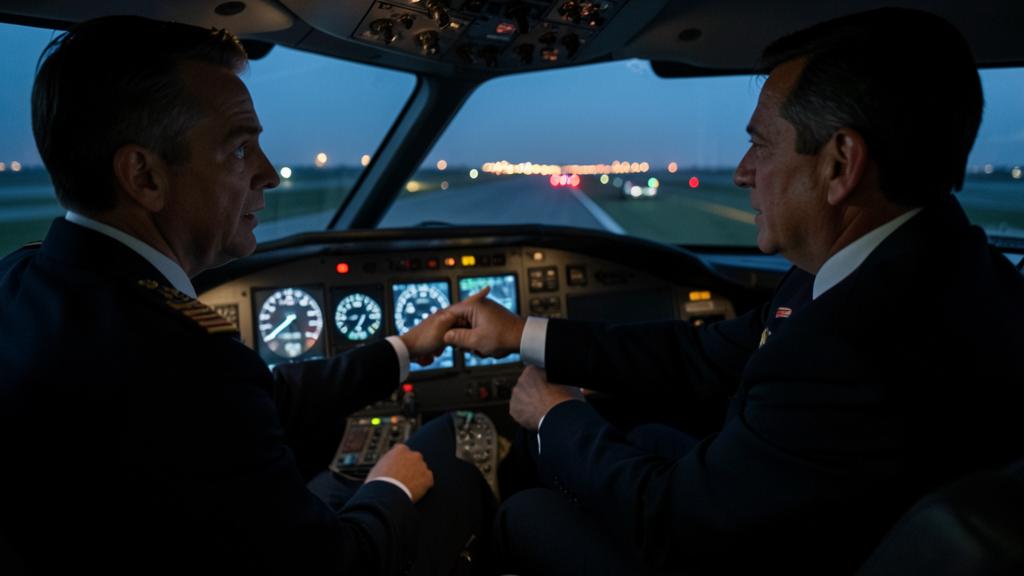
A first officer watches the speed settle some twenty knots above the target in the descent, and says: “we’re a bit fast, aren’t we?”. The captain does not answer. A minute later the aircraft is high, fast, and the go-around has become the only reasonable choice. Nothing was missing on the detection side, nor in the courage to speak up. What was missing was a form of words the receiver could not sidestep.
Why an accurate remark triggers nothing
The sentence quoted is technically correct, and it fails on three points of form. It names no one, so it assigns no one the duty of answering it. It carries no measured value: “a bit fast” compares with no criterion. And it ends with a request for confirmation, which hands the other person the job of qualifying the deviation — precisely the person whose picture of the situation is drifting.
This mitigation is not a character flaw, it is the normal outcome of a trade-off made in a few tenths of a second. Speaking up costs something: the risk of being wrong in front of someone more experienced, of coming across as fussy, of opening a disagreement at the worst possible moment. Saying nothing costs something too, but that cost stays abstract as long as nothing is broken. The two do not cross at the right moment.
The problem isn’t about being brave enough to speak up, but about using the right words at the right time. If you wait until the problem is obvious to everyone, it’s often too late to fix it easily.
An Airbus A320 is on final approach to Paris Charles de Gaulle (LFPG) on runway 27L. The first officer notices the speed is 10 knots above target at 1,000 feet. Instead of saying “we’re a bit fast,” they say: “Captain, speed is 150 knots, 10 above target.” The captain immediately corrects the speed, preventing a go-around.
Graduated verbal escalation exists precisely to reverse that order. It makes the first word cheap, so that it comes early, and it adds one more constraint to each of the words that follow. It is not a method for courage: it is a method of form.
The five levels, and what rises from one level to the next
The models taught in crew resource management training differ in vocabulary — probe, alert, challenge, emergency, in several English-language manuals — but they describe the same staircase. What increases from one step to the next is neither the volume of the voice nor the harshness of the tone: it is the constraint placed on the answer. The higher you climb, the fewer acceptable ways the other person has of doing nothing.
- Question. “Which descent profile are we using?” You are not reporting anything, you are asking for information and comparing two mental pictures. This level is free: it puts no one in the wrong, and it often reveals that the other person does not have the same picture of the situation.
- State. “Profile one thousand feet high, target speed plus twenty.” One parameter, one value, one deviation from the reference, with no judgement and no request: the fact is on the table, and it becomes difficult to claim not to have heard it.
- Alert. “I am not comfortable with this approach.” The statement moves from the parameter to the consequence and commits the person speaking. This is the level that costs the most socially, and the one most readily skipped — wrongly, because it is the last one where discussion is still possible.
- Order. “Go around.” An action verb, with no justification and no politeness: at this level, the sentence is no longer asking for agreement, it is asking for execution.
- Take over. “I have control.” This is no longer a form of words meant to convince: it is the announcement of a movement already begun.
The grammar of a sentence that carries
An effective intervention fits into four blocks and a few seconds. The order matters as much as the content, because it determines what the receiver will already have processed when the request arrives.
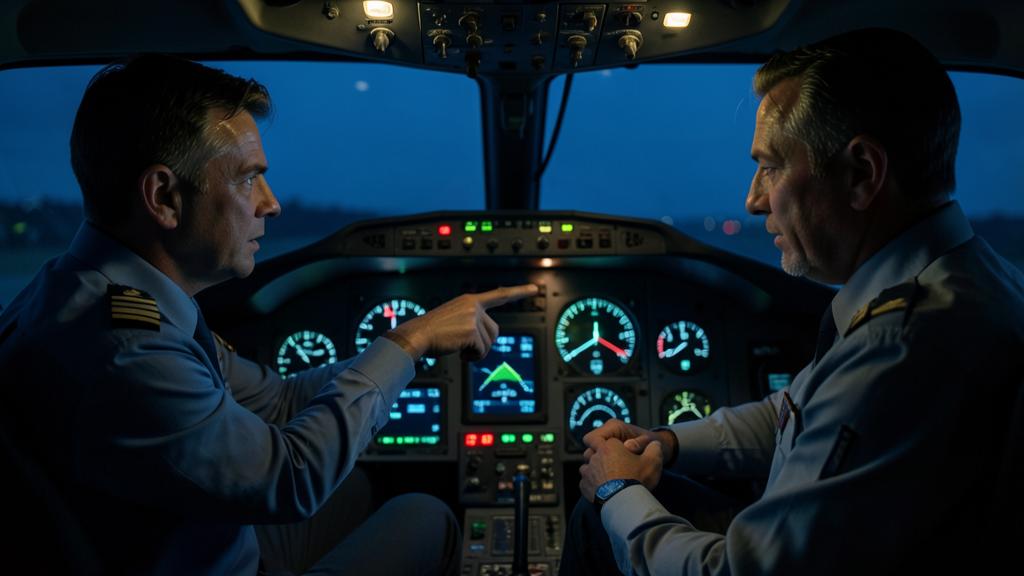
- The name or the role. One word that assigns the duty of answering. Without it, the statement floats and each person can assume it is addressed to the other.
- The measured fact. One parameter, its value, the deviation from the shared reference. This is the only block that cannot be argued with: it can be checked on an instrument.
- The consequence. What that deviation produces if it persists, in operational terms and not in terms of opinion. This is the block that turns an observation into a problem.
- The request. One action verb, one single action, in the imperative. Two requests in the same sentence cancel each other out: the receiver picks the easier one.
The fifth block is the silence that follows. Going straight on to a justification cancels everything: it offers the receiver a way out, a ground for discussion, and above all the time to do nothing. Staying silent for a second or two forces the answer to come from him.
| Level | Typical wording | What the answer must contain | Window of use |
|---|---|---|---|
| Question | “Which descent profile are we using?” | Information | Several minutes available |
| State | “Profile one thousand feet high, target speed plus twenty” | An explicit acknowledgement | Of the order of a minute |
| Alert | “I am not comfortable with this approach” | A correction, or the reason for not correcting | A few tens of seconds |
| Order | “Go around” | The action, immediately | A few seconds |
| Take over | “I have control” | Nothing: the action is already under way | The useful time is spent |
The trap: humour and hedges protect the person speaking, not the flight — and they leave a trace that creates the opposite illusion. The remark is indeed on the recording, it will be found afterwards, it will even be quoted as proof that the deviation had been seen; at the time, it asked nothing of anyone and the receiver could hear it without having to answer. The impersonal “we” has the same effect: “we’re high” assigns no duty to anyone. And when nothing moves, the temptation is to harden the tone rather than to move up a level: tone creates a relational conflict that draws attention away from the parameter, whereas the level above still speaks only about the aircraft.
The time available sets the entry level
The mistake that costs the most has nothing to do with the wording: it consists in entering at the bottom of the staircase when there is no longer time to climb it. Climbing the five steps takes of the order of a minute: three exchanges, two silences, one answer. That budget exists in cruise; it no longer exists on short final, nor during a go-around, nor at rotation.
The practical rule is therefore the opposite of intuition. You first estimate the time remaining before the situation becomes irreversible, then you enter at the level that time allows. When only a few seconds are left, the first sentence spoken is already an order: this is not a breach of good manners, it is the only wording sized for the time available.
The right habit: before opening your mouth, estimate the time remaining, then build the sentence in the order name, figure, action — and then be quiet. One or two seconds of silence after a request are worth more than one more sentence of explanation: they force the answer to come from the other person, and they make its absence immediately audible to the whole flight deck.
The two-attempt rule
The principle appears in many crew resource management programmes, and its virtue is that it is arithmetical: two interventions left without effect amount to a presumption that the pilot flying is no longer processing the information, and they trigger the takeover. No assessment of the other person’s character enters into the calculation, and no estimate of his competence either. You count, that is all.
You still need to know what resets the counter. A visible action on the parameter, first. An explicit reason next, because it proves that the message was received and weighed, and because it can in turn be checked. An “it’s fine” with no correction, no: it proves hearing, not processing.
| Answer received | What it proves | Immediate follow-up |
|---|---|---|
| Complete silence | Neither listening nor refusal: no information | Move up a level without delay |
| “It’s fine”, with no visible action | Hearing, not processing | Move up a level, giving the figure |
| Visible action on the parameter | The message got through | Stay at that level, call the return to target |
| Explicit reason for maintaining | The message got through and was weighed | Check that the reason holds, otherwise resume at the same level |
| Answer off the point or repeated word for word | Possible sign of subtle incapacitation | Go straight to the order, prepare the takeover |
Taking control, and keeping a crew
Taking control is a technical act, not a sanction. It comes in three inseparable parts: the announcement out loud, the hands on the controls, the other pilot’s acknowledgement. The order matters little, simultaneity matters a great deal: a transfer that has to be guessed is the most effective way of ending up with two people on the controls, each correcting the other.
What follows decides the rest of the flight. The pilot who has just taken over states his intention in one sentence, then immediately gives the pilot he has relieved a role again: the radio, the checklist, monitoring a parameter. Leaving the other person with nothing to do costs a pair of eyes at the exact moment when the workload is highest, and turns a flight path correction into a relational incident that will last until the end of the trip.
Subtle incapacitation looks like nothing spectacular. The pilot stays seated, speaks, sometimes answers — but his answers are out of step, repetitive, or unrelated to the question, and the parameter keeps drifting while he gives every outward sign of being present. This is exactly the scenario the two-attempt rule is built to catch: it does not ask anyone to diagnose a medical condition, only to count two communication failures.
What the receiver must do for the system to hold
Escalation is a two-person arrangement, and half the work falls to the person receiving. The rule is simple: every intervention receives a verbal answer, and that answer contains either an action or a reason. “Roger, correcting” and “roger, maintaining because control gave us this descent” are valid. Silence is not, even when it means the message has been processed: nothing, from the seat next door, makes it possible to know.
The second lever is the briefing. Announcing at the start of the trip that deviations are to be voiced, and saying what will be done if you do not answer yourself, costs a few seconds and removes the most expensive step on the staircase: the one where the first officer has to decide alone whether he is allowed to speak. A captain who has himself said “if I do not answer, move up a notch” has made escalation ordinary, and therefore quick.
What to check before the next recurrent check
Three documents deserve a targeted re-reading. The standard operating procedures, first: they contain the list of callouts that trigger a mandatory action, and that list is shorter than people think. The chapter on transfer of control, next, whose wording varies from one operator to another. And the paragraph on crew member incapacitation, finally, which sets out the criteria used and what is done with the pilot who has been relieved.
Three grey areas remain that the documentation rarely covers. Exchanges with air traffic control, where standard phraseology provides no intermediate level between the request and the declared emergency. Reports passed from the cabin to the flight deck, which cross a door, an interphone and a hierarchy, and lose a level at every obstacle. And the augmented crew, where escalation has to designate someone in a flight deck with more than two seats occupied.
For anyone preparing a type rating or a line check, these behaviours are graded as competencies in their own right, on the same footing as holding a flight path. An examiner does not grade politeness: he grades whether the deviation was named, whether a request was made, and whether the absence of an answer produced a move up a level. Crew resource management training programmes work through these sequences in a dedicated session, away from the pressure of the full flight simulator.
The applicable regulation, the approved operations manual and the operator’s standard procedures prevail in all circumstances over this article, whose only purpose is to explain a mechanism. Where there is a difference between what is described here and what your documentation prescribes, it is the documentation that governs.
Questions fréquentes
Do you have to climb the levels one by one?
No, and wanting to do so is precisely the classic mistake. The entry level is chosen according to the time remaining before the situation becomes irreversible: several minutes allow a simple question, a few seconds impose the direct order. Once you have entered, however, you do not come back down: each subsequent intervention is worded at least at the same level as the previous one.
What should you do if the pilot flying answers “it’s fine” without changing anything?
That answer proves hearing, not processing, and it therefore does not reset the counter. What comes next is to move up a level, this time giving the measured value and the consequence, not to repeat the same sentence. If the second intervention also has no effect on the parameter, the two-attempt rule applies and taking control becomes the expected action.
Is a first officer allowed to take control from the captain?
Operators’ procedures cover this case, generally in the chapter devoted to crew member incapacitation, and the takeover is described there as an expected action and not as a transgression. The captain remains responsible for the conduct of the flight, which does not prevent a temporary transfer of control when he is no longer processing the information. The exact wording and the criteria used appear in the operations manual, which should be re-read before you need it.
How can you recognise subtle incapacitation from the seat next door?
It looks like nothing spectacular: the pilot stays seated, speaks and answers, but his answers are out of step, repetitive or unrelated to the question asked, while the parameter keeps drifting. The crew is not being asked to make a medical diagnosis in flight. Two clear interventions left without effect are enough to trigger the required course of action, whatever the cause.
How can a captain make escalation easier for his first officer?
By announcing it at the trip briefing, in a few seconds: saying that deviations are to be voiced, and setting out what is expected if he does not answer himself. That sentence removes the most expensive step on the staircase, the one where the first officer has to decide alone whether he is allowed to speak. In flight, the second lever is to answer systematically with an action or a reason, never with silence.
Do these forms of words change when the crew works in English?
The levels remain identical, but the margin for nuance disappears in a language that is not your mother tongue, and mitigated forms are perceived even less well there. The counter to this is to rely on standard callouts, which are already worded as orders, and to favour the pairing of a measured value plus an action verb. A short, imperative sentence is not felt as brutal in that context: it is simply understandable.


Leave a Reply
You must be logged in to post a comment.