
A passenger collapses in the aisle three hours after takeoff, in the middle of an ocean crossing. The nearest reachable airfield is several hours away; the one with emergency services able to handle the case is farther still. The flight deck is going to ask the cabin a single question, and it is not « is it serious ». It is: what have you measured, at what time, and where will this be in an hour. The whole judgment call hinges on the quality of that answer, because it is the one of the six inputs to the calculation that the technical crew cannot produce on its own.
The flight deck is not waiting for a diagnosis, it is waiting for variables
A medical diversion decision combines six inputs: the person’s clinical trajectory, the flight time to each candidate airfield, what that airfield can actually do for a sick person, the fuel and weight that will remain after the detour, the weather and runway condition on arrival, and finally the crew’s flight and duty time limits. Five of these six inputs are already on the flight deck, in the form of charts, performance pages and computers. The sixth exists only in the cabin, and no procedure will produce it in place of the person kneeling beside the seat.
« Is it serious » is a bad question: the answer varies with the experience of whoever gives it and with the fatigue of a seventh hour of flight, and it is not comparable from one flight to the next, nor from one half-hour to the next. Stating a diagnosis is worse still: announcing a cardiac or vascular event mentally closes off the range of possibilities, including for the ground service, which then locks onto the label instead of reasoning from the signs. What is expected from the cabin is of a different nature: observable facts, described in the same terms at each check, tied to a time, and reported at least twice so that a trend can emerge.
The flight crew needs hard numbers, not guesses. They can’t judge how sick someone is, but they can calculate fuel, distance, and runway conditions. The cabin’s job is to give clear, timed updates on the passenger’s condition—like pulse, breathing, and consciousness—so the pilots can decide if they need to land early.
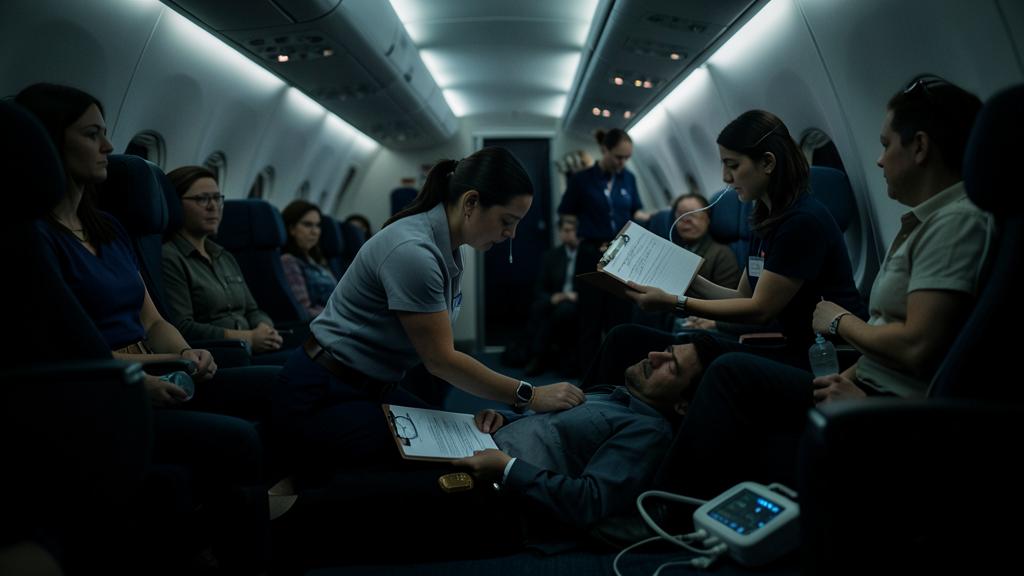
On a Boeing 787 flying from Paris to Los Angeles, a passenger at 30,000 feet has chest pain. The cabin reports: “50-year-old male, no known history, first signs at 14:30 UTC (passenger’s time), now at 15:00 UTC: conscious, breathing fast, pulse 120, oxygen at 4L/min, improving slightly.” The flight deck checks fuel (enough to reach 3 airfields) and runway conditions (one has a wet runway, disqualifying it). They divert to the next best option, 2 hours away.
The useful report fits in a few lines and a clock
The structure that works is easy to remember without a form. Who: apparent age, sex, what the person or their companions state as medical history, and where their medication is. What: at what time the first signs appeared, what the person was doing at that moment, and the main complaint as stated. How: level of consciousness, breathing, perceived pulse, colour, sweating, ability to speak a full sentence without catching their breath. What has been done: oxygen and the flow rate chosen, position adopted, contents of the first-aid kit used, defibrillator set up or not. And finally the one line that nothing replaces: the comparison between two readings taken a known interval apart.
The time here is a clinical data point, not a reporting formality. An altered level of consciousness present for a few minutes and the same state present for over an hour do not call for the same response, and the difference between the two cannot be guessed. On a long-haul flight crossing several time zones, where the crew lives on one hour and the passengers on another, the only reference that cannot be misread is universal time, the same one the flight deck and the ground service already use. A common clock costs one sentence in a briefing and prevents the most frequent misunderstanding in ground-air exchanges.
What must accompany every measurement
Every reading must state what was being administered at the moment it was taken. A patient improving under oxygen and a patient improving spontaneously have nothing in common for the ground service: the first is a case being compensated by a limited, consumable resource, the second is an incident resolving itself. Reporting the improvement without the treatment turns the first into the second, and eases off diversion preparation at exactly the moment it should be held firm.
| Element reported | What it determines on the flight deck and on the ground | What a vague wording costs |
|---|---|---|
| Time of onset and time of each measurement, in universal time | The trend: worsening, stabilising or improving | Two readings without times do not make a trend; the opinion falls back on the worst-case assumption |
| Level of consciousness, ability to speak in full sentences | The degree of urgency and the possibility of sustaining prolonged monitoring | « Seems confused » cannot be compared from one reading to the next |
| Breathing: rate, effort, sound, spontaneously adopted position | The oxygen requirement, hence the remaining endurance of the bottles | An undescribed discomfort causes oxygen to be consumed with no known limit |
| Perceived pulse, regularity, colour, sweating, skin warmth | The orientation toward a circulatory case, which weighs heavily in the recommendation | A « weak » pulse without regularity or location points to nothing |
| What was administered, at what time, and the effect observed afterward | The reading of any improvement: effect of the intervention or natural course | An improvement reported without its treatment reads as a recovery |
| Stated medical history, medication present in the cabin or left in the hold | The immediate resource and the orientation of the receiving hospital | An option closes without anyone on board knowing it |
| Companion, language spoken, mobility, build | Preparation for arrival and the actual duration of disembarkation | Discovered when the door opens, this adds minutes at the costliest moment |
The trap. Improvement observed under oxygen is often reported as improvement, full stop. It reaches the flight deck as « doing better », the sense of urgency around the diversion eases, and an hour later it turns out the bottle is empty and the condition has returned to its starting point, this time with several hundred more nautical miles in the wrong direction. Every measurement must be stated with what is supporting it, and remaining oxygen endurance must be stated like fuel: in minutes at the flow rate used.
The right reflex. Immediately designate someone who does not provide care and only writes: the time of each reading, values, actions taken, arrival of a passenger who is a doctor, the content of each call to the flight deck. Whoever is giving care will never keep this log, and without it the trend has to be reconstructed from memory, which means poorly. This same document will be handed to the medical team on arrival and will form the basis of the event report.
Ground medical assistance gives an opinion, not an order
Many long-haul operators have access to a medical assistance service reachable in flight, by satellite voice or by message. How it works is worth understanding before you need it. It receives a clinical picture relayed through two successive non-physicians, the cabin crew member and then the pilot who passes it on; it rephrases, asks for what is missing, and every exchange costs time. The quality of its recommendation is mechanically bounded by the quality of what it was sent: a structured report saves an entire round of questions.
What the service sends back is an opinion: an assessment of the urgency, a recommendation on whether a diversion is warranted, sometimes a preference among the airfields on a list submitted to it, and specific requests for the ground reception. It knows neither the remaining fuel, nor the contaminated runway at the nearest airfield, nor the crew’s duty time. The decision remains with the captain, the only one who holds all six inputs at once: which is why an opinion favouring diversion can translate into a detour to an airfield other than the nearest one, or into continuing under close monitoring.
The other trap. A passenger who identifies as a doctor becomes, in everyone’s perception, the one who decides. They are not: they have neither the airfield charts, nor the fuel figures, nor knowledge of the onboard equipment, and their specialty may be very far removed from the case at hand. Their role is to examine, to state what they observe, and to speak directly to the ground service when the link allows it. Opening the emergency medical kit, whose carriage is required beyond a certain number of seats and a certain distance, is governed by conditions written by the operator, and the captain’s agreement is part of them.
The nearest airfield is almost never the useful airfield
On a long crossing, the flight time to the nearest reachable airfield grows after leaving the coast, peaks near the equal-time point, then decreases. This curve is familiar to any crew preparing an extended-range operation. What preparing a medical case adds is a second curve, consistently above the first: the time to the first airfield capable of treating the case. The gap between the two curves is the real object of the judgment call.
Landing on a runway treats no one. What matters is the delay until treatment begins: flight time, taxi and positioning, disembarking a patient who cannot walk, then the road journey to a facility capable of handling the case. At some isolated airfields, this last leg is longer than the detour just paid for, and it runs on a road that is nothing like a motorway. The reasoning has to be conducted over the whole chain, and ground medical assistance is the party who can say what actually lies behind each airfield’s name.
| Criterion | Nearest reachable airfield | Airfield with a medical facility |
|---|---|---|
| Additional flight time | The shortest, its only advantage | Significantly longer, sometimes double |
| Runway, approach, aids available at night | Often barely adequate, sometimes without a precision approach | Generally comfortable, with a clean alternate |
| Medical resources at the aircraft | An ambulance called from town, medicalisation not guaranteed | A medical team announced in advance by ground assistance |
| Distance to the facility capable of treating the case | Sometimes longer than the detour itself | Short, and known to medical assistance |
| Opening hours, customs, border police | To be checked; a closed airfield reopens but not instantly | Open, with well-rehearsed procedures for a medical disembarkation |
| Landing weight | High, arrival shortly after the decision point | Lower, the fuel burned during the transit works in the crew’s favour |
| Continuation of the flight for the other passengers | A stop with no support or spares, a long delay | Resumption or onward routing can be organised |
| Reversibility of the decision | Low: once down, there is no free way back up | Low as well, but the target is right from the start |
Fuel, weight and window: what a late decision costs
A diversion is paid for in fuel twice over: through the added distance, and through the lower flight level at which it is flown. Every increment of time spent hesitating does not merely delay the arrival, it removes candidates from the list of airfields reachable with the required reserves. The list shrinks silently, and it happens that the airfield with resources still in the discussion shortly before is no longer there when the decision comes. An early decision keeps every option open; a late decision has already used up half of them.
Weight is the other constraint. Arriving shortly after the decision point means arriving at high weight, which points toward a landing above the maximum certified landing weight or toward a fuel dump, where the type has that system; not all do. Landing above the maximum landing weight is generally provided for in the type’s documentation, under the conditions it sets out: control of the touchdown rate of descent and a post-flight inspection. Neither a feat nor an incident, but an operation whose conditions are found in the manual before being invoked. The real constraint lies elsewhere: at high weight, on a short, wet or contaminated runway, landing performance can disqualify the nearest airfield for reasons that have nothing to do with medicine. A cabin report on remaining oxygen endurance, given in minutes rather than as a percentage of the bottle, feeds into this calculation and sometimes decides it on its own.
That leaves flight and duty time limits. A distant diversion followed by an unplanned stop can carry the crew beyond their limits; the captain has the authority to extend duty in an unforeseen situation, and the use of that authority is reported. This input must never outweigh the clinical trajectory, but it is legitimate for choosing between two airfields that are otherwise medically equivalent.
Preparing the arrival while the decision is being made
As soon as a diversion becomes plausible, the cabin works on two fronts. The first remains the patient: readings at the same interval, oxygen management, and above all a question that is too often asked too late, that of their position for landing. A person who is unconscious or in respiratory distress will not be strapped into an ordinary seat; it has to be decided where they will be, with whom, and how that arrangement holds under braking. This concerns the flight deck directly, because it bears on how the approach is flown.
The second front is everything the diversion sets in motion: clearing the path for the stretcher, deciding which door will be used and confirming it will be serviced, notifying the companion and locating their luggage and documents, preparing the written handover, briefing the rest of the cabin briefly and honestly once they have grasped that something is happening. During this time, service is suspended and part of the crew has left their station: ordinary surveillance thins out. A second event is no less likely because the crew is already occupied, and this reduction in coverage is part of what the cabin manager reports to the flight deck.
The second reflex. Prepare a written handover before landing, even a brief one: the time of onset, the sequence of time-stamped readings, what was administered and when, the name of the ground medical service consulted and its case reference. The first minutes with the medical team are spent on questions this piece of paper answers all at once, and it prevents a treatment from being repeated or a sign observed two hours earlier from being lost.
What to go and check in your own documentation
A few points are worth checking calmly, and never in flight. Does the medical event report form in the operations manual follow the order in which the ground service asks its questions? A form built on a different logic loses a whole exchange on every call. What is the call path when the satellite link fails, which still happens on some routes: relay through air traffic control, HF radio, retransmission through another aircraft? Who has physical access to the emergency medical kit, and under what conditions may the seal be broken? Does the en-route alternate airfield list carry a column on medical resources, or only runway data? Is the endurance of portable oxygen bottles given at each of their flow rates, in a form readable in thirty seconds?
Two grey areas remain, and it is better to have looked at them beforehand. The first is the divergence between the doctor passenger present on board and the ground medical service: rare, unsettling, and few manuals say which of the two opinions the captain should follow or how the divergence should be reported. The second is death in flight, where the diversion loses its medical purpose while other obligations appear, legal and human, rarely written down with the same precision as the rest. Both cases are usefully discussed among practitioners, and the forum is a better place for that than the briefing room of a three-in-the-morning stopover.
For anyone preparing a qualification or a first cabin manager assignment, what is expected has shifted to the same place. What is now demonstrated in a check is no longer the listing of what the kits contain, but the ability to produce a time-stamped, comparable report within a few minutes, then to state by when the oxygen will stop sustaining the patient. It is this vocabulary shared with the flight deck that distinguishes a cabin that raises an alarm from a cabin that contributes to the judgment call.
In every case, the applicable regulation, the authority’s instructions and the operator’s approved documentation take precedence over this article, whose purpose is to explain a mechanism, not to stand in for a procedure.
Questions fréquentes
Who has the final say on a medical diversion?
The captain, and the captain alone. The ground medical assistance service issues a recommendation based on the clinical picture it has been sent, and the doctor passenger on board gives an assessment, but neither of them has the remaining fuel, the runway conditions, or the duty time limits. The cabin supplies the clinical trajectory, the flight deck adds the flight constraints, and the judgment call is made on all six inputs at once.
What should be reported first when the link is poor or talk time is short?
Four things: the time the signs appeared, the level of consciousness and breathing described in observable terms, what was administered and at what time, and the comparison with the previous reading. This last item is the most useful of all, because it gives a trend rather than a snapshot. Everything else can wait for the next contact.
Can a doctor passenger open the emergency medical kit on their own initiative?
No. Its carriage is required beyond a certain number of seats and a certain distance, and the conditions for opening it are set out by the operator in its manual: identification of the person intervening, the captain’s agreement, and in most cases contact with the ground medical service. The doctor passenger’s role is to examine, to observe and to talk with the ground, not to grant themselves access.
Why not simply divert to the nearest reachable airfield?
Because a reachable airfield is not necessarily a useful one. What matters is the delay until treatment begins, which adds up the flight, the taxi, disembarking a patient who cannot walk, and the road journey to a facility capable of treating the case. At an isolated airfield, this last leg can exceed the detour just paid for, and the choice has to be made on the whole chain.
Should readings continue once the diversion has been decided?
Yes, at the same interval and in the same terms. The ground service adjusts its recommendation and prepares the reception based on the latest values, the team waiting on the ground sizes its resources around them, and a worsening can still change the airfield as long as the descent has not begun. A decision made is not a decision fixed.
How should oxygen be managed when remaining flight time exceeds bottle endurance?
This should be stated as a fuel problem, in minutes at the flow rate used rather than as a percentage of the bottle, and it must be passed to the flight deck as a hard deadline. The flow rate is reduced only on medical advice, never on one’s own initiative to make the resource last longer. This constraint feeds into the choice of airfield and sometimes decides it on its own between two otherwise equivalent options.


Leave a Reply
You must be logged in to post a comment.