

Eleven hours fifty minutes of flight, twelve cabin crew members, six bunks and three rest blocks: the purser fills in the plan before push-back. The question that comes up at every briefing is not the one people expect. It is not who sleeps, it is who sleeps where, and until when. A senior crew member who claims the bunk at the back because the galley noise carries less there is not wrong about the noise; he is simply applying the wrong criterion. An assignment plan rewards no one: it resolves three constraints that have nothing to do with seniority, and that leave almost no margin.
The compartment is a certified space, not a bedroom
A crew rest compartment is not a fitted-out space: it is an approved installation, examined at certification as an occupied volume that must be possible to leave. The special conditions governing it revolve around a single assumption: a sleeping occupant, held by a restraint, in the dark, must be able to reach the cabin without depending on anyone else. Hence two means of egress leading to the passenger cabin, an emergency exit distinct from the normal access, smoke detection dedicated to the compartment, a fire extinguisher and portable protective breathing equipment kept in place, oxygen, emergency lighting with path marking, a means of communication with the flight deck, and a restraint device at each bunk.
Two practical consequences follow. The first: the number of bunks is not the number of people authorised to be in the compartment at once. The maximum occupancy is posted, it has been demonstrated, and it applies for the entire duration of occupancy, including the few minutes when crew cross paths at handover. The second: a place is an equipped place, with its own restraint device, its oxygen point where the model has one, its coverage by the lit path marking. Settling elsewhere, on the corridor floor because no bunk is free, means occupying a position that was never demonstrated for anything.
The class of the installation, on the other hand, is not a matter of aircraft certification but of flight and duty time limitation rules. It determines what the rest taken on board produces in the calculation, and it is on that basis that it concerns the operator as much as the crew.
| Class | Nature of the bunk | Separation required | What it allows |
|---|---|---|---|
| Class 1 | Bunk or surface allowing a lying or near-lying position | Compartment separated from the flight deck and the cabin, isolated from noise, light and odours, with controlled ventilation and temperature | The highest credit in the service calculation — it is the installation targeted by long-handover schedules |
| Class 2 | Seat allowing a lying or near-lying position | Separated from passengers by at least a curtain, reasonably sheltered from passage and disturbance | An intermediate credit : rest is real, sensory cut-off is not guaranteed |
| Class 3 | Seat with a strong recline — on the order of about forty degrees from vertical — with leg and foot support | No separation required ; the seat may be located in the passenger cabin | The lowest credit : recovery, not proper sleep |
The figure to remember is not the scale itself, it is its logic: the credit grows with what the installation removes from the occupant — noise, light, passage, posture. The bunk is therefore not an extra comfort granted on top, it is the technical means by which a rotation becomes possible with the crew complement carried. That is enough to explain why its allocation is not left to corridor negotiation.
The bunk isn’t just a bed—it’s a certified space designed for safety. It must let crew leave quickly if needed, with proper exits, lighting, and oxygen. The better the bunk isolates from noise and light, the more rest counts toward duty limits. That’s why bunk assignments follow strict rules, not seniority.
On an Airbus A350 with a Class 1 rest compartment, the purser assigns six crew to three rest blocks. The first block (four crew) ends 30 minutes before descent, the second (three crew) ends 20 minutes before, and the third (two crew) ends 10 minutes before. The purser takes the bunk closest to the access in the first block, ensuring they can wake up and reach the cabin quickly for the critical descent phase.
First criterion: the time by which rest must end
A rest plan is not built from the start of the blocks, but from their end. What matters is not the moment one lies down, it is the gap between the moment one gets up and the moment one must be fully available. Between the two lies sleep inertia: the person is awake, standing, able to answer, and yet below their normal performance, with a lengthened reaction time, a shortened working memory, and poorly ranked priorities. The commonly accepted order of magnitude is counted in tens of minutes, typically twenty to thirty, and more when the wake-up occurs from deep sleep — that is, the case of a wake-up triggered in the middle of a block.
The decisive parameter is therefore the buffer: how much time separates the end of rest from the first task that admits no error. For the cabin, that task is not the arrival service, which can be caught up; it is securing the cabin and holding position during the descent, which cannot be caught up. A crew member woken a quarter of an hour before the start of descent is compliant on rest by the book, and operationally behind themselves.
That is where the rule comes from that surprises newcomers: the crew member with the most demanding handover does not take the longest block, they take the block that ends earliest relative to their task. And since they must be woken without waking the entire compartment, they take a bunk close to the access. The place nearest the curtain is not the worst one, it is the one belonging to whoever gets up first.
The schedule produces a second effect, this one circadian. The window of low alertness, defined by reference to the time zone the crew is acclimatised to, falls in the middle of biological night: the block covering it is the one in which people fall asleep fastest and sleep most deeply. It is also the one from which people wake up worst. Placing the arrival handover on a block entirely contained within this window means buying sleep and paying for it in inertia.
Second criterion: the place within the evacuation arrangement
While some crew members sleep, the cabin is kept covered by those who remain. The minimum cabin crew complement is derived from the number of installed passenger seats — one member per fifty seats, or fraction of fifty, on a given deck. This baseline is precisely what putting crew to rest is not meant to erode: a handover schedule is built on the crew carried above that minimum, and it is that surplus, not the number of bunks, that fixes how many people may be absent from the cabin at the same instant. An aircraft carrying only the minimum complement and nothing more has no rest plan to write, whatever the flight duration and whatever the number of places available in the module. Where an operation provides for an adjustment to this principle, it is not decided on board: it appears in a written and approved scheme, with a presence maintained on each deck. The number of places occupied at the same instant is therefore not decided by the number of bunks available, it is decided by what the cabin must retain.
The second constraint is geographic. Every crew member has a door, and that door has neighbours. A plan that left an entire zone without anyone able to reach its exits within a reasonable time would not be a plan but a gamble. Blocks are therefore not composed by preference or by list order, but so that each of them leaves a mesh of staffed stations covering the full length of the aircraft.
The third constraint is internal to the compartment. The compartment empties in the order dictated by geometry: whoever is nearest the access leaves first, whoever is at the back leaves last, regardless of rank. That mundane observation has a consequence for assignment. The person whom crew want to reach the cabin fastest — the one holding the link with the flight deck, the one carrying overall responsibility, the one whose station is furthest from the compartment — occupies a bunk close to the access. The back, symmetrically, is not a punishment: it is also the place closest to the emergency exit when the layout puts it at the other end. The right question is not which bunk is best, but by which way each person leaves, and in what order.
This geometric reading has one limit, and it is a significant one: an exit only counts if the order to leave reaches the inside.
Third criterion: bunks are not physically equal
Within the same module, two bunks do not deliver the same sleep, and the differences are systematic enough to be anticipated. Thermal stratification makes the upper bunk noticeably warmer than the lower one, as fresh air generally enters from below and warms as it rises. Noise is no better distributed: the place next to the access receives foot traffic, light from the curtain and the slam of the panel, while the one next to a galley partition or an air-conditioning duct inherits a continuous noise wrongly assumed to be tolerable because it is steady.
The longitudinal position of the module, meanwhile, determines what the occupant feels in turbulence, and the mechanism is purely mechanical. A shaken aircraft does not only move up and down: it also rotates about its centre of gravity. A point far from that centre combines the overall motion with the lever arm of the rotation, so that the vertical amplitude there is greater than near the centre; fuselage bending modes add their own contribution at both ends. A module fitted towards the rear, as in many layouts, will therefore move more for the same level of turbulence than a forward module. The gap is not dramatic, but it is constant, and it is paid over the entire duration of a block.
These differences have no normative value: no text prescribes allocating the quietest bunk to anyone. They serve as a fine adjustment. When two people are interchangeable with respect to the first two criteria, that is where the decision is made — the shortest block in the quietest bunk, the upper place spared for whoever is coming off a short night. It is also at this level, and only at this level, that seniority may legitimately break the tie.
The order in which the constraints are resolved
An assignment plan is built in a set order, and that order is not negotiable because each stage reduces the margin left for the next. First, how many people may be absent from the cabin at the same instant is fixed, which gives the size of the blocks. People are then allocated between blocks according to what each must do afterwards: service programme, station held at landing, particular responsibilities such as caring for an unaccompanied minor or a passenger with reduced mobility. It is then checked that each block leaves a mesh of staffed stations and that no zone is left without anyone qualified for its exits. Finally, bunks are allocated within each block, following the order of waking and then the order of egress. Seniority appears only in the event of a strict tie, at the last step.
| Constraint | What it fixes | Whom it designates | What it leaves open |
|---|---|---|---|
| Cabin crew staffing level | The number of people absent at the same instant, hence the size of the blocks | No particular person | The composition of the blocks |
| Service programme and station at landing | The block each person occupies | Those who must be available on arrival | The bunk within the block |
| Mesh of staffed stations | The compatibility of blocks with one another | Those whose simultaneous absence is ruled out | The order within a block |
| Buffer before the critical phase | Each person’s wake-up time | Whoever gets up first, hence the place close to the access | The relative comfort of the places |
| Order of egress from the compartment | The relative position of the occupants | Whoever must reach the cabin first | The duration of rest |
| Physical characteristics of the bunk | Nothing mandatory : height, proximity to the galley, position along the fuselage | Serves as an adjustment when the five preceding lines leave two people tied | Nothing : it is the final tie-break, and the only one where seniority has a place |
The mechanism explains why the purser so often ends up near the access: not through privilege, but because they are both the person who must be reachable and the person who must leave first. It also explains what results from a plan built on seniority alone: the most senior installed at the back, woken first because they are covering the handover, and waking everyone else by climbing over them on the way out.
What breaks an assignment plan
The best-built plan comes undone on a single point: the link between the cabin and the compartment. A space designed to isolate from noise also isolates from public address announcements. Add hearing protection, a sleep mask and the constant hiss of ventilation, and an alert chain relying solely on the PA system stops transmitting anything, without anyone noticing. This is why installations include a dedicated alert means for the compartment and an intercom, and why the « wake-up » part of a plan is described in physical gestures: who goes up, by which way, who touches which shoulder, in what order.
The trap: assuming that a cabin announcement will wake the compartment. An occupant deeply asleep, with hearing protection in place, hears neither the PA nor a voice from the corridor; and a sleeper jolted out of sleep by an alert rushes down the stairs at the exact moment the aircraft is moving. A rest plan that does not name, physically, who fetches whom, and that does not provide for the case where the person responsible for waking others is themselves held back in the cabin, is not a plan but an intention.
The second point of failure is a late change. The plan is built on a crew list, and a last-minute change — a replacement, a member left on the ground, a station swapped between two colleagues — silently invalidates the mesh: the person going up now rests in place of someone whose station they do not hold. The plan must then be rebuilt, not corrected from memory, because the check that matters concerns the zones left uncovered, not the names.
The right reflex: a plan written and posted at the compartment access, showing for each occupant the name, the block, the wake-up time and the station held at landing, backed by a three-point check before closing the curtain: shoes at the bunk and not stowed elsewhere, an individual lighting means reachable from the lying position, restraint device in place. The posted plan serves first and foremost whoever will have to run it if the purser is occupied elsewhere.
There remains the handover. Whoever goes down to rest leaves behind a zone in the state they put it in: trolleys braked and locked, galley closed, flagged passengers entrusted to a named colleague. This is not courtesy, it is the condition for the block to count as rest rather than as a series of interruptions.
What to go and check, and what remains grey
Four points are read in the aircraft’s own documentation rather than assumed. The posted maximum occupancy of the compartment and its regime according to phase of flight: some compartments allow occupancy during taxi, take-off and landing subject to a harness, others must be empty, and this is read on the placard and in the approved documentation, not from habit. Conduct in turbulence: depending on the operator, the occupant either remains restrained in their bunk or returns to the cabin, and the two answers are not equivalent when the stairs are the most exposed point of the arrangement. The wake-up and alert protocol, with the means to be used and the expected delay. Finally, how an interrupted rest is treated in the service calculation: a recall to the cabin does not only cost sleep, it can make the block lose the effect it had been planned for.
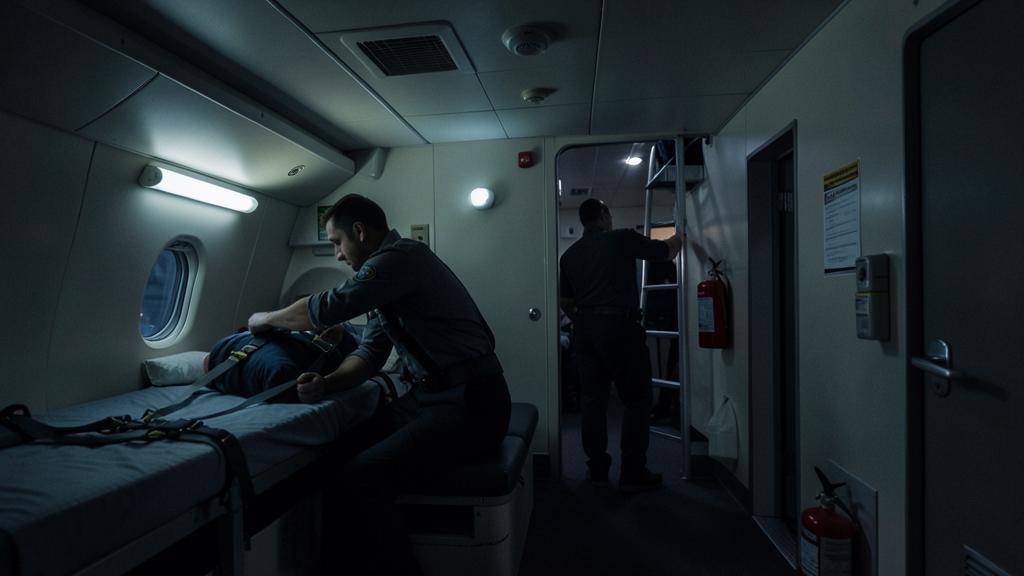
The most stubborn grey area is not regulatory, it is architectural. Compartments differ enough from one type to another that habits do not carry over: access by stairs or by ladder, an emergency exit opening into the cabin or into a galley, oxygen at the bunk or portable within the compartment, an alert sound dedicated to the compartment or relayed through the general PA. A crew member qualified on two types works with two compartments that do not behave the same way, and nothing in the wording of their qualification warns them of it. The safeguard lies in a simple habit: the first time one enters the compartment on a given flight, one locates the emergency exit before locating one’s own bunk. These differences, moreover, are documented better between practitioners than in manuals, and the forum keeps a record of it.
For anyone preparing to take up purser duties, the expectation has shifted. What is checked in an assessment is no longer the ability to recite the rest facility classes, but the ability to justify an assignment plan: why this person in this block, why this bunk, what happens if one of the three blocks fails, and which station is given up first. The role-preparation modules now approach it as an exercise in justification rather than recitation. A plan one cannot defend in three sentences is a plan one has simply copied out.
In all circumstances, the applicable regulation, the installation’s approval conditions and the operator’s approved documentation prevail over this article, whose purpose is to set out a mechanism, not to serve as a procedure.
Questions fréquentes
Does seniority play a role in bunk allocation?
It comes in last, and only to break a tie between two people whom the operational criteria leave equal. The plan is built first on the crew that must remain staffed in the cabin, then on the service programme and the station held at landing, then on the wake-up time and the order of egress from the compartment. When an operator writes a seniority rule into its manual, it applies within the margins these constraints have left, never against them.
Why does the bunk close to the access often go to whoever gets up first?
Because waking someone is a physical act, and it must wake only the person concerned. Fetching someone from the back of the module means crossing the aisle, switching on a light and speaking, and so cutting short the rest of the other occupants. The same place also serves whoever must reach the cabin fastest in the event of an alert, which makes two criteria converge on the same bunk.
How many cabin crew members can rest at the same time?
The number is not fixed by the number of bunks but by what the cabin must retain. The minimum complement is derived from the number of installed passenger seats, at a rate of one member per fifty seats or fraction of fifty on a given deck, and this baseline is not meant to be eroded by rest: the handover schedule is built on the crew carried above that minimum. A flight carrying only the minimum complement therefore has no rest plan to write, however long it is and however many bunks the module has. Any adjustment to this principle appears in a written scheme of the operator, with a presence maintained on each deck; it is not improvised on board.
What happens if an occupant of the compartment has to be recalled to the cabin?
A recall is possible, and sometimes necessary, but its cost is twofold. The person resumes their station with a wake-up inertia counted in tens of minutes, and the interrupted block may cease to produce the effect it had been planned for in the service calculation. This is why the plan designates in advance who is recalled first, choosing whoever’s interruption degrades the rest of the flight the least.
Can a rest compartment be occupied at take-off or landing?
Both cases exist, and it is the installation’s approval that decides, not local practice. Some compartments are approved for occupancy during taxi, take-off and landing with a suitable restraint device, others must be unoccupied in these phases. The answer is read on the compartment’s placard and in the approved documentation; it cannot be inferred from the aircraft type or from experience gained at another operator.
Why does a rear bunk move more than a forward one?
In turbulence, the aircraft does not only move up and down: it also rotates about its centre of gravity. A point far from that centre adds the overall motion to the displacement caused by the rotation, and fuselage bending modes amplify the effect at both ends. The gap between a forward module and an aft module remains moderate, but it applies for the entire duration of the block.


Leave a Reply
You must be logged in to post a comment.