
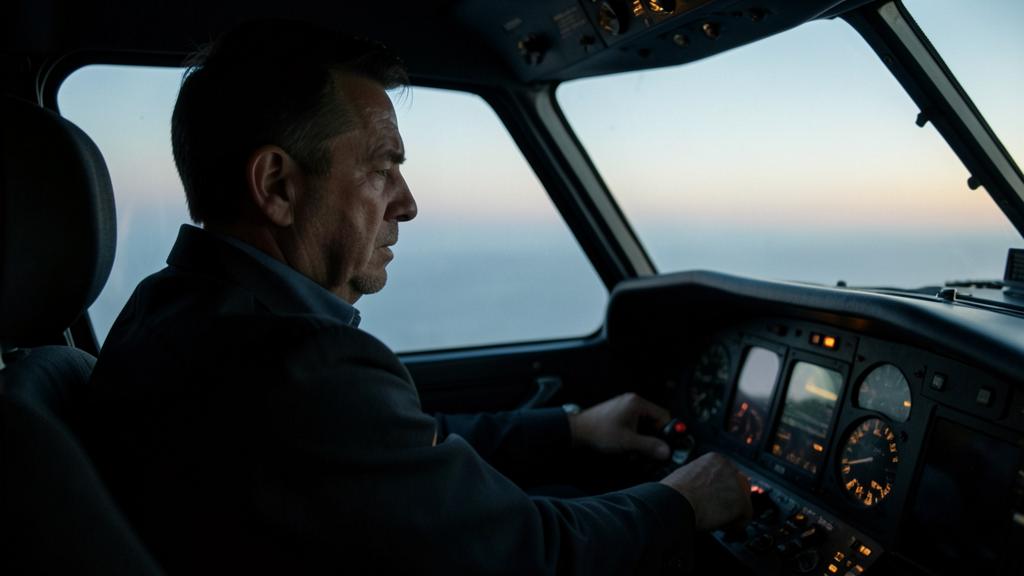
Two pairings in the same roster, the same number of time zones crossed, the same layover length: the one heading west is absorbed in a night or two, the one heading east leaves several days of broken sleep and of awakenings in the middle of the night. This is neither an impression nor a matter of individual stamina. It is the measurable consequence of an internal clock whose own period exceeds twenty-four hours, and of light that, on arrival, does not fall on the right side of the temperature minimum.
A clock that runs a little too slowly
Internal clocks Placed in temporal isolation, with no daylight and no imposed schedule, a human subject does not settle their sleep-wake rhythm on exactly twenty-four hours. They settle it on a slightly longer period, by a few tens of minutes in the great majority of subjects, with real individual scatter but a clear imbalance on the same side: own periods shorter than the solar day remain a minority. This endogenous period is the factory characteristic of the hypothalamic pacemaker that drives the circadian system.
The consequence is permanent and goes unnoticed: every day of ordinary life, the clock has to be pulled ahead of itself to keep pace with the Earth. It is morning light that does this work, silently. The daily advance required is minute and the apparatus is perfectly sized for it. It is not sized to produce ten or twenty times as much in forty-eight hours.
Phase delay Delaying, on the other hand, requires no work at all: it is enough to release the zeitgebers and the clock drifts that way on its own. Everyone has domestic experience of it — going to bed two hours later on a Friday costs nothing and holds without effort; getting up two hours earlier on Monday costs a week. The whole asymmetry between east and west is contained in that sentence, and the rest is only its development.
Your body’s internal clock naturally runs a bit slower than 24 hours. Every day, it needs a small push from morning light to stay in sync. When you travel east, you’re trying to force your clock to run faster, which is much harder than letting it slow down when you travel west.
A pilot flying from New York to London (westward) crosses 5 time zones. Their body clock naturally drifts to match this delay over 2-3 days. The same pilot flying from London to New York (eastward) would need 4-5 days to adjust, despite the same 5-hour time difference.
One point of vocabulary deserves to be held on to, because it governs the countermeasures: sleep debt and phase misalignment are two distinct quantities. The first is quantitative — hours are missing, they are paid back by sleeping. The second is temporal — the hours are there, but placed at the wrong point of the internal cycle. Sleeping more does not correct a misalignment, and a comfortable layover in which one slept a great deal can end with a return to duty in the middle of the biological night.
Light does not always push in the same direction
Phase response The dominant zeitgeber is light, and its effect is not monotonic: the same stimulus, depending on the internal time at which it falls, delays the clock, advances it, or does almost nothing. This is what the phase response curve describes, the tool that makes the whole subject predictable instead of leaving it to be experienced as a fate.
The reference point is not the time on the watch, it is the core body temperature minimum. It lies in the last part of the biological night, typically a few hours before the spontaneous waking time. The rule fits in two lines. Light received before that minimum delays the clock. Light received after it advances it. In the middle of the biological day, the effect becomes weak.
Two parameters modulate the amplitude. Intensity first: outdoor light, even under an overcast sky, lies far above the indoor lighting of a hotel room — the gap is counted in orders of magnitude, not in percentages. Spectral content next: short wavelengths are the most effective on the melanopsin-containing ganglion cells that inform the clock. Hence the status of an accessory too often taken for an object of comfort: dark glasses worn on leaving the aircraft do not serve to reduce glare, they serve to remove a powerful zeitgeber at the exact hour when it would act the wrong way.
Finally, the amount of shift obtained per twenty-four hours is capped. In the delaying direction, one typically speaks of an order of magnitude of one hour per day when exposure is well managed. In the advancing direction, appreciably less. No discipline, no willpower and no protocol crosses that ceiling: they only make it possible to reach it instead of staying far below.
Why east costs more than west
Three causes Three causes add up, and they all point the same way. The first has already been stated: an eastward flight demands a phase advance, that is, climbing back up the natural slope of the clock, whereas a westward flight demands a delay, that is, going down it.
The second is the most counter-intuitive, and it is the one that catches out the experienced practitioner. On arrival in the east, the internal clock is behind local time. Local morning therefore does not correspond to biological morning: depending on the size of the shift, it falls in the middle of the biological night, that is to say before the temperature minimum. Local morning light, which looks like the most obvious countermeasure in the world, then produces a phase delay — it moves you away from the target instead of closer to it. The same action after a westward flight is beneficial, because the clock is ahead of local time and local light falls on the right side.
The trap. Arriving in the east at the end of the night, dropping the bags and going out to walk in the rising sun “to get onto local time”. As long as the temperature minimum has not been passed, that exposure delays the clock and adds hours to the shift still to be made up. The useful reference is not local time but body time: as long as you are still in your own night, light is a zeitgeber working the wrong way — dark glasses, blacked-out room, and exposure deferred to the late local morning or the early local afternoon.
The third cause appears only for large eastward shifts. Beyond a certain gap, the system may re-entrain “the other way round”: instead of advancing by seven or eight hours, it delays by what remains out of twenty-four. This re-entrainment in the wrong direction is not uniform — some markers go one way, others the other. The result is internal desynchrony, in which sleep, temperature, alertness and digestion no longer tell the same time. That is the signature of those layovers one comes out of with the impression of a fog lasting several days, without being short of hours of sleep for all that.
An uncomfortable conclusion has to be drawn for rostering: a layover of the same length, counted in clock hours, does not represent the same load depending on the direction of travel. Counting time zones in absolute value amounts to measuring a height difference without looking at whether it goes up or down.
The body does not shift as one block
Multiple oscillators The circadian system is not a single oscillator. The central pacemaker is entrained by light; the peripheral clocks, those of the liver, the digestive tract and the muscle, are sensitive to meal times and to physical activity. These oscillators do not move at the same speed, and an abrupt shift dissociates them.
Hence the familiar chronology of symptoms, which is not haphazard. Alertness generally reorganises itself first, because sleep pressure obeys the simple duration of wakefulness and resets by sleeping. Appetite and transit follow with a lag, and appear at the hours of the former time zone. Thermoregulation and the nocturnal secretion of melatonin, markers of the central pacemaker, bring up the rear. Feeling operational is therefore no proof of being realigned.
One mechanism deserves particular attention because it explains the most frequent failure of eastward layovers. The few hours preceding the usual bedtime — typically two to three — constitute a wake maintenance zone: the circadian alerting signal is at its maximum there, and falling asleep is harder than at any other moment of the twenty-four hours — including harder than in the middle of the afternoon. Now an eastward flight demands precisely going to bed early by local time, that is, falling asleep right in the middle of that zone. “Going to bed early on arrival” is not a countermeasure, it is a prescription for insomnia.
The practical answer follows from the drawing: rather than a single block impossible to obtain, an anchor sleep placed on the overlap of the two windows, supplemented by a short nap in the trough of the biological afternoon. One does not seek to sleep at local time, one seeks to sleep where sleep is available, moving the whole thing in small steps.
What the asymmetry changes about the direction of pairings
Three regimes Three layover regimes exist, and the first task is to choose which one applies before departure, not on arrival. Staying on home base time, attempting no shift at all, is the right answer for short layovers: alignment is protected for the return to duty and for the trip home. Switching entirely to local time only makes sense if the layover is long enough for the realignment to be completed, failing which one pays the price of the phase shift without ever collecting its benefit. Between the two, a deliberate partial shift — two or three hours in the useful direction — is worth more than an aborted attempt at a full switch.

| Criterion | Westward — phase delay | Eastward — phase advance |
|---|---|---|
| Direction demanded of the clock | With the endogenous drift | Against the endogenous drift |
| Synchronisation effort | Releasing is enough, the clock moves on its own | It has to be forced, and the daily gain is capped lower |
| Local morning light | Falls after the temperature minimum: it helps | May fall before it: it acts the wrong way |
| Dominant difficulty | Early waking in the second part of the local night | Impossible sleep onset at the start of the local night |
| Specific risk | Sleepiness at the end of the local day | Re-entrainment the wrong way and internal desynchrony |
| Most effective lever | Light at the end of the local day, delayed bedtime | Darkness on local waking, deferred light, anchor sleep |
| Short layover | A partial shift often remains manageable | Attempting the switch is the worst choice available |
The boundary between these regimes does not fall in the same place depending on the direction. A layover one would judge sufficient to switch westward is not necessarily so eastward, where the speed of realignment is lower and the first night is often lost.
| Moment, local time | After westward travel | After eastward travel |
|---|---|---|
| Daybreak, first hour | Seek outdoor light | Avoid: dark glasses, curtains closed |
| Late morning, early afternoon | Weak effect, immaterial | Seek it: this is the useful window |
| Late afternoon | Seek it, to hold out until local bedtime | Reduce it, avoid late outings |
| Evening and night | Light tolerated to delay bedtime | Strict darkness, screens set aside |
The right reflex. Decide the regime before departure, and write it down: home base time kept, partial shift of so many hours, or full switch. That choice then governs meal times, nap times, the wearing of glasses on leaving the aircraft and the hour at which you leave the room. A mediocre regime held from start to finish systematically beats a good regime improvised at the third awakening.
The sequence of legs counts as much as each leg taken in isolation. An outbound flight eastward followed by a return westward brings the clock back in the direction of its natural slope: the return is absorbed better than the outbound, and the whole thing closes. The reverse sequence — outbound westward, then return eastward, then a quick return to duty — adds two phase advances, the second of them at a moment when the recovery reserve is already drawn down. With an identical number of time zones and an identical trip length, two rosters therefore do not carry the same physiological cost.
The regulation measures the size, not the direction
Regulatory limits The European framework for flight time limitations deals with time zone difference through the notion of acclimatisation: a crew member is deemed acclimatised to a given time zone, which determines the time reference used to calculate permissible duty times, the window of circadian low and rest periods. A table cross-references the size of the difference relative to the reference time zone and the time elapsed since departure in order to decide: acclimatised to the departure time zone, acclimatised to the arrival time zone, or unknown state, the latter calling for more restrictive limits.
This arrangement is robust and is worth more than a naive count of duty hours. It bears, however, in its principle, on the magnitude of the difference and on the time elapsed — not on its direction. In other words, a six-hour westward displacement and a six-hour eastward displacement receive the same treatment there, whereas physiology knows that they have neither the same cost nor the same time to resolve.
That is precisely where the fatigue risk management system takes over. Where the limitations set an enforceable floor identical for everyone, the risk management approach allows the operator to identify the genuinely costly pairs of pairings, to collect reports and sleep measurements, and to act on what the table does not see: the direction of the sequence, the position of the duty night within the trip, the quality of the accommodation, the length of rest on return. The direction of travel is a roster engineering parameter, not a regulatory variable.
What to go and check in your own documentation
Four points Four points deserve to be opened and read once, rather than assumed. First, the definition your operator uses for the state of acclimatisation and the way it is recalculated after a layover: it is that definition which determines the reference for your windows of circadian low, and therefore the limits that actually apply to your duty day. Next, what the operations manual means by suitable accommodation on a layover: blackout, quiet and the possibility of obtaining a meal outside local hours are not comfort, they are the tools that make a shifting strategy workable.
Thirdly, the feedback loop of your fatigue risk management system. An isolated report on one eastward pairing will change nothing; a documented series on the same pair of pairings, with concrete elements of the sleep actually obtained, is the only material that makes it possible to discuss the order of the legs or the extension of a rest period. The safety reporting channel and the exchanges between crews on the professional forum do not replace one another: the first has the power to change the roster, the second serves to know what to write in it.
Fourthly, the medical question. Melatonin and hypnotics each have their effect profile and their constraints of use in operations; they fall to the aeromedical examiner and to the operator’s policy, never to improvised use on a layover. Caffeine, for its part, acts on sleep pressure and not on phase: it masks fatigue without realigning anything, and a late dose eats into the very night one was trying to obtain.
One acknowledged grey area remains: there is no individual measurement of phase available on the line. Chronotype, age and tolerance to shift work make the response vary greatly from one individual to another, and no scale substitutes for that. For anyone preparing a rating, a progression towards a cabin manager position or a recruitment interview, being able to state the mechanism — an endogenous period longer than twenty-four hours, the phase response curve, the marker of the temperature minimum — is worth infinitely more than reciting a recovery duration. It is also what makes it possible to explain a crew decision, and to defend it. The professional training modules that deal with human factors take up these mechanisms in a form applicable to the real roster.
On all these points, the applicable text, the decision of the oversight authority and your operator’s approved documentation prevail over this article, which has no ambition other than to explain a physiological mechanism and its operational consequences.
Questions fréquentes
Should you seek daylight as soon as you arrive after an eastward flight?
Not until the core body temperature minimum has been passed. On arrival in the east, the internal clock is behind local time: local morning may correspond to the middle of the biological night, and light received at that moment delays the phase instead of advancing it. The useful exposure is placed rather in the late local morning or the early local afternoon, the first hour of the day being handled with dark glasses.
On a short layover, is it better to stay on home base time or to switch to local time?
On a short layover, keeping home base time is almost always the better choice, and it is even more so eastward. A switch begun without being completed makes you pay the cost of the phase shift without giving its benefit, and leaves you coming back misaligned for the return to duty. The decision is taken before departure, because it governs meal times, nap times and the moment you leave the room.
Why can you not fall asleep early on an eastward layover even when exhausted?
Because the bedtime imposed by local time falls in the wake maintenance zone, the few hours preceding the usual bedtime, where the circadian alerting signal is at its maximum. Accumulated fatigue does not compensate for that signal: falling asleep is harder there than at any other moment of the twenty-four hours. It is better to place a block of sleep on the overlap of the two windows and to supplement it with a short nap.
Does napping compromise realignment to local time?
A short nap, placed in the trough of the biological afternoon, reduces sleep pressure without moving the phase significantly: it serves alertness and does not cancel the work of light. A long or late nap, on the other hand, eats into the main sleep of the following night and further fragments an already disorganised rhythm. The useful rule is duration and timing, not a blanket prohibition.
Does the European regulation take account of the direction of the time zone shift?
The acclimatisation arrangement reasons on the size of the difference relative to the reference time zone and on the time elapsed, in order to determine the time reference and the window of circadian low. In its principle, it does not distinguish the direction of travel: a shift of several hours eastward receives the same treatment there as the same shift westward. It is for the operator’s fatigue risk management system to deal with what the table does not see.
Is sleeping more enough to erase jet lag?
No, because two distinct quantities are superimposed: sleep debt, which is quantitative and is paid back by sleeping, and phase misalignment, which is temporal and is corrected only by moving the clock. A layover in which one slept a great deal can end with a return to duty in the middle of the biological night. Only light, darkness and, secondarily, meal times move the phase.


Leave a Reply
You must be logged in to post a comment.