
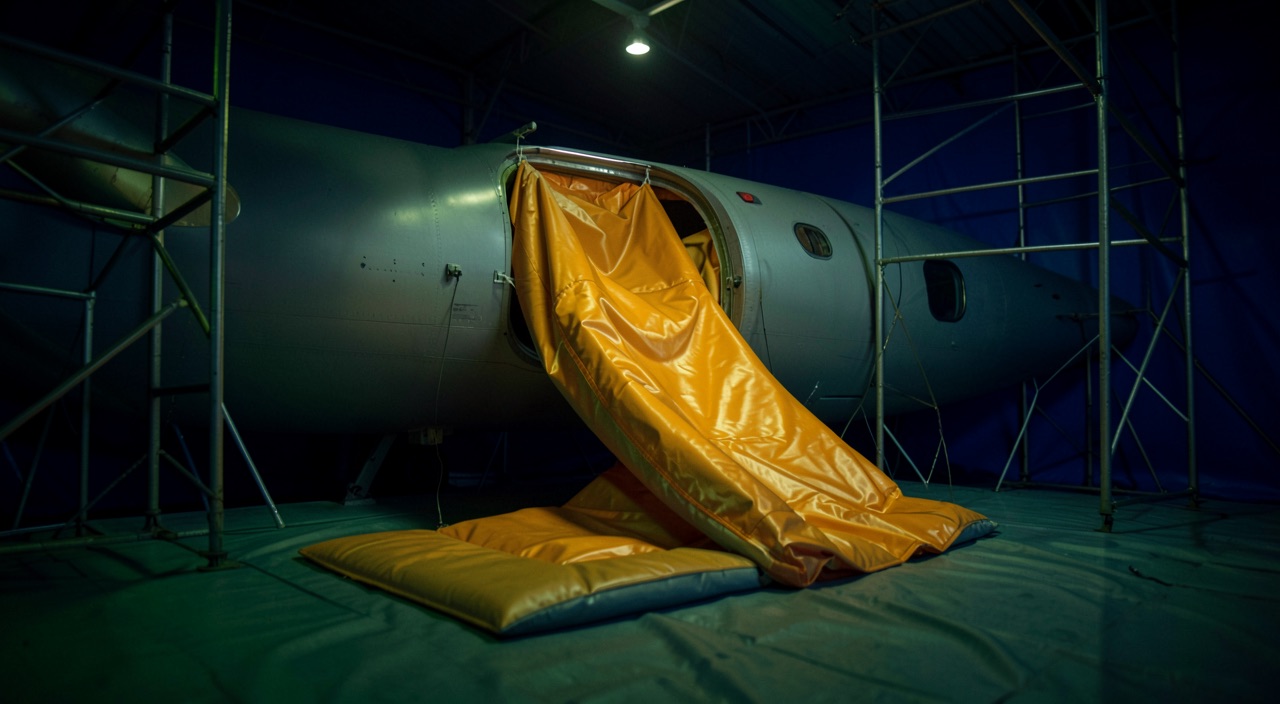
In recurrent training, the question comes up almost every time: if an aircraft can be evacuated in ninety seconds during certification, why did a real event take several minutes? The test is neither rigged nor lenient. It simply measures something other than what people credit it with: the capability of a cabin architecture, under conditions chosen to remain reproducible, starting from a moment that is not the moment the aircraft comes to a stop. Everything these conditions set aside does not vanish — it becomes the operator’s responsibility.
What the test measures, and under what conditions
The evacuation demonstration does not judge people, it judges a design. What is at stake is the number of exits, their type, their distribution along the fuselage, the width of the aisles and the access paths leading to them, the space left for a crew member to stand at the door and direct the flow, slide performance, emergency lighting, and floor-level path marking. The pass criterion, meanwhile, is binary: the entirety of the occupants, at the maximum passenger seating capacity requested for the type, must have left the aircraft within the ninety seconds following the evacuation signal.
Around this single criterion, the protocol locks down everything that would make the test incomparable from one run to the next.
- The aircraft is on the ground, in a normal attitude, gear down, engines shut down.
- The test is conducted at night, or in reconstructed darkness: emergency lighting and floor marking must prove their usefulness.
- Only half of the exits are available, those on the same side, designated by the authority and not chosen by the applicant.
- No exit is pre-opened: the opening, deployment, and inflation of the slides by their own system are part of the measured time.
- Baggage, blankets, and various objects are scattered in the aisles and along the access paths to create obstructions.
- The crew occupies its takeoff stations and has not rehearsed the exercise.
The half-exits rule is not a rhetorical precaution: it reflects the most common accident hypothesis, one side rendered unusable by an external fire, an obstacle, a list, or the proximity of an embankment. The fact that the authority itself designates the exits to be used prevents optimizing the design around a favorable combination, and that is the whole value of the procedure: the result holds for the architecture, not for a chosen scenario.
As for the figure itself, it is nothing like an athletic performance. It was calibrated to the order of magnitude of the time during which the inside of a cabin remains tenable once an external fuel fire has broken out, before heat and smoke make survival unlikely. It does not, therefore, describe an expected evacuation duration: it sets a bar the architecture must clear, under otherwise favorable conditions.
The test checks if the plane’s design allows evacuation in 90 seconds under ideal conditions. It doesn’t account for real-world chaos like fire, injuries, or panic. The operator must handle those extra risks.
On a Boeing 737-800 with 189 seats, certification tests use 9 exits (half). In a real emergency, if one slide fails, the remaining 8 must handle the full load. The test never simulates this mid-evacuation failure, making crew coordination critical.
The occupant panel is not the cabin of the day
This is the most debated part of the test, and the most misunderstood. The occupants are neither mannequins nor manufacturer employees rounded up from the neighboring offices: the panel’s composition is constrained. Minimum proportions of women and of participants belonging to the older age brackets are mandated, including a share reserved for women within those same brackets, precisely to rule out a sample of young, athletic adults. The exact thresholds appear in the text applicable to the type; they have evolved and do not overlap from one airworthiness code to another, so they must be read at the source rather than quoted from memory. Life-size dolls stand in for infants and are carried by occupants. Neither the participants nor the crew have rehearsed the maneuver, and those who took part in a comparable test in the recent past are excluded.
What this panel does not carry is more instructive than what it does. It does not carry smoke, which strips away sight and breath within a few inhalations. It does not carry heat, nor the smell of fuel, nor the noise of an airframe that has just deformed. Nor does it carry uncertainty: a volunteer knows that no fire awaits at the bottom of the slide, and that certainty alone changes how they wait their turn, how they step over an obstacle, how they accept an order from a crew member. Finally, it carries neither the injuries of deceleration, nor genuinely mobility-impaired passengers, nor families trying to regroup before exiting.
The test is not harmless for all that: past demonstrations have produced serious injuries, up to permanent after-effects, on healthy, forewarned volunteers, in a cabin with no fire or smoke. That finding weighs today as heavily as the result itself, and explains the authorities’ reluctance to require a full test when another path to demonstration is available.
The clock starts once the hardest part is over
The point most often overlooked does not appear in the list of conditions: it lies in the very definition of the clock. The ninety seconds run from the evacuation signal to the exit of the last occupant. Everything preceding the signal falls outside the measurement.
Yet in a real event, that is exactly where the time is spent. The aircraft comes to a stop, the flight crew carries out its immediate actions, tries to find out what is burning and on which side, communicates with the cabin, sometimes with rescue services, shuts down what needs to be shut down — and decides. Deciding is not a formality: evacuating over an engine still rotating, onto a cluttered apron, or under a rain of kerosene also kills, and staying on board is sometimes the right answer. This phase is bounded by no certification requirement. It is bounded only by the operator’s procedures, the clarity of communication, and training.
The consequence is immediate for anyone analyzing an event, drafting a report, or running a debrief: the total duration, measured from the aircraft coming to a stop to the last passenger being accounted for, is not to be compared with the certification figure. At best, one compares the duration of the equivalent segment alone, and treats the decision phase separately, since it stems from a different family of causes and different remedies.
What the accident adds, line by line
| Parameter | Certification demonstration | Real event |
|---|---|---|
| Cabin environment | Darkness, cabin intact, no smoke or heat | Dense smoke, heat, irritant combustion products, noise |
| Available exits | One half, designated before the test, all serviceable | Number unknown at the outset, liable to decrease after the signal |
| Occupants | Healthy, informed volunteers, composition constrained by quotas | Real population: injured, children, reduced mobility, varied languages |
| Clutter | Obstacles laid out in advance in the aisles and access paths | Open baggage, pulled from the bins and carried off despite the order not to |
| Aircraft attitude | On the ground, normal attitude, gear down, engines shut down | Collapsed gear, list, lateral departure, body of water, engine still rotating |
| Clock start | At the evacuation signal | After an assessment-and-decision phase of highly variable duration |
| Crew | Trained on type, at their stations, knowing it is a test | Same training, but partial, late, or contradictory information |
| End of measurement | Exit of the last occupant from the aircraft | Moving clear, regrouping, headcount, care of the injured |
Two lines of this table carry more weight than the others. The first is exit availability after the signal: the demonstration never loses a door along the way, whereas a real event often begins by losing one — fire visible at the foot of the slide, slide not inflated, door jammed by deformation, wing emergency exit opening onto a wing on fire. The second is baggage-retrieval behavior: in the test, obstacles are placed in advance and no one tries to open a bin. In a real event, some occupants retrieve a bag, and every bag retrieved slows down the entire aisle behind it.
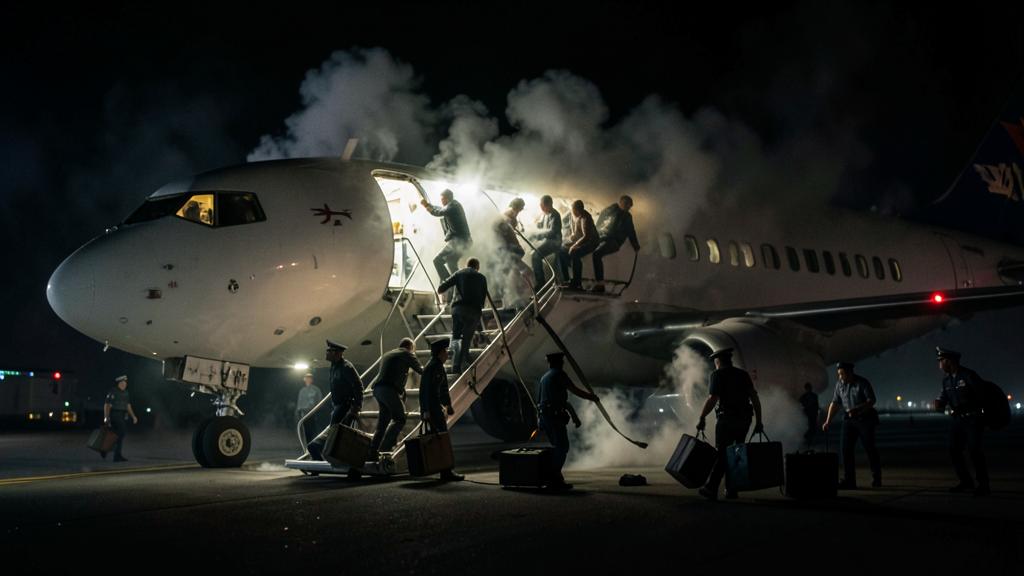
The trap. The reasoning « half the exits are enough, certification proved it » is wrong the moment an exit is lost mid-evacuation, because the demonstration starts from a half that is chosen and intact, never from a half amputated in mid-sequence. Flow rerouting from a blocked door to another has never been demonstrated at the scale of the complete aircraft: it is the sole point in the whole setup that rests entirely on the cabin crew’s command, on its wording, and on the second at which it is given.
Why the full-scale test is done less and less
The full demonstration is not the only path to compliance. The airworthiness code accepts that proof be provided by analysis, provided it rests on tests actually conducted. In practice, a derivative type, a fuselage stretch, or the addition of a pair of exits is handled through a bundle: partial door-by-door tests, exit flow-rate measurements, slide deployment tests, calibration of a flow model against an earlier demonstration, then a reasoned comparison of the new configuration with the demonstrated one.
This shift from the full-scale test to the paper file is reasonable — it avoids exposing volunteers — but it has a direct operational consequence. The demonstration underpinning the maximum capacity of an aircraft delivered today may have been conducted decades earlier, on a cabin whose layout, seat pitch, and number and position of galleys and lavatories bear little resemblance to today’s. What guarantees the transposition is not a new test, it is the rigor of the documented deltas in the file — and that file, the operator never sees.
What the operator must compensate for
What the test sets aside does not evaporate: it changes owners. Certification delivers an architecture whose capability is established; operation must restore to it, every day, the conditions the test assumed to be in place.
| Item | Established at certification | Upheld by the operator |
|---|---|---|
| Number, type, and distribution of exits | Maximum seating capacity admitted for this architecture | Verify that the cabin configuration operated is indeed the one approved |
| Slides | Deployment and inflation by their own system, without outside intervention | Arming and disarming of doors, pre-flight check, discipline of the command |
| Emergency lighting and floor path marking | Effectiveness demonstrated in darkness | Operating condition, missing or obscured elements dealt with before departure |
| Cabin crew complement | Complement used to conduct the test | Regulatory minimum tied to the number of seats installed, and absence management |
| Occupants of exit rows | Outside the scope of the test | Fitness criteria, seat reassignment, individual briefing |
| Cabin baggage | Represented by fixed obstacles that no one tries to carry off | Boarding policy, stowage, wording of the order to leave everything behind |
| Loss of an exit after the signal | Never replayed | Standard flow-rerouting command, periodic training, physical blocking of the door |
| Inoperative evacuation equipment | Outside the scope of the test | Minimum equipment list and associated limitations, decided before departure |
Cabin crew complement deserves a word, because it follows two different logics. The demonstration is conducted with a given complement, the one the applicant chooses. Operation, meanwhile, applies a regulatory minimum based on the number of passenger seats installed: on the European side, one cabin crew member per started bracket of fifty seats on a single deck. Other authorities set a similar but not identical baseline, and it is the text governing the operator’s certificate that controls. The two numbers do not always coincide, and when the chosen configuration puts the operator at the minimum, the loss of a crew member is handled through a limitation, not an improvised reshuffling of stations.
The right reflex. During the silent review, do not recite the aircraft’s certified allocation: count the exits genuinely available for this flight, removing the one whose slide is inoperative under the minimum equipment list, the one whose row is occupied by passengers who do not meet the fitness criteria, and the one that will be obstructed by a jump seat or a curtain. Then silently rehearse the exact flow-rerouting phrase, with the gesture that goes with it: it is the one part of the whole setup that nothing has ever demonstrated in your stead.
What to go check in your own documentation
Three checks can be carried out on paper, with no tool other than the aircraft’s documentation, and give an accurate picture of the margin genuinely available. First, compare your configuration’s seating capacity to the type’s certified maximum capacity: a low-density layout leaves a margin that certification did not have to demonstrate, a layout at the ceiling leaves none. Next, read the minimum equipment list entries relating to slides, exits, and emergency lighting, focusing not on the repair time limit but on the associated operational limitation: reduced passenger numbers, prohibition on occupying certain rows, physical sealing of a door. Finally, find in the operations manual the standard flow-rerouting command and check that it is indeed the one heard during periodic training sessions.
A gray area remains, and it is better to name it than to work around it: cabin densification and the growing share of occupants with reduced mobility, very young children, or passengers who do not share the crew’s language are covered by no recent full-scale test. Managing them runs through the operator’s approved procedures — seat allocation, internal caps, individual briefing — more than through a single figure written down somewhere. That is also what makes the subject worth its weight in type-rating preparation: a candidate who knows why the clock starts at the signal, and not at the stop, will never again confuse a design requirement with an operational promise, and that is one of the misunderstandings that comes up most often in exchanges between crews.
On any point of detail, the certification specifications applicable to the type, the operator’s approved documentation, and the flight manual prevail over this article, whose purpose is to lay out a mechanism, not to serve as a reference.
Questions fréquentes
From what moment are the ninety seconds counted?
The clock starts at the evacuation signal and stops at the exit of the last occupant from the aircraft. The entire preceding phase — coming to a stop, immediate actions, exchange between the flight deck and the cabin, the decision to evacuate — falls outside the measured scope. That is why the total duration of a real event is not comparable to the certification figure: it contains a segment the demonstration does not measure.
Why does the demonstration use only half the exits?
Because the most common accident hypothesis is that one side of the aircraft becomes unusable, due to an external fire, an obstacle, or the attitude taken on the ground. The exits retained are those on the same side, and it is the authority that designates them, which prevents optimizing the design around a favorable combination. The demonstration therefore starts from an evacuation capacity already halved, but with every remaining exit fully functional.
Is an aircraft certified after a mere analysis less safe than one actually evacuated in a test?
Not necessarily, but the nature of the proof changes. The analysis must rest on tests actually conducted — partial door-by-door tests, flow-rate measurements, slide deployments — and on a reasoned comparison with an already demonstrated configuration. The quality of compliance then hinges on the rigor of the documented deltas, not on a stopwatch observed on the day of the test.
What should be done when an exit is lost during evacuation?
This is the case the demonstration never replays, and it rests entirely on the cabin crew. The crew member responsible for the door physically seals it off, positions themselves so as to block access, and gives the standard command to reroute toward the usable exit, repeating it. The operations manual sets the exact wording and the accompanying gesture, and it is that exact wording that must be heard during periodic training.
Does a low-density cabin configuration give a margin relative to the demonstration?
Yes, in principle: the demonstration is conducted at the maximum passenger seating capacity requested for the type, so a less dense layout finds itself in a more favorable situation than the one demonstrated. This margin, however, exempts nothing, since the operated configuration must itself form part of the approved layout, including monuments and access paths.
Is the number of cabin crew members used during the test the same as what is found in service?
Not necessarily: the test is conducted with the complement chosen by the applicant, whereas operation applies a regulatory minimum based on the number of passenger seats installed, at a rate, on the European side, of one cabin crew member per started bracket of fifty seats on a single deck. When the two numbers differ, it is the operating minimum that governs, and the absence of a crew member is handled through a limitation decided before departure.


Leave a Reply
You must be logged in to post a comment.