
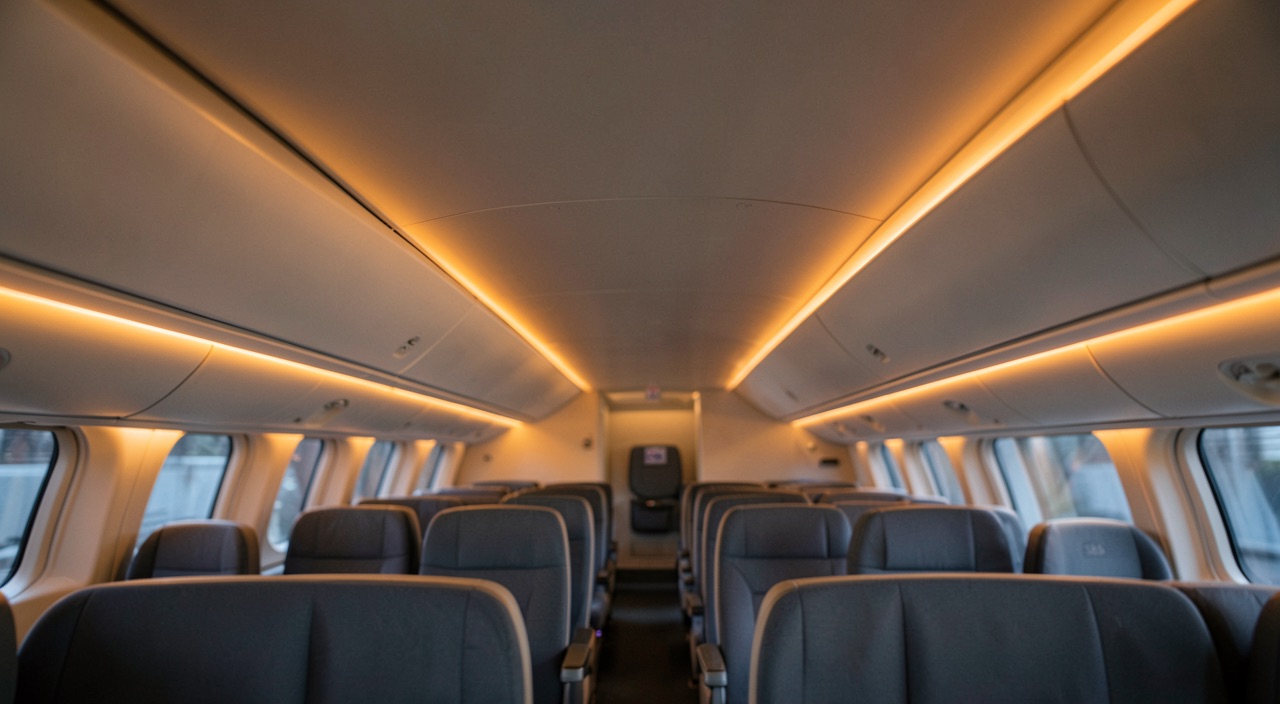
Six hours from arrival, the ceiling shifts to amber, then goes dark. Outside it is broad daylight; at the destination it is three in the morning, and no two people on board share the same body clock. One passenger is about to fall asleep; the neighbour is about to raise a window shade and, with that single gesture, wipe out everything the lighting system has just set up. The light sequence is neither decoration nor a service amenity: it is the only synchroniser the operator genuinely controls, and it is timed to the flight, not to the clock at the arrival airport. Understanding why requires separating two quantities that everyday language blurs together: what the eye sees, and what the clock records.
The eye and the clock do not read the same light
The retina does more than let us see. Alongside the rods and cones, a minority population of ganglion cells carries its own pigment, melanopsin, and projects directly to the suprachiasmatic nuclei of the hypothalamus — the master clock. These are the cells that drive melatonin suppression, the setting of core body temperature, and sleep pressure. They work without going through image formation: people with no functional vision retain light synchronisation as long as the retina itself is intact.
The point that matters to you is that this pathway does not share the spectral sensitivity of vision. Daytime vision peaks in the yellow-green; the melanopic pathway peaks at a noticeably shorter wavelength, in the blue. Yet lux, the unit in which every lighting specification is written, is weighted by the vision curve. Two ambiances showing the same lux level can therefore act very differently on the clock, and nothing in the scene’s name — “relax”, “night”, “dawn” — settles the question.
Metrology has since caught up with this mismatch: standardised melanopic quantities now exist, weighting the spectrum by the sensitivity of the clock pathway and expressed as daylight-equivalent illuminance. It is this quantity, not visual lux, that predicts melatonin suppression. It is not among the quantities airworthiness requirements ask to be characterised: describing a cabin’s ambiances in melanopic terms is a matter for dialogue between manufacturer and operator, not third-party verified compliance.
Your eyes and your internal clock react to light differently. Your eyes see best in yellow-green light, but your clock is most sensitive to blue light. This means that two lights that look the same brightness to you can affect your sleep differently. The technical term for this is “melanopic” light, and it’s what really matters for sleep.
On a Boeing 787 flying from London to Los Angeles (a 10-hour flight), the cabin lighting might shift to a dim blueish “night” setting 6 hours into the flight. However, a passenger from New York (who is 5 hours ahead of London time) might find this light too bright because their internal clock is already in “night mode,” while a passenger from Tokyo (who is 9 hours ahead) might find it not bright enough because their internal clock is still in “day mode.”
The same light advances or delays the clock depending on the body’s own time
A light exposure does not shift the clock in a fixed direction: its effect depends on when it falls relative to the core-temperature minimum, which sits in the last third of the usual sleep period, a few hours before the ordinary wake time. Received before that minimum, light delays the clock: it pushes back the following evening’s sleep onset. Received after it, light advances the clock. In the middle of the biological day, the resetting effect becomes weak — this is the zone where light produces alertness without shifting the clock.
Two operational consequences follow. The first is that the size of a shift obtained from a single exposure stays modest, at best on the order of an hour: the clock does not jump, it drifts, and a gap of several time zones is paid off over several days. The second, which is the heart of the matter, is that a cabin does not contain one thermal minimum but as many as there are sleep histories on board. The same cool-toned ceiling, at the same minute, delays the person coming from the west and advances the person coming from the east.
Two effects that are readily conflated must also be distinguished. The acute alerting effect is immediate, measured in minutes, barely depends on internal time, and fades almost as quickly as it appeared. The resetting effect, by contrast, is not visible in the moment: it shows up the next day, in the time of sleep onset. An ambiance can therefore wake people effectively without resetting anything, and vice versa.
The same light can either delay or advance your internal clock, depending on what time it is for your body. If you’re exposed to light before your body’s natural low point (a few hours before you usually wake up), it will delay your sleep. If you’re exposed to light after that point, it will advance your sleep. This is why cabin lighting can’t be set to work for everyone at the same time.
On a flight from Paris to Tokyo (a 12-hour flight), a passenger from Paris (who is 8 hours behind Tokyo time) might be in the “delay” phase of their internal clock when the cabin lights dim, while a passenger from Los Angeles (who is 17 hours behind Tokyo time) might be in the “advance” phase. This means the same lighting setting could make one passenger sleepier and the other more awake.
Why the sequence follows the flight, not the arrival time
An operator programming a light scenario is pursuing four objectives that do not overlap. The first is operational: making the flight sequence legible, opening and closing service windows, letting the cabin crew work. The second is the immediate alerting of occupants at the desired moment. The third is opening a genuine sleep window, which above all means not lighting the cabin. The fourth, true circadian resetting, is the only one that would require knowing each individual’s internal time.
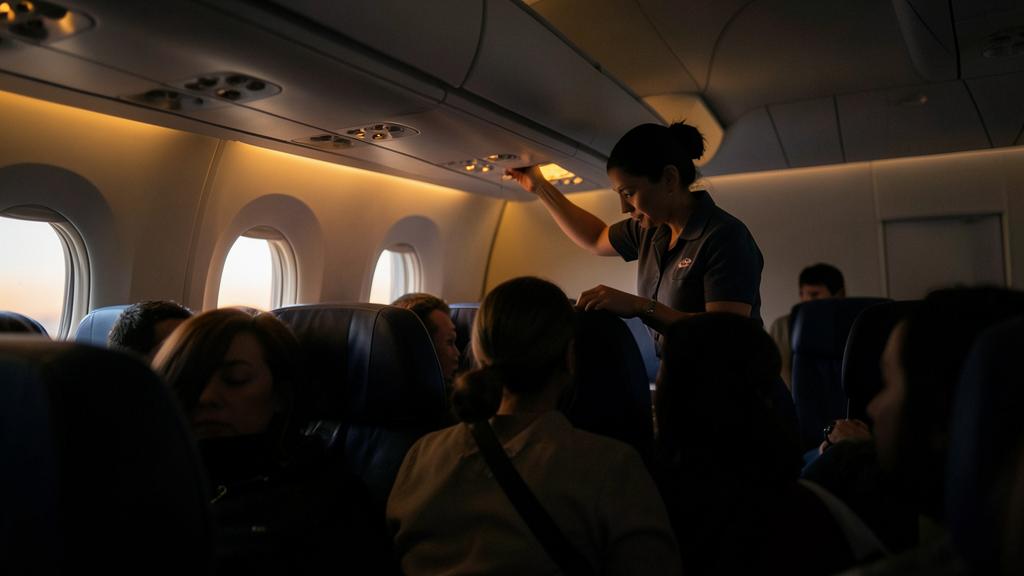
The first three are programmed against flight time, because they depend only on the sequence on board. The fourth cannot be programmed collectively: targeting the arrival airport’s local time would mean imposing strong light at a moment that, for part of the cabin, falls before the thermal minimum and, for the rest, after it — thereby delaying some occupants while advancing others. A sequence timed to the flight does not claim to reset anyone: it protects a sleep window and avoids adding disorder. Actual resetting happens on the ground, over the following days, with local light.
Destination time nonetheless returns in the design, but through geography rather than biology. On an eastbound flight that crosses sunrise, the outside imposes its own law and the scenario decides only one thing: whether to follow that sunrise or try to hold it back. On a short night sector, conversely, the usable window is so narrow that the question of resetting disappears: only the darkness actually achieved matters, and how long it lasts.
| Criterion | Sequence timed to the flight | Sequence timed to destination time |
|---|---|---|
| Time reference | elapsed time since take-off and service milestones | local time at the arrival airport |
| Population targeted | the whole cabin, regardless of origin | only the occupants already acclimatised to the destination |
| Intended effect | protected sleep window, alertness at the right point in the service | phase advance or delay |
| Implicit assumption | none about occupants’ internal time | a shared internal time, rarely verified |
| Main risk | sleep obtained a few hours too early or too late | pushing part of the cabin the wrong way |
| Robustness to a departure delay | strong: the sequence slides with the flight | weak: service milestones fall out of alignment |
| Compatibility with the service | direct, it follows from it | frequent conflicts with meal service and securing the cabin |
| Verifiability on board | the crew sees what it is doing | invisible without knowing every individual sleep history |
Cabin lighting is timed to the flight, not the destination, because it’s impossible to know everyone’s internal clock. The lighting is set to help people sleep during the flight and to keep them alert when needed, but it can’t reset everyone’s clock at the same time. Real clock resetting happens on the ground with natural light over several days.
On a 13-hour flight from Paris to Singapore, the cabin lights might dim 6 hours into the flight. However, a passenger from Paris (who is 7 hours behind Singapore time) might be in the "delay" phase of their internal clock, while a passenger from Los Angeles (who is 15 hours behind Singapore time) might be in the "advance" phase. The same lighting setting could therefore make one passenger sleepier and the other more awake.
What matters is not the scene, it is the dose received by the eye
An ambiance is not judged at the ceiling but at the eye, and the eye is in the seat. The relevant quantity is the illuminance received at the plane of the cornea, hence in a vertical plane when the person is looking straight ahead. Direction matters too: circadian sensitivity is not evenly distributed over the retina, and the available research credits light coming from above — the light that falls on the lower part of the back of the eye — with greater effectiveness. A strip that washes the ceiling therefore acts more, at equal level, than a grazing source or a reading lamp aimed at a page. A dim cabin where every reading lamp is switched on remains, for the clock, a dark cabin.
Three further parameters run counter to intuition. The response is dose-dependent but saturates: past a certain level, doubling the illuminance does not double the effect, and a brief but bright exposure can do most of the work. Recent light history shifts sensitivity: after several hours in a dimmed cabin, the eye reacts more strongly to the same level, which is why an abrupt switch to full lighting is as unpleasant as it is effective. Finally, colour alone says nothing: a strong amber source can carry more melanopic load than a very weak cool-white one. It is the product of spectrum and level that decides, never either factor taken alone.
| Ambiance | Visual impression | Relative melanopic load | Justified use |
|---|---|---|---|
| Cool white, high level, washed ceiling | full daylight | the highest in the range | alertness, service, securing the cabin |
| Cool white, very low level | bluish night light | low, but not zero | night-time movement, best confined to the aisle |
| Warm white, high level | lit lounge | intermediate, often underestimated | service, sleep window closed |
| Amber, low level | twilight | the lowest in the range | transition into the dark phase |
| Individual reading lamp, tight beam | a localised spot | low at the plane of the eyes | reading during the dark phase |
| Personal screen at short distance | negligible to the eye | not negligible, owing to proximity | tolerated, but not to be encouraged |
It’s not just about how bright the cabin is—it’s about how much light actually reaches your eyes. Light coming from above affects your sleep more than light from below. Also, a short burst of bright light can have a big effect, and the color of the light isn’t as important as how much of it there is. A dim cabin with lots of reading lights can still be “dark” for your internal clock.
On an A380 flying from Dubai to Sydney (a 14-hour flight), the cabin lights might be set to a dim amber "twilight" setting 6 hours into the flight. However, a passenger reading with a bright individual reading lamp might still be getting enough light to disrupt their sleep, even though the cabin looks dark. Similarly, a passenger looking at a bright personal screen up close might also be getting enough light to affect their sleep, even if the screen seems small.
Three sources overwhelm the programmed sequence
A single window shade raised in broad daylight delivers, on its own, more light than the entire lighting system at its maximum level: the gap is measured in orders of magnitude, not percentages. On a daytime flight where the scenario is trying to open a sleep window, shade policy is not a comfort detail — it is the dominant variable, and the only one applied by hand, passenger by passenger, with no technical lever at all.
The galley is the second leak point. Behind the curtain, lighting stays at working level, for good reason: crew handle carts, scalding water and sharp blades there. But this is where the crew take their own light dose, and they take it precisely during the phase when the cabin is dark — that is, when it acts most strongly on their own clock. Depending on the direction of the flight and the layover recovery plan, this dose is either an advantage — supporting end-of-night alertness — or a handicap, when it delays a clock that should instead be advanced.
The third point concerns cabin geometry: a galley opening spilling light onto a row, an aisle lit by an overhead strip rather than at floor level, a lavatory door opening in the middle of the dark phase. These events are brief, but they hit eyes that are dark-adapted, hence at their maximum sensitivity. From this standpoint, low-level floor path marking and properly crossed curtains are worth more than fine-tuning the ambiances.
The trap: raising window shades to see better during a service that falls right in the middle of the programmed dark phase. The gesture seems harmless, yet it is the single most consequential one of the flight: in broad daylight, a row of open shades injects, within seconds, more light than the lighting system at its maximum, and the dark-adapted eye is at the peak of its sensitivity when it happens. The sequence becomes ineffective for the whole affected area, and passengers woken this way rarely fall back asleep.
Three things can ruin the cabin lighting plan: passengers raising window shades, bright galley lights, and light spilling from other parts of the cabin. Even a small amount of extra light can be enough to disrupt sleep, especially when the cabin is otherwise dark. This is why it’s important to keep window shades down and to be careful with other light sources during the sleep phase.
On a flight from Frankfurt to Los Angeles, the cabin lights might be dimmed 4 hours into the flight to encourage sleep. However, if a passenger raises their window shade to look outside, the amount of light entering the cabin could be 100 times brighter than the cabin lights at their maximum setting. This sudden burst of light could wake up nearby passengers and disrupt their sleep for the rest of the flight.
The end-of-flight light rise is not just a wake-up call
The end of the sequence fulfils two functions that pull against each other. The first is physiological: a gradual rise, spread over roughly half an hour, softens sleep inertia because it gives the body time to climb out of deep sleep stages before full wakefulness. Switching directly to full lighting wakes people just as effectively, but it wakes people out of deep slow-wave sleep, with the disorientation that produces — and, for a crew member coming out of in-flight rest, minutes lost before becoming operational.
The second function is a safety one and pulls the other way. For a night landing, cabin lighting is brought down to a low level before the approach, so that occupants’ vision is adapted to the darkness outside and so that floor path lighting and emergency exit lights remain immediately discernible should an evacuation become necessary. This is not an ambiance but a configuration, and it takes precedence over any consideration of comfort or service. A well-designed sequence therefore places its illuminance peak on the arrival service, then brings the level back down — never the other way around.
This point explains a recurring complaint: passengers woken late find the cabin too dark on arrival, and the crew has no leeway to fix it. The answer is not decided during the approach but an hour earlier, in when the rise is triggered.
The right reflex: judge an ambiance seated, facing forward, never standing in the aisle. What the clock records is the illuminance received at eye level while seated: a cabin that looks dark to an adult standing under an overhead strip can be plainly lit for the person seated below. The same check applies to the end-of-flight rise: trigger it before the first cart moves, not alongside it.
The gradual increase in light at the end of the flight isn’t just to wake people up—it also helps them wake up more gently. If the lights go from dark to bright too quickly, people can feel disoriented. However, for safety reasons, the lights might need to be dimmed again before landing, which is why the cabin might seem too dark when you arrive. The timing of the light increase is set well before the approach begins.
On a flight from London to New York (a 7-hour flight), the cabin lights might start to gradually increase 30 minutes before landing. However, if the flight is landing at night, the lights might be dimmed again during the approach to ensure passengers' eyes are adjusted to the darkness outside. This means that even though the lights were increasing, they might be dimmed again just before landing, making the cabin seem darker than expected upon arrival.
What to go and check in your own documentation
Four points are worth opening before the next overnight long-haul flight. First, scene names: “night”, “relax”, “dawn” are ambiance labels, and nothing guarantees they describe a specific spectral content or level. The cabin management system documentation gives the actual parameters; the operator’s procedures give the scene mandated for each phase. Next, the leeway allowed on board: who may deviate from the scenario, under what conditions, and whether the deviation must be logged.
Third, shade policy, rarely written down even though it weighs more heavily than the scenario itself: at what point closure is requested, in what form, and what response is given to a passenger who refuses. Fourth, the grey zone: galley and crew rest area lighting generally does not follow the cabin scenario, and the light dose received by crew during the dark phase is almost never described. For anyone preparing a qualification or building a fatigue risk management case, this is the blind spot that is easiest to document and least often addressed: light appears in manuals as a comfort topic, when it is in fact a fatigue parameter on the same footing as the splitting of rest periods.
One question remains open, and it is better asked than settled: nothing requires the melanopic value of the programmed ambiances to be verified at aircraft delivery. As long as this characterisation remains a matter of dialogue between manufacturer and buyer alone, two cabins that look identical to the eye can produce different effects on sleep on board, with no document on board making that difference apparent.
The applicable specifications, the manufacturer’s approved documentation and the operator’s approved procedures prevail in all circumstances over the mechanisms set out here, whose sole purpose is to explain the logic behind a light sequence.
Questions fréquentes
Should window shades stay closed for the whole dark phase?
On a daytime flight, yes, if the sequence’s goal is to open a sleep window: natural light entering through a single window exceeds by several orders of magnitude anything the lighting system can produce. The request is made before the phase begins, not after, and it is better explained than imposed. The requirements for preparing the cabin for take-off and landing remain a priority, however: operator procedures generally call for shades to be raised for those phases, regardless of the scenario.
Does the cabin's blue light pose a risk to the eyes?
The issue is not photobiological risk: cabin levels are nowhere near the thresholds covered by ocular safety limits. The question is chronobiological — a question of timing: the same ambiance is useful at the start of a service and counterproductive in the middle of a sleep window. Framing it as harm shifts the debate onto the wrong ground.
Does a light scenario really help with jet lag adjustment?
It mainly helps obtain sleep during the flight, which reduces the debt accumulated on arrival. The shift of the clock itself plays out on the ground, over several days, through exposure to local light and the sleep schedule adopted at the destination. A flight does not last long enough, and the cabin does not know its occupants’ internal time, for a collective resetting to be feasible.
Why is lighting dimmed for a night landing?
So that occupants’ vision is adapted to the darkness outside should an evacuation become necessary, and so that floor path lighting and emergency exit lights remain immediately discernible. This is a safety configuration, not a comfort ambiance, and it is not negotiable against service. The exact conditions are set out in the operator’s cabin procedures.
Should the crew dim the galley lighting during the dark phase?
Not at the expense of work safety: carts, scalding liquids and sharp blades are handled there, and the working level is justified. What can be managed, however, is how well the curtains are crossed and light leakage into the front rows. It is worth knowing that this exposure counts toward the crew’s own clock, and factoring it into the layover recovery plan.
How long should the end-of-flight light rise take?
The useful order of magnitude is half an hour, a gradual rise giving the body time to leave deep sleep stages before full wakefulness. The exact duration is a parameter of the cabin management system, set by the operator, not the crew. The point to watch is the trigger: the rise must begin before the first cart movement, or it serves no purpose.


Leave a Reply
You must be logged in to post a comment.