
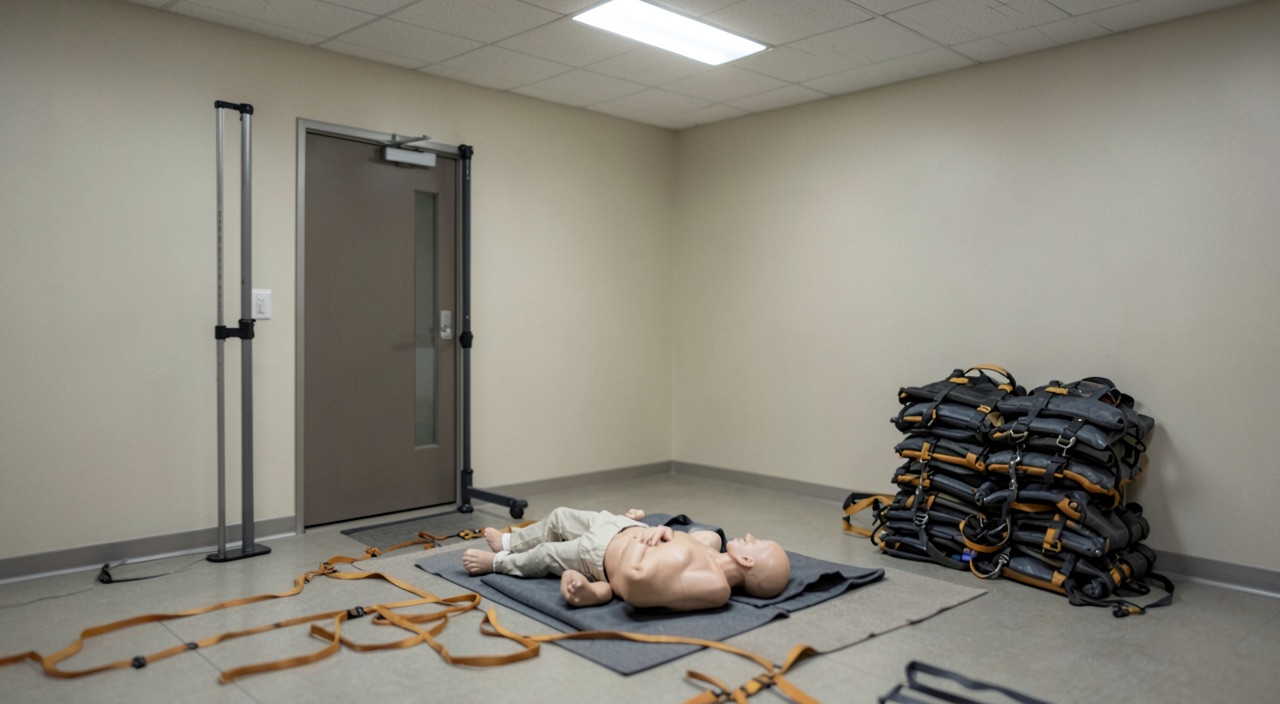
The demonstration is crisp: door in manual mode, outside check, handle, body brace, all in one continuous movement that the trainees watch the way you watch a party trick. A few days later, at the practical assessment, part of the group reversed two actions; another reproduces the sequence exactly as they saw it, without knowing what each action checks. The gesture was shown; it was not acquired. The whole gap between an excellent crew member and an instructor lies in that nuance.
An instructor doesn’t just show how to do something—they teach why each step matters and how to do it correctly every time. The difference between a good crew member and a good instructor is the ability to break down skills into teachable parts.
On an Airbus A320, an instructor demonstrates the manual door opening procedure. One trainee opens the door correctly but explains they’re checking for “the right moment” rather than the specific visual cues (like the door handle alignment). The instructor must then teach the underlying reasoning, not just the movement.
What the operator is buying when it appoints an instructor
An instructor appointment is not a reward for technical level. The operator is buying a precise capability: getting others to reach a described standard, within a fixed timeframe, with an evidentiary trail that will stand up. The best performer in a section produces a gesture; the instructor produces gestures in people they did not choose, on equipment that is not always the one used on the line, and within a time that does not stretch.
The function sits within a compliance chain. The training programme is approved by the competent authority: the instructor is not its author, but its faithful executor. Their signature on the training file attests that an objective written into that programme has been reached by a named person, on a given date. It is this signature that the authority will come and read during an audit, long after the session has been forgotten, and it commits the operator far more than it commits the trainee.
Three distinct competencies hide behind the word instructor, and none can be inferred from the other two:
- technical mastery of the domain being taught, which is an entry prerequisite and not a selection criterion;
- instructional technique: building a progression, breaking down a gesture, calibrating help, phrasing a correction that addresses the cause and not the form;
- assessment ability: observing without judging the person, applying a common scale, writing down what was seen in terms a third party can review.
The most frequent selection error consists in measuring only the first, because it is the only one that operations make visible. A remarkable cabin manager can turn out incapable of breaking down what they do, simply because they have not broken it down for years.
The expert’s trap: showing is not teaching
Expertise is paid for with a loss. A gesture that has become automatic no longer needs speech to unfold, and its holder loses conscious access to the sub-steps that make it up. The experienced instructor does not omit steps out of carelessness: they have ceased to exist as steps for them. So they teach a gesture whose construction they have themselves forgotten, and they teach it at the speed at which they perform it.
This loss produces three recognisable symptoms in the training room. Full-speed demonstration first, illegible to anyone who does not yet have the reference points needed to break down the flow: the trainee retains a pace from it, not a structure. Descriptive commentary next, which states what the hand is doing instead of stating what the eye is looking for and what would trigger a stop. Finally, correction of form, which treats the visible symptom rather than its cause.
One example is enough to measure the gap. Telling a trainee that their hand moves too early describes what is seen; telling them that they are looking at the handle instead of outside, and that their hand therefore moves before the information arrives, names what produces the error. The first correction manufactures a held-back hand and a gaze that is still wrong. The second repositions the hand without it needing to be mentioned again.
The trap. Finishing the gesture in the trainee’s place because the session is running over. The trainee walks away with the memory of a success that was not theirs, and the instructor with the conviction that the objective has been reached. What the session actually produced is a gesture that nobody has ever performed alone: the first autonomous execution will take place on the line, with passengers on board.
Just because a trainee can copy a movement doesn’t mean they understand it. A good instructor teaches the “why” behind each step, not just the “how.” Without understanding, the skill won’t hold up under real-world conditions.
On a Boeing 737, an instructor notices a trainee opening the emergency exit door too quickly. Instead of saying, “Slow down,” they explain, “You must confirm the slide is fully deployed before stepping out—otherwise, you risk falling.” This teaches the reasoning behind the action, not just the motion.
The architecture of a session that installs a gesture
A training objective is not a chapter heading. « Know how to open a door in manual mode » says nothing; an action, conditions and a criterion say everything. As long as the objective is not written in that form, neither the instructor nor the trainee can know when the session is over, and the session then stops on the clock instead of stopping on the skill acquired.
The demonstration happens in two stages, never in one. A first pass at real speed gives the target and the pace; a second, broken down and verbalised, gives the structure, the check points and the stop criteria. Then come the guided attempt and the independent attempt, with a progressive withdrawal of help that must be decided, not just allowed to happen: a trainee who always succeeds with a voice behind them has no benchmark for their own reliability.
The retake follows a simple rule that is often broken: correct on the fragment, but redo the entire sequence. Correcting a fragment and only replaying that fragment leaves a seam, that is, a transition the trainee has never executed correctly from start to finish. That is exactly where the gesture will break the day an interruption invites itself in.
Then there is workload. A session that stacks three novelties installs none of them, and a gesture is only acquired once it holds up under disturbance: darkness, noise, an unusual order, a question asked at the wrong moment. Overlearning is not zeal, it is what separates a gesture that comes out in the training room from a gesture that comes out on board.
The right reflex. One correction at a time, stated as a cause and not as a symptom, followed immediately by a retake of the complete sequence. If two deviations appear in the same attempt, address the one that explains the other and let the second resolve on its own: in most cabin gestures, the gaze and the body brace drive the hand.
Learning a skill isn’t just about doing it right once—it’s about doing it right every time, even when things get chaotic. A good instructor makes sure trainees practice under realistic conditions, not just in perfect scenarios.
On an Embraer 190, an instructor teaches emergency evacuation procedures. Instead of just demonstrating once, they simulate a nighttime evacuation with loud noise, forcing trainees to perform the steps under stress. This ensures the skill is truly learned, not just memorized.
Standardisation: the trainee must not be able to name their instructor
A single sentence reveals a standardisation flaw: « with the other instructor, we don’t do it that way. » It does not mean that one of the two is wrong. It means that the trainee now has two references and will have to choose one, alone, under load, on a day when no one will be available to arbitrate. It is a safety cost, not an organisational inconvenience.
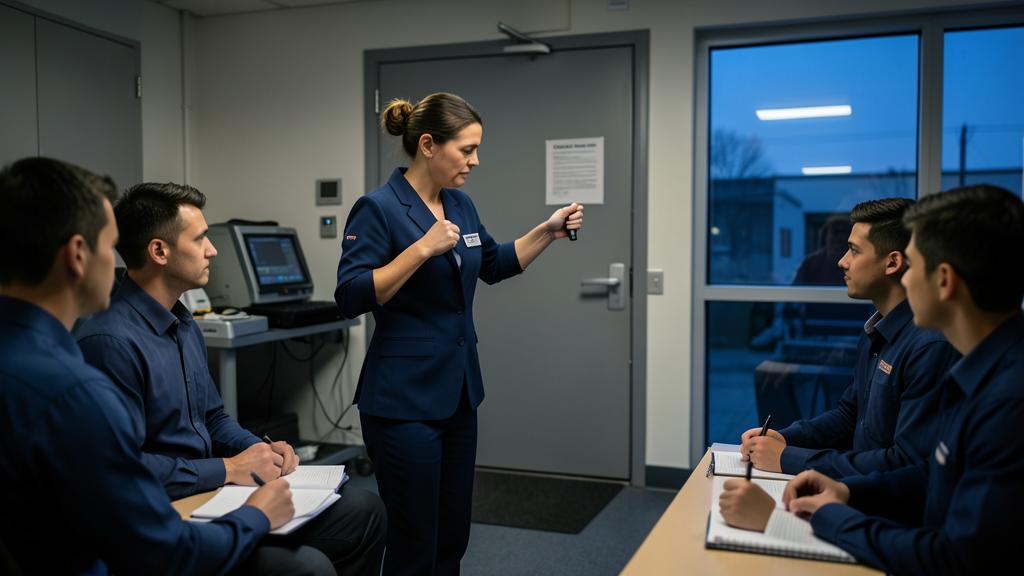
The remedy consists in cleanly separating style from standard. Style is what makes a session come alive: the pace, the imagery, the order of examples, the chosen scenarios, the tone of a debrief. The standard is what must come out identical from every training room: the sequence of actions, the wording of standard callouts, the success criteria, the way a deviation is handled and recorded.
| Element of the session | Room for style | Invariant | What the drift produces |
|---|---|---|---|
| Sequence of the procedure | Instructional breakdown, number of passes, pace | Order of actions and check points as written | Two gestures coexist on the line; the crew can no longer predict each other |
| Callouts and vocabulary | The words used in instructional commentary | The exact wording of standard callouts | A callout not recognised at the other end of the cabin or at the flight deck |
| Mnemonic devices | The images used to aid understanding | They never enter the written reference and never substitute for it | The trainee recites an unfamiliar formula to the examiner during a check |
| Success criteria | The way feedback is delivered to the trainee | The pass threshold and the list of eliminatory points | The same gesture passes with one instructor and fails with another |
| Handling a deviation during the session | The tone and the moment chosen to say it | The deviation is named, redone, then recorded | The deviation corrected verbally disappears from the file and from collective memory |
Drift almost never comes from carelessness; it comes from a useful shortcut. An instructor finds an image that makes something understood at once that the manual explains in several paragraphs. The image spreads, becomes a rule, then a sequence of actions, and ends up being recited in front of someone who does not know it. The mechanisms that hold back this slippage are well known: a single, versioned written reference, shared materials, standardisation meetings, cross-observation between instructors, and above all calibration of assessments on commonly described cases. Having the whole team score the same fictitious trainee remains the simplest way to measure the gap between assessors.
The shape of the risk changes with the size and nature of the operation. At a regional operator where a handful of instructors share the whole programme, the reference survives for a long time through conversation: little is written down, and standardisation holds as long as the team does not change; a departure then takes away a part of the rule that no one can find again. At a mixed-fleet operator, the risk reverses: the reference exists and is written, but it is broken down by aircraft type and by base, and a trainee trained on one variant discovers on the line variants that no one presented to them as such. In the first case, the work consists in writing down what was only spoken; in the second, in explicitly stating what varies and why, instead of letting people believe in a single gesture.
Assessing without confusing the gesture with the person
Two kinds of assessment coexist in the same day and serve opposite purposes. Formative assessment supports learning: it names a deviation in order to correct it, it has no administrative consequence, and it assumes the trainee dares to make mistakes in front of the instructor. Summative assessment pronounces: it validates an objective or not, it leaves a trace, it can suspend progression. Mixing the two dries up the first, because a trainee who knows they are being judged at all times stops exposing their doubts.
The practical rule is to announce the switch explicitly, with the criteria used and the number of attempts offered. This announcement protects the trainee, but above all it protects the instructor: it turns a judgement into a finding, and a finding can be defended.
What gets written matters as much as what gets said. An appraisal of the « good performer » type is worth nothing: it does not allow the training to be revisited, nor the next instructor to be informed, nor a decision to be defended against anyone who challenges it. A usable record names the gesture concerned, the deviation observed in observable terms, the condition in which it appeared, the remediation prescribed and the verification method chosen.
The second trap. The courtesy sign-off granted at the end of a course for a gesture that is almost acquired. It does not remove the failure, it postpones it: it will reappear at a line check, or on the first real flight where the gesture is missing. The instructor who signed then finds themselves with nothing to counter it, and the trainee discovers in operations what they should have corrected in the training room.
Assessments must be clear and objective. A good instructor doesn’t just say “good job” or “needs work”—they explain exactly what was done right or wrong, so the trainee knows how to improve.
On an Airbus A350, an instructor assesses a trainee’s emergency slide deployment. Instead of just saying “good,” they note: “You confirmed the slide was fully deployed before stepping out (correct), but you didn’t check for obstructions first (needs correction).” This gives the trainee clear feedback.
The path to the function, and what sustains it
Access to the function follows a comparable logic from one operator to another, even if the required volumes and titles vary. A base of line experience first, which provides the substance: without recent and varied flights, one teaches a theoretical airline. Training in instructional techniques next, which belongs to a profession in its own right and not to a supplement of technical knowledge. Then a period of instruction under supervision, where someone observes not the gesture being taught, but the way it is taught.
Maintenance rests on three things that busy schedules mistreat: regular instructional activity, periodic refresher training in instructional techniques and assessment, and the maintenance of line activity. This last is the most neglected and the most structuring. An instructor who no longer flies keeps teaching the airline they left: procedures amended since, equipment replaced, layover constraints that have disappeared. They remain credible to their peers and become false to their trainees.
What to open in your own documentation before applying
Before applying, it pays to read the internal texts that actually define the function, rather than the job description circulated at recruitment:
- the part of the operations manual devoted to crew training and checking, which sets the programme, objectives and criteria;
- the conditions for appointing and maintaining a cabin instructor: required experience, initial training, supervision, minimum volume of activity;
- who signs what, and what the signature commits: validating an objective, validating a module, pronouncing a failure;
- the procedure applicable to a trainee in difficulty: catch-up, retake, appeal, and who decides;
- the connection with other roles, particularly when the same person instructs then assesses, or instructs then observes on the line.
There remains a grey area that no one will write for you: the gap between the approved programme’s objective and the means actually available on the day of the session. An unavailable door simulator, an out-of-service dummy, a shortened time slot, an oversized group. The instructor is in a position to see it before anyone else, and the expected response is not to compensate silently. An objective that the means available on the day do not allow to be reached is a compliance deviation, which is reported up through the internal reporting channel like any other.
For anyone preparing for the function, the most rewarding practice is not technical. It consists in taking three gestures performed without thinking, breaking them down in writing into actions, check points and stop criteria, and then having someone else perform them without ever touching them yourself. The exercise is unpleasant, and that is exactly what it measures. The FL330 training courses and the exchanges between practitioners on the FL330 forum make it possible to compare these breakdowns with those of other operators.
This article describes mechanisms; it does not replace any text. The applicable regulation, the approved training programme and the operator’s documentation take precedence over what is written here, including where they diverge from it.
Questions fréquentes
Do you have to be the best performer in your section to become an instructor?
Technical mastery is an entry prerequisite, not a selection criterion. What sets an instructor apart is the ability to break down a gesture they perform automatically, to spot where it will distort for a beginner, and to phrase a correction that addresses the cause. An excellent performer who can no longer describe what they do is a fragile candidate, even if impeccable on the line.
How do you avoid finishing the gesture for the trainee when the session runs over?
By treating the overrun as a programming problem, not a session problem. An objective reached and recorded, plus a second one postponed with its reason written down, is better than two objectives declared reached when one is not. The rule fits in one sentence: you only validate what the trainee has executed alone, at least once, on the complete sequence.
Can the same person train and then assess?
Many operators do this and it is not contradictory in itself; the difficulty is holding both roles without mixing them. The remedy is to explicitly announce the switch from the formative phase to the assessment phase, with the criteria used and the number of attempts offered. Check what your documentation requires: some programmes mandate a separate assessor for eliminatory objectives.
Is a personal mnemonic device a problem?
Not as long as it remains a tool for understanding. It becomes a problem when it substitutes for the written reference, because it then has no documentary existence: the trainee recites it one day in front of someone who does not know it, and the deviation reads as a procedural error. The image helps understanding; the written reference remains what is taught and assessed.
What if the available equipment does not allow the programme's objective to be reached?
An objective that the means available on the day do not allow to be reached is a compliance deviation, not a training-room annoyance. It is reported up through the internal reporting channel, and the objective concerned is not validated. Compensating silently with a demonstration or a degraded exercise amounts to signing a record that corresponds to nothing, and it is the operator who answers for it during an audit.
Must an instructor keep flying on the line?
Yes, and it is the maintenance element most often sacrificed during busy periods. An instructor who no longer flies keeps teaching the airline they left: procedures amended since, equipment replaced, layover constraints that have disappeared. Line activity sustains both the substance of the teaching and credibility in front of trainees who, unlike the instructor, will go back out there the following week.


Leave a Reply
You must be logged in to post a comment.