
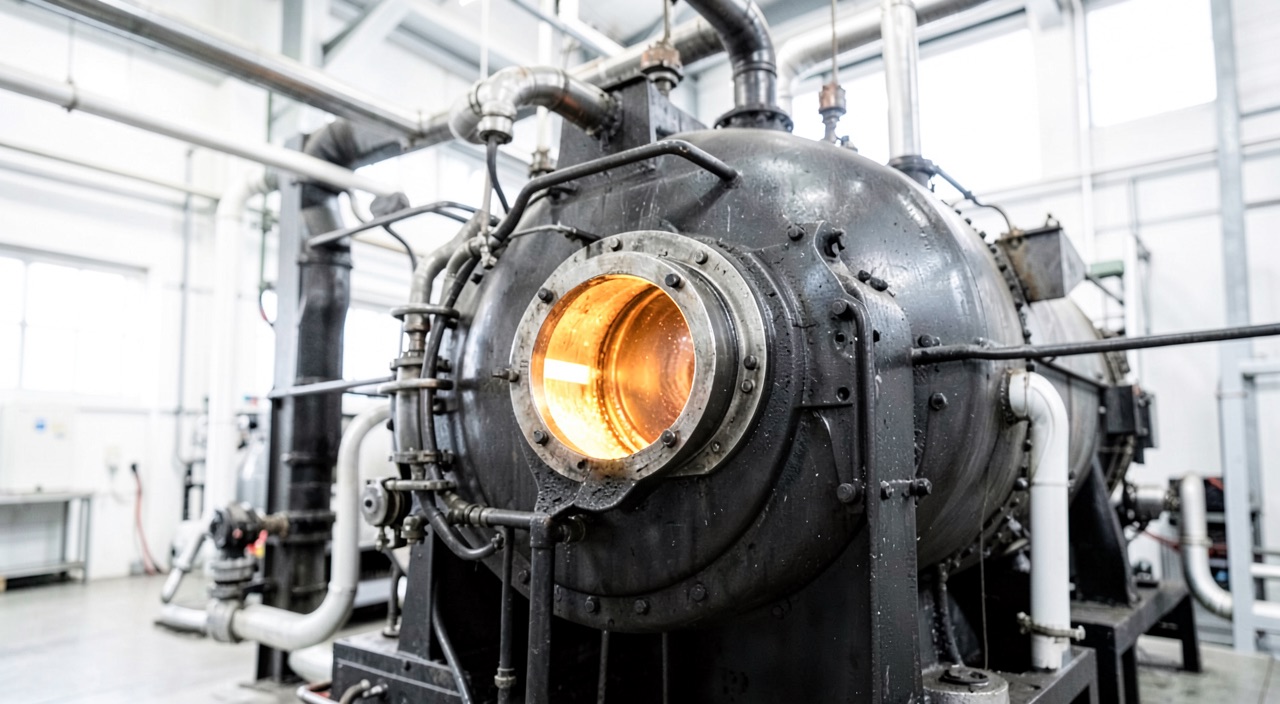
A high-pressure turbine blade quoted several quarters out, a spare disc that stalls an engine removal, a shop that answers “it’s the material”: the answer is true and completely unactionable. Behind the part lies a supply chain that is short in number of steps, long in lead times, and where several links do not respond to demand at all. Here is where the delay is actually built, and which of these links an operator can anticipate.
What the hot section demands of the material
The first-stage turbine blade works in a flow whose temperature exceeds the melting point of the alloy it is made of. It survives only because air bled from the compressor circulates through its internal channels and exits as a film over its skin, and because an insulating ceramic deposited on the surface limits the incoming heat flux. The metal itself lives at a very high fraction of its own melting temperature, in rotation, under a centrifugal load that never stops as long as the shaft turns.
Three mechanisms set the limit, and they are not addressed by the same lever. Creep first: under stress and at high temperature, the metal slowly elongates, and a blade that elongates eventually touches its shroud. Oxidation and hot corrosion next: the skin is consumed, all the faster when the fuel or ambient air brings sulfur and salts. Thermomechanical fatigue finally: every flight cycle imposes a gradient between the cooled skin and the core of the part, and this gradient cracks the thin edges.
The industrial response splits these requirements across four building blocks: alloy chemistry, solidification structure, coating system, internal cooling architecture. Each has its own supply chain, its own suppliers, its own special processes. It is this division that makes the chain impossible to accelerate with a single move: you cannot make up a remelting delay by pushing the coating shop.
The turbine blade must survive extreme heat and stress. It does this through cooling, protective coatings, and special metal properties. But these properties come from a complex supply chain that can’t be rushed.
A GE90-115B first-stage turbine blade operates at 1,450°C (2,642°F) while its alloy melts at 1,350°C (2,462°F). The cooling system must reduce metal temperature to 1,100°C (2,012°F) to prevent creep. A delay in rhenium supply can push lead times from 6 months to 12 months for these blades.
The supply chain starts very far from the engine
Nickel is a base metal, quoted on world markets, produced in large quantities — which does not mean it is available in the usable form. Superalloys require infinitesimal levels of sulfur, lead, bismuth and so-called tramp elements, guaranteed batch after batch by a small number of refiners. The market is vast; aerospace-grade quality is a niche within it.
The elements that truly make the performance are elsewhere, and they share a decisive trait: they are by-products. Rhenium, which pushes back the creep limit of the latest-generation single crystals, is extracted from the roasting fumes of molybdenum recovered from porphyry copper mines; global annual production is on the order of a few tens of tonnes, and it does not depend on aerospace demand but on the price of copper. Hafnium, which improves the adhesion of the protective alumina layer, is a by-product of the zirconium-hafnium separation carried out for the nuclear industry. Cobalt comes from copper and nickel metallurgy, with a geographic concentration of extraction unmatched among metals in everyday use.
The mechanism is there, and it only needs to be learned once: the supply of a by-product does not respond to the price of that by-product. If the engine industry demands more of it, the price rises, but the quantity extracted remains governed by the economics of the primary metal. Engine makers have known this for a long time; they have responded with reduced-rhenium alloys, long-term contracts, and above all closed-loop recycling.
Vacuum melting, and why it is done twice
A superalloy is not cast like structural steel. The first step, VIM, melts the charge under vacuum in an induction crucible. The vacuum is not a refinement: it removes dissolved nitrogen and oxygen, volatilizes impurities with high vapor pressure, and allows a chemistry to be adjusted where the reactive elements — aluminum, titanium, hafnium — and the residual impurities are counted in parts per million. The product is not yet a part: it is an electrode.
This electrode is then remelted, once or twice. Electroslag remelting, ESR, passes each droplet through a slag bath that captures sulfur and inclusions. Vacuum arc remelting, VAR, remelts under high vacuum and above all imposes a slow, directional solidification that limits segregation at the ingot scale. For critical rotating parts, the two are chained together: triple melting is not a luxury, it is the only known way to achieve the inclusion cleanliness a disc requires, where a defect inherited from melting, too small to see with the naked eye, is enough to initiate the crack that leads to an uncontained failure.
| Sequence | What remelting provides | Typical use | What it costs |
|---|---|---|---|
| VIM alone | Controlled chemistry, dissolved gases removed | Foundry charges, non-rotating cast parts | Shortest cycle in the chain |
| VIM + ESR | Desulfurization, cleanliness, good ingot surface condition | Bars and forgings for hot-section structure | One additional slow remelt |
| VIM + VAR | Controlled solidification structure, limited segregation | Shafts, cases, lightly loaded discs | Scarce, highly capital-intensive furnace capacity |
| VIM + ESR + VAR | Cumulative: highest inclusion cleanliness | Rotating, life-limited parts | Longest lead time, head and tail scrap |
One point deserves to be remembered as it stands: remelting speed is not a management parameter. Remelting a large ingot faster shifts the liquid pool and causes channel segregation defects that ultrasonic inspection will find later. A furnace’s throughput is bounded by metallurgy, and a new installation takes years between order and first qualified ingot.
Casting: the grain that is eliminated
For the blade, the next step takes place in precision foundry. A wax pattern is coated with a ceramic shell, dewaxed, fired, then filled under vacuum. The decisive progress of recent decades comes down to a simple idea: grain boundaries are the weak points at high temperature, so they are oriented, then eliminated. Directional solidification aligns columnar grains along the axis of the centrifugal force; the single crystal, obtained by filtering growth through a helical selector or a seed, eliminates every grain boundary.
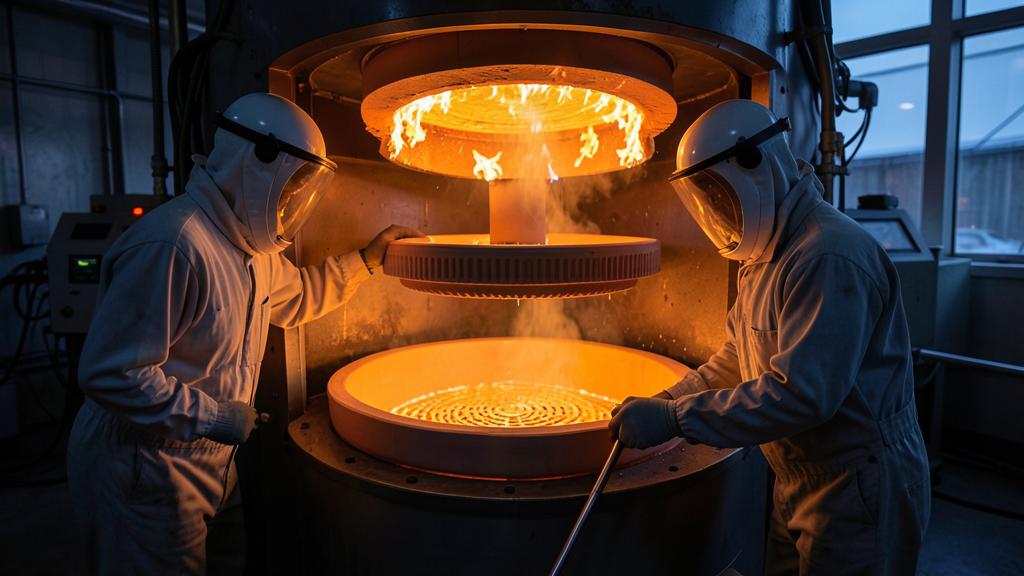
The benefit is not only mechanical. With no grain boundaries left to reinforce, the elements that stabilized them — carbon, boron, zirconium — can be removed from the chemistry, freeing up margin to load the alloy with refractory elements. This is how temperature capability has advanced in steps, each step requiring a new furnace, a new mold and new know-how.
| Structure | Grain boundaries | What is gained | Manufacturing constraint |
|---|---|---|---|
| Equiaxed | Numerous, randomly oriented | Short cycle, high yield, low cost | Lowest creep resistance |
| Columnar (directional solidification) | Aligned with the load axis | Improved creep and thermal fatigue | Slow withdrawal, thermal gradient to hold |
| Single crystal | None | Freed chemistry, maximum temperature capability | Grain selection, scrap for stray grains and recrystallization |
A casting shop’s throughput is then calculated very simply: number of furnaces, multiplied by cycle duration, multiplied by a yield. None of the three terms can be pushed easily. And the shell, like the ceramic cores that shape the internal channels, comes itself from a small number of qualified suppliers, where an industrial incident spreads across the entire chain before a backup source can be qualified.
Revert: the loop that closes the material balance
A hot-section part buys a lot of metal for little flight time. Machining chips, risers and feed channels, parts downgraded at inspection: all of this represents a considerable mass of perfectly characterized superalloy. This material returns to melting under the name of revert, and it forms a structural share of the furnace charge, not a top-up.
It is also a risk. A poorly segregated batch of returns introduces a foreign element into a chemistry counted in parts per million; a chip contaminated by cutting fluid brings in sulfur. Engine makers’ material specifications therefore cap the admissible fraction of returns, impose segregation by grade and lot traceability — this is a supplier audit checkpoint, on the same footing as heat treatment.
The economic mechanism deserves attention, because it explains the tensions observed during rate ramp-up. Today’s available revert is produced by yesterday’s machining. When production accelerates, the need for charge grows immediately, while the flow of returns still corresponds to the earlier level of production. The gap is filled with primary metal, and therefore with the same by-products that are already stretched. The recycling loop, however virtuous, mechanically amplifies the supply chain’s sensitivity to rate variations.
Where rate breaks the chain
To this must be added a property that has nothing to do with metallurgy: the behavior of a production system near its capacity. As long as the furnaces and casting shops operate with slack, a hiccup is absorbed and the quoted lead time holds. Beyond a certain utilization rate, queues lengthen much faster than the load, and a backlog that grows by a few points can translate into months of slippage on a given part.
Two customers, moreover, compete for the same furnace output: the new-engine assembly line and the spares network. The first is planned years in advance and carries heavy weight; the second is random and urgent by nature. An operator who discovers a spares lead time at the occasion of an unscheduled removal thus arrives in an already-formed queue, and their demand has no way of moving up in it, except by a contractual agreement made in advance.
The temptation, then, is to seek an escape through the material, as the cold section managed to do: fan and cases have migrated to composites, low-pressure compressor blades to titanium alloys, and, on recent engines, the first low-pressure turbine stages to titanium aluminides. These substitutions relieved mass, not the hot section. Ceramic matrix composites are arriving, ring segments and nozzles first, with their own fiber supply chain and their own bottlenecks. In test cells as on the wing, the high-pressure turbine rotor blade remains, even today, a vacuum-cast nickel part.
What the supply chain imposes on the field
The first consequence concerns timing: a hot-section part is not a consumable, it is a long-lead-time item, and its procurement must be handled as a program milestone, not as a stockroom order.
The second is documentary. A hot-section part is not defined by its drawing alone: it is defined by a drawing and by a list of approved sources, down to the grade, the melting route and sometimes the furnace. Changing source is a definition change, not a purchasing act. This is what explains why an apparently identical part, available and cheaper, may not be installable.
The trap: a reworked coated blade comes back with a valid authorized release certificate, and it is concluded that the repair process was approved. The certificate attests that the organization is authorized and that the part conforms to the data used — on its own, it says nothing about the nature of the redeposited coating, the remaining layer thickness after stripping, or the number of reworks already undergone. On a diffusion coating, each cycle consumes base metal: the limit lies in the repair data, not on the label.
The right reflex: on receipt of a hot-section part, systematically pull three pieces of information before shelving it — the reference of the repair data used, the count of reworks or exposures already carried out, and continuous traceability since manufacture for any life-limited part. These three items can be requested at the time of ordering, where they cost an email; demanded when opening the box the night before a flight, they cost an aircraft-on-ground.
What to check in your own documentation
Three checks can be made without waiting for the next supply-chain tension. In the support contract, look for what is actually committed: a delivery lead time, access to a pool, priority in case of shortage — or only an indicative lead time that commits no one. In the maintenance program, identify hot-section items whose due date falls within the resupply window and verify that they are indeed treated as long-lead-time items in planning, with their own alert. In the maintenance organization’s procedures, verify that receiving inspection requires manufacturing traceability for life-limited parts, and not only the release certificate.
There remains an acknowledged gray area. Additive repair of hot-section parts is progressing fast, and the approval framework governing it is still under construction: the same deposit may count as approved repair data at one engine maker and as a modification at another. For anyone preparing a type qualification or a continuing-airworthiness-management role, this is the subject to watch: in the coming years it will shift the boundary between what gets replaced and what gets repaired, and therefore part of the pressure this article has described. Those who want to compare organizations’ practices will find material for discussion on the FL330 professional forums.
This text describes an industrial mechanism; it does not replace any maintenance data. In case of discrepancy, the type certificate holder’s specifications, the operator’s approved documentation and the applicable regulatory text prevail over what is written here.
Questions fréquentes
Why is a high-pressure turbine blade ordered several quarters in advance?
Because its manufacture chains together slow, incompressible processes: vacuum melting, one or two remeltings, directional-solidification casting whose withdrawal speed is set by metallurgy, then machining, inspection and coating. Each step is a special process performed by a qualified shop, and none can be made up by pushing the next. The quoted lead time mainly reflects the queue in front of the remelting and casting furnaces.
Is rhenium really a weak point in the supply chain?
Yes, but not because of its cost: because of the nature of its supply. There is no rhenium mine; it is a by-product of molybdenum extracted from copper deposits, which makes its production insensitive to aerospace demand. Engine makers have responded by developing reduced-content grades and by organizing the return of removed parts to dedicated recovery channels.
Can a hot-section part from another supplier be installed?
Not on the basis of apparent conformity to the drawing alone. A hot-section part is defined by its geometry but also by its grade, its melting route, its solidification structure and its coating system, all recorded in approved data. Any part must be covered by a valid design approval accepted under the maintenance organization’s procedures; failing that, availability and price change nothing.
What is revert, and why do specifications limit it?
Revert refers to manufacturing returns reintroduced into the melting charge: machining chips, risers, downgraded parts. It is already-characterized material, and therefore valuable, but also a contamination vector if segregation by grade or chip cleanliness is not controlled. Material specifications therefore cap its fraction and require lot traceability, making it a classic supplier audit checkpoint.
Can composites free the hot section from its dependence on nickel?
Not yet for high-pressure turbine rotor blades. Ceramic matrix composites are progressively entering static parts of the hot gas path, ring segments and nozzles first, where they reduce the cooling air bled off. They shift the dependency to another supply chain, that of ceramic fibers and their densification, itself highly concentrated.
What must certifying staff check on receipt of a coated blade?
Three things beyond the release certificate: the reference of the repair data actually used, the number of reworks or exposures already undergone where that count is limited, and continuous traceability since manufacture if the part is life-limited. This information should be requested at the time of ordering, not when opening the box, on pain of grounding the aircraft while it is obtained.


Leave a Reply
You must be logged in to post a comment.