

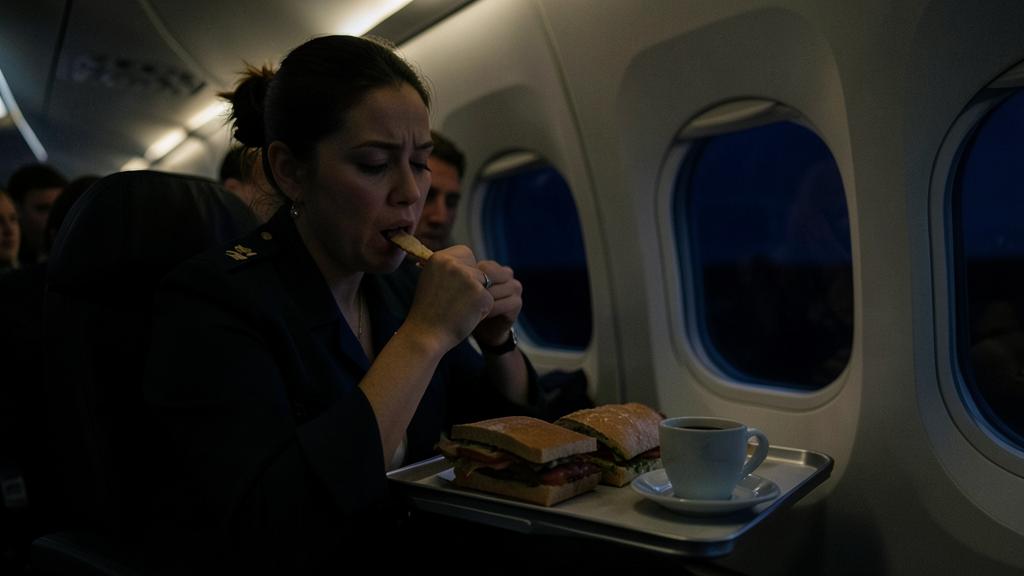
On a night rotation, the crew meal is eaten whenever the service allows it: after the second pass, once the cabin has settled, often in the middle of what remains night-time for everyone on board. No one really chooses that moment, it simply falls. And it is that moment, far more than the composition of the tray, that decides what the body will do with the meal: the sugar tolerance available to it at that instant, how long digestion will take, and above all which direction the whole will push the internal clocks. Food is not just an intake, it is a time signal — and one of the few a crew member controls without depending on the schedule or on light.
Two clocks, two synchronisers
The expression “biological clock” fosters a confusion worth dispelling. There is not one clock, there is a network of them. The central clock, in the hypothalamus, is reset almost exclusively by light received through the retina. But the liver, pancreas, intestine, adipose tissue and muscle each carry their own oscillators, with the same clock genes, and these listen mainly to something else: the time at which food arrives.
The consequence is counterintuitive. Shift meals by several hours without touching light exposure, and the organ clocks shift within a few days, while the central clock stays where it was. The body does not shift as a block: it comes apart. It is this internal desynchronisation, more than the time-zone shift itself, that produces the characteristic feeling of the day after arrival — appetite absent at the right moment, sudden hunger at the wrong one, disorganised transit, jagged alertness even though the hotel night was decent.
For the practitioner, this means two levers, not one. Light is the more powerful, but it is poorly controllable: on board it depends on the cabin lighting scenario and the window shades, on the ground on arrival time and weather. Meal timing is weaker, but it is available and decidable. The problem appears when the two pull in opposite directions — a breakfast at home time eaten in a room with the curtains drawn at three in the afternoon local time helps no one.
Your body has two types of clocks: one in your brain that reacts to light, and others in your organs that react to food. If you eat at the wrong time, your organs get out of sync with your brain, making you feel off even if you slept well.
A pilot flying from Paris to Tokyo at night eats a meal at 3 AM local time (which is 8 PM Paris time). Their brain clock still thinks it’s evening, but their liver and stomach think it’s breakfast. The next day, they feel sluggish and hungry at odd times because their body is out of sync.
The same tray does not have the same effect at two different times
Glucose tolerance is not a physiological constant, it is a function of internal time. Insulin sensitivity and the response of beta cells follow a rhythm: they are at their best in the biological morning and at their worst in the depths of the biological night. A rigorously identical meal, eaten at these two moments, produces a markedly higher and longer glycaemic excursion in the second case. No line of the menu changed; only the time moved.
The rest follows the same logic. Gastric emptying slows during the biological night. Lower oesophageal sphincter tone and oesophageal clearance decrease, and the reclined position that often follows the crew meal during rest mechanically worsens reflux. Post-prandial thermogenesis, finally, raises core temperature at the exact moment it should be reaching its minimum: a heavy meal placed there is not just poorly digested, it pushes the clock in a rarely desired direction.
| Parameter | Meal eaten during the biological day | Meal eaten in the depths of the biological night |
|---|---|---|
| Glycaemic excursion | Moderate, quick return to baseline | Higher and longer for the same intake |
| Gastric emptying | Normal | Slowed, prolonged feeling of heaviness |
| Reflux when reclined | Limited if the interval before lying down is respected | Favoured: sphincter tone and clearance lowered |
| Effect on alertness within the hour | Classic, brief post-prandial dip | Dip that adds to the already-present circadian trough |
| Signal sent to the organ clocks | Consistent with the light received | Contradictory: sustains the desynchronisation |
One last mechanism closes the loop, and it explains why the question of content is secondary: after a short night, ghrelin rises and leptin falls. Appetite shifts on its own toward the dense, the sweet and the salty. In other words, the content of the plate is largely a consequence of sleep and meal timing, not an independent variable. Correcting the timing corrects part of the content; the reverse is far less true.
What the cabin adds: pressure, dryness, posture
At the cabin altitude tolerated in cruise — on the order of two thousand four hundred metres at most on transport aircraft, often less on recent airframes — a volume of gas trapped in the digestive tract increases by a quarter to a third. The important point is that this is the gas already present. The climb creates nothing: it expands what was already swallowed or produced on the ground and during cruise.
This shifts the question from the menu to the manner of eating. A carbonated drink, air swallowed during a meal eaten standing in five minutes, a portion of fermentable carbohydrates served before a climb: these three elements matter more than the calorie value of the tray. Added to this is the dryness of the air, well below ground-level comfort levels, which weakens the sensation of thirst and makes incipient dehydration pass for hunger.
Posture and fragmentation do the rest. A meal eaten in three sittings, interrupted by calls, gulped down standing against a worktop, does not trigger satiety signals within the same time frame as a seated meal lasting some twenty minutes. The result is known to everyone on board: you eat more and digest less well, for a content strictly identical to what would go down without difficulty at home.
Anchor or shift: the decision is made before the flight
The useful strategy does not depend on the menu but on two variables: the length of the layover and the size of the time-zone shift. Below a short layover — typically rest reduced to a single night on site — there is no benefit in shifting clocks that will have to be reset the day after next. Home time is kept, owned as such, and two meals are accepted to fall in the middle of the local night. Beyond two or three days on site, the trade-off reverses: shifting to local time becomes worthwhile, and this is where meal timing takes on its full value.
The anchor meal is the technical crux of this shift. After a fasting period of several hours, a meal containing protein, eaten in daylight and at local breakfast time, ranks among the clearest time signals that can be sent to the organ clocks. It is not interchangeable with a later meal: the value of the signal lies in the contrast with the preceding fast and the coincidence with morning light. A snack taken at three in the morning local time, before this meal, cancels most of it out.
| Comparison point | Anchored to home time | Shifted to local time |
|---|---|---|
| Situation targeted | Short layover, quick return toward the origin time zone | Layover of several days, or consecutive local turns |
| Meal timing | Home time, even if it means eating in the middle of the local night | Destination time, from the first local waking onward |
| Anchor meal | Not applicable: nothing needs resetting | First local breakfast, after a fasting period |
| Associated light exposure | Room kept dark during the home-time night | Outdoor light sought around the anchor meal |
| Main risk | Poorly tolerated night meals, reflux, fragmented sleep | A shift started then abandoned: the worst of both regimes |
| Cost on return | None or low: the clock has not moved | Real: the path will have to be retraced in reverse |
The trap: starting a shift and then interrupting it. A dinner at local time, waking at home time, a skipped breakfast followed by a night-time snack: the sequence sets nothing at all, it blurs both reference frames and produces an internal desynchronisation more marked than if no decision had been made. A mediocre meal strategy applied through to the end is worth more than a good strategy applied halfway.
Relative fasting is a tool, not a diet
The fasting period preceding the anchor meal has a precise function: to make that meal legible to the organ clocks. It has nothing to do with calorie restriction and is not judged by what it makes you lose. It is judged by a single criterion: is it placed on a rest period, or does it encroach on a duty period?
The distinction is not cosmetic. A crew member who applies a fasting window during a cabin duty period puts themselves in a situation where the drop in blood sugar adds to the circadian trough and the workload, and the usual compensation — extra coffee — degrades sleep during the following layover. The practical rule fits in one sentence: the fast belongs on rest, never on duty, and it only makes sense if it leads to an anchor meal identified in advance.
The right reflex: decide the time of the anchor meal at the same time as you decide the layover bedtime, that is, during flight preparation, not on arrival. Note it as a milestone on the same footing as hotel checkout: this is what stops the shift from being abandoned at the first sign of fatigue.
Two reservations, finally, that are not a matter of personal preference. A treatment with fixed dosing times, treated diabetes, a pregnancy or a history of digestive disorders make the trade-off a medical, not an individual, matter: the question is for the physician overseeing fitness to fly, and the answer may be that no voluntary shift of meal times is indicated. And a fast that degrades alertness on duty is not a lifestyle choice, it is a contributing factor to be reported as such.
Caffeine and alcohol: two signals on the same tray
Caffeine is usually filed under alertness. It also belongs in this file, for two reasons. Its half-life is typically on the order of five hours, with substantial individual variation: a coffee served with the night tray is still active at layover bedtime. Above all, it does not simply mask sleep pressure, it acts directly on the clock and tends to delay it — which runs exactly counter to an eastward shift.
Alcohol works the other way, and no less poorly. It shortens sleep onset latency, which earns it its reputation, then fragments the second half of the night and cuts into REM sleep, precisely when recovery takes place. Placed in the same meal as still-active caffeine, it produces a layover night that feels long and restores nothing. Regulatory limits ahead of duty only address the safety side of the question: they say nothing about the cost to adaptation, which is paid the next day.
What your documentation says, and what it does not say
Three checks are worth making in one’s own documents, because the answers vary considerably from one operator to another. First, what the operations manual provides as an opportunity to eat during duty: flight and duty time regulation requires such an opportunity to be arranged, without prescribing either its time or its duration, and it is the operator’s documentation that fills the gap. Next, what the catering contract actually allows: an anchor meal at seven local time only makes sense if the hotel serves it, or if onboard logistics allow taking away enough to make it up. Lastly, what the fatigue risk management scheme describes — and one finds almost every time that light already features there, while meal timing does not.
This is the grey zone of the topic, and it is better to name it than to sidestep it. No fatigue report asks for the time of the last meal; no duty scale takes it into account; no data is collected on what the crew ate and when. An operator who documented this parameter on the same footing as sleep would probably uncover an explanatory variable it currently lacks, but nothing obliges it to, and the burden of the decision therefore remains individual.
For anyone preparing a type rating or a new role on a long-haul aircraft, the practical consequence comes down to a distinction not to be confused in the exam room any more than on the line: the opportunity to eat is a regulatory requirement enforceable against the operator, whereas timing meals as part of an adaptation strategy is a lifestyle practice, neither prescribed nor monitored. Confusing the two means missing the question; separating them also shows which one it is legitimate to press during a crew briefing.
The applicable texts, the operator’s operations manual and approved procedures, together with the opinion of the physician overseeing fitness to fly, prevail in all circumstances over the mechanisms described here, whose sole purpose is to explain why the time of a meal weighs more heavily than its content.
Questions fréquentes
Is it better to skip the night meal or eat it anyway?
Skipping a meal is only useful when it is part of a strategy: a fasting period that sets up an anchor meal at local waking. Taken in isolation, skipping a meal in the dead of night exposes you to compensatory cravings later in the flight, usually oriented toward sweet foods. If the duty period continues, a light intake, low in fat and without a carbonated drink, remains preferable to abstaining and then catching up.
How long a layover justifies switching to local time?
The trade-off rests on two criteria: how long you stay on site and the size of the time-zone shift. A one-night layover never justifies switching, whatever the shift, because the clock will have to be reset immediately afterward. From about two to three days on site with a substantial shift, switching becomes worthwhile, and it is then the first local breakfast that carries most of the signal.
Does the content of the tray really not matter at all?
It does matter, but at a secondary level, and it concerns digestive mechanics rather than adaptation. Fats slow gastric emptying, carbonated drinks and swallowed air add to a volume that will expand by a quarter to a third in cruise, and fermentable carbohydrates produce gas on the spot. These choices improve flight comfort; they do not shift the internal clocks, which is what timing does.
Should the anchor meal contain protein specifically?
A meal containing protein and some carbohydrate is generally considered a clearer signal than a sugary drink alone, because it more broadly engages the metabolic pathways involved in training the organ clocks. The dominant factor, however, remains the contrast with the preceding fasting period and the coincidence with local morning light. Excellent content at the wrong time is worth nothing.
How should meals be managed when the time shift forces fasting during a duty period?
You don’t manage it: you give up the fasting window. A drop in blood sugar added to the circadian trough and the workload degrades alertness, and compensating with caffeine mortgages sleep during the following layover. The fasting window belongs in a rest period; if the schedule does not allow it, the meal-anchoring strategy is postponed to the following day.
Should diet be mentioned in a fatigue report?
Forms generally do not ask for it, but nothing prevents noting it in the free-text section, and it is useful. A sequence where meals fell systematically in the depths of the biological night is a factual element that the department analysing reports can use. Otherwise, this parameter remains absent from the operator’s data and can therefore never explain a series of events.


Leave a Reply
You must be logged in to post a comment.