
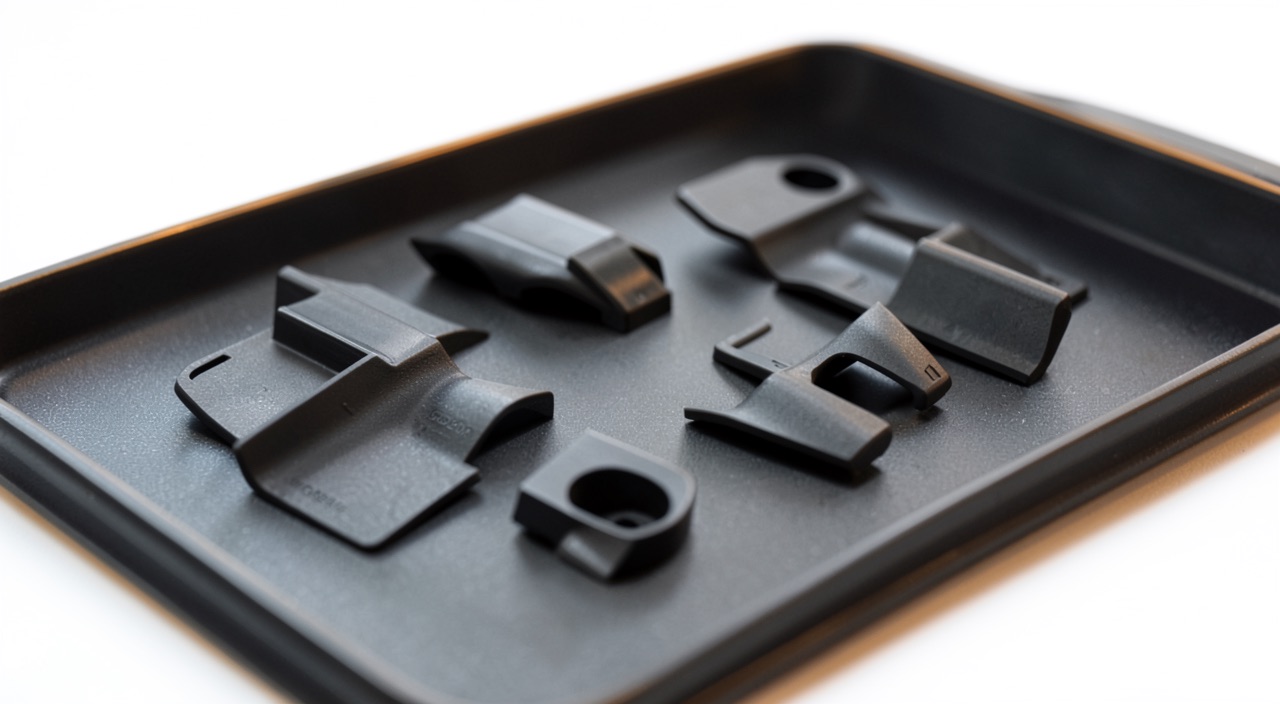
A missing access panel from the supplier, an individual duct support to be replaced on an aging fleet: 3D printing delivers in days where the traditional supply chain takes months. The mechanical file for these parts closes quickly—tens of newtons, no dimensioning fatigue. What truly closes the material gap is fire testing: flammability, smoke, and heat release. Material selection is decided before structural calculations even begin.
The scenario that sizes everything: a fire in an enclosed volume
The requirements for inhabited volumes do not seek non-combustible materials—none exist at this level of mass and cost—but materials that buy time. The sizing scenario is a declared fire in an occupied, enclosed volume, on the ground or in flight: what the rule buys is an evacuation window. Each test corresponds to a specific mechanism for reducing this window.
Self-extinguishing first: a part licked by a flame must neither sustain combustion once the source is removed nor propagate the flame front beyond a bounded length, nor project flaming droplets that spread the fire. Smoke next: visibility conditions the evacuation speed, and opaque smoke ruins it in tens of seconds. Finally, the heat released, the least intuitive but most structuring: in an enclosed volume, the radiant heat from the first burning surfaces preheats all others; past a critical flux, the entire volume ignites almost simultaneously. This generalized ignition marks the end of any evacuation. Limiting the heat release rate of walls delays this tipping point.
In a fire, the goal is to give people time to escape. Materials must stop burning quickly, produce little smoke, and not release too much heat. If the heat gets too high, everything catches fire at once, and there’s no time left to escape.
On an Airbus A320, a cabin panel made of a standard thermoplastic like ABS would fail the vertical burner test because it melts and drips flaming droplets. A panel made of PEI (polyetherimide) would pass because it chars instead of melting, slowing down the fire and giving passengers more time to evacuate.
This hierarchy explains the test architecture: everything exposed goes to the burner; only large surfaces, capable of tipping the volume, add heat release and smoke. The printed part falls into the same grid as the injected part it replaces.
Three metrics, a ranking piece by piece
The vertical burner is the baseline test. The specimen, held vertically, receives a calibrated flame for a duration depending on the part category—long exposure for interior wall surfaces and linings, shorter for other categories. The self-extinguishing time after flame removal, the destroyed length, and flaming droplets (with their own extinction time) are recorded. A thermoplastic that melts and drips flaming fails, even if the specimen body extinguishes.
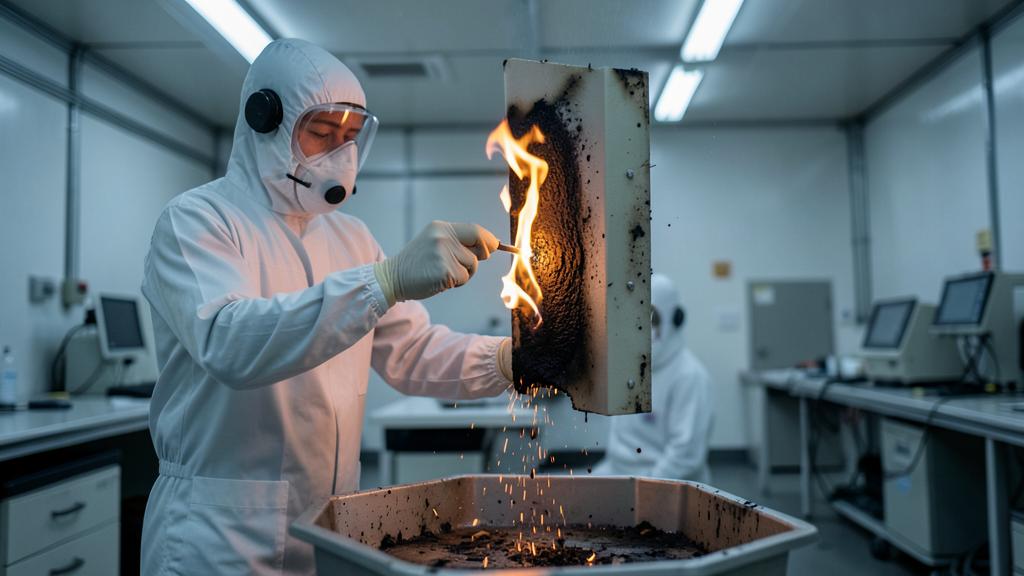
Smoke density is measured in a closed chamber: the sample is subjected to a radiant flux, with or without a pilot flame, and a light beam passes through the chamber. For large surfaces concerned, the specific optical density recorded at four minutes must not exceed a ceiling of around 200. Heat release, meanwhile, is measured in a calorimeter—we return to this, as it’s the test that decides what the additive can target.
| Essai | Measured quantity | Parts concerned | What it rules out |
|---|---|---|---|
| Vertical burner, long exposure | Self-extinguishing, burn length, flaming drips | Exposed interior surfaces: walls, linings, covers | Commodity polymers, untreated polyamides and ABS |
| Vertical burner, short exposure | Same quantities, lower severity | Less exposed parts, depending on classification | Unstable filled grades, thin walls that drip |
| Heat release (radiant heat calorimeter) | Peak heat release rate and total over two minutes | Large wall panels, cabins above about twenty seats | Almost all solid thermoplastics over large areas |
| Smoke density (closed chamber) | Specific optical density at four minutes | Same large surfaces | Heavily smoke-producing halogenated flame-retardant grades |
| Gas toxicity (manufacturer specifications) | Combustion gas concentrations by species | Equipment and furnishings, according to the specification | Resins whose flame retardancy degrades the gases emitted |
Toxicity of gases, however, is not covered by certification text in most cases: it’s the cabin material specifications of the airframers that contractually enforce it, with ceilings per chemical species. A part supplied to a cabin integrator must comply, even if the authority does not require it.
Remains the exemption for small parts: regulations allow that a very small part, whose contribution to fire propagation would be negligible, may be exempt from testing. The formula seems comfortable; it’s a gray area without a universal dimensional definition, assessed piece by piece—and says nothing about the cumulative effect of dozens of small parts in the same environment.
The materials funnel: the catalog narrows before the first calculation
Apply this grid to the catalog of printable polymers, and the funnel closes quickly. Commodity materials—ABS, PLA, PETG—burn openly and drip: eliminated at the burner stage. Standard polyamides melt and drip flaming. Commercial « flame-retardant » grades sometimes hold the flame, but their halogenated additives load the smoke and degrade the emitted gases: what flammability allows, smoke and toxicity catch up.
Remain the aromatic-skeleton polymers, which char instead of melting: PEI, polyphenylsulfone (PPSU), the family of polyaryletherketones (PAEK), and a few flame-retardant polyamides formulated for powder bed. The mechanism is the core of the matter: under thermal flux, these polymers form a carbonaceous char layer that insulates the healthy material, cuts off the pyrolytic gas supply, and smothers combustion. Self-extinguishing is not an additive, it’s the chemistry of the backbone. Hence a short, stable list of cabin resins—almost exactly overlapping with expensive, hygroscopic, high-temperature-process polymers.
Mechanics has yet to speak. It expresses itself afterward, in what remains—mechanically honorable, by the way: correct rigidity, comfortable temperature resistance for an inhabited volume. The real sacrifice is economic: expensive material, heated enclosures, mandatory drying, careful post-processing.
The trap: the « V-0 » datasheet. A filament classified as self-extinguishing under an electrotechnical standard has demonstrated nothing in the aeronautical sense: neither exposure duration, nor specimen geometry, nor droplet criteria match. A classification, moreover, is valid for a given thickness: the same resin passes in thick sections and fails in thin walls. The « flame retardant » label on a spool is not a compliance starting point, it’s a marketing argument.
The machine is part of the material
In injection or machining, the material preexists the process: the material certificate follows the batch of pellets or the plate. In additive manufacturing, the process manufactures the material at the same time as the part, and the fire behavior inherits from it. Porosity between layers creates capillary channels and increases the surface area offered to pyrolysis; surface grooves guide a flame front like ignition channels; the build orientation determines the direction in which these grooves work.
Qualification campaigns draw the consequence: test printed specimens in unfavorable orientations, on the production machine, with the frozen set of parameters, within the thickness range of real parts. The compliance that emerges does not belong to the resin: it belongs to the triplet of material, machine, and parameters—and to the covered thickness range. Changing the nozzle, layer height, infill rate, or annealing cycle means exiting the demonstrated domain. For powder bed, the recycled powder rate is added, which shifts the material chemistry from batch to batch.
Drying deserves special mention: these resins are hygroscopic, and the water carried in the filament or powder translates into additional porosity, hence degraded fire behavior. Fire compliance starts at the drying cabinet.
The right reflex: freeze the triplet before designing. Start with the list of already-qualified material-machine pairs, with their covered orientations and thicknesses, and design within. Demand follow-up specimens printed in the same batch as serial parts: it’s the only proof that the delivered part belongs to the tested domain.
Heat release, the make-or-break for large surfaces
The heat release test exposes a vertical panel to a calibrated radiant flux in an air-circulation calorimeter, tracking the heat release rate over time. Two limits fall together for large cabin surfaces beyond a few dozen seats: the instantaneous peak heat release rate, and the total heat released in the first two minutes—the so-called « double 65 » rule, with a common ceiling for both metrics.
This is the test that currently sets the boundary for 3D printing in cabins. A solid thermoplastic, even if charring, offers the fire a full fuel reserve; the panels lining the inhabited volume remain composite-skin sandwiches with phenolic resin, whose massive charring crushes the heat release rate. The printed part thus lives today below panel size: fittings, covers, grilles, shutters, ducts, finish trims—parts with modest exposed surfaces that fall under the burner, not the calorimeter.
This boundary is not a fate—filled resins and printed cellular structures are working on it—but it is the demonstrated state of the art: aiming for a large additive surface means facing the most selective test in the inhabited volume.
What the design office verifies before drawing
The order of criteria reverses compared to the mechanical engineer’s reflex: you don’t choose a material for its modulus before checking fire, you start with the regulatory category of the part—size, location, exposure—and mechanics expresses itself in what remains. Four verifications precede the first sketch.
- The part category: exposed or hidden behind a lining, small or not, contributory or negligible surface—it sets the test regime, and it is justified in writing, not by intuition.
- The qualified domain of the material-machine pair: orientations, thicknesses, colors. A pigment changes the fire behavior; an untested color is an untested material.
- The finish: compliance is assessed on the finished part. A non-qualified paint, decorative film, or adhesive can disqualify a compliant substrate—the stack is tested as installed.
- Traceability: material batch, recycled powder rate, follow-up specimens from the production run, drying records. It’s this file, not the resin datasheet, that the auditor will read.
This framework explains where additive has broken through first: in-flight test installations and temporary fittings, outside commercial cabins, where the short cycle of printing is worth gold.
The most active gray area remains the assessment of small and hidden parts, where practices vary from file to file; this is where additive proliferates, and where a poorly justified classification is paid for years later, at the first audit or the first cabin modification. The profitable investment is not an additional resin: it’s the written justification, piece by piece, of the retained test category.
Rules evolve, and airframer specifications even more so: the applicable certification text and the approved documentation of the operator or certificate holder prevail over this article for any design or compliance decision.


Leave a Reply
You must be logged in to post a comment.