
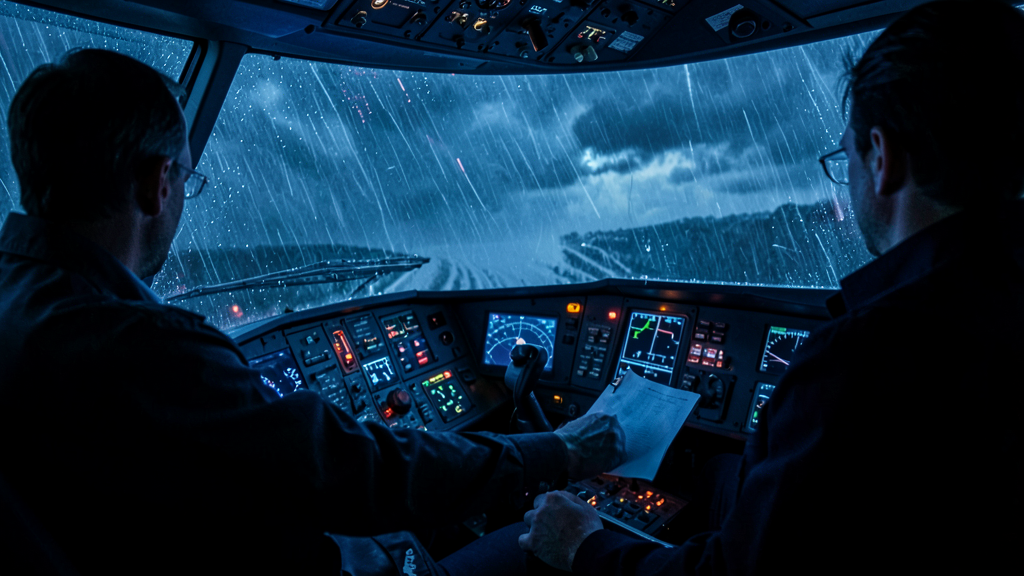
A type rating course looks like a sequence of subjects: some weeks of systems, some weeks in the box, some months on the line. It is not a syllabus in the school sense, and the order is not pedagogical convention. Each phase exists because the phase after it cannot be assessed until the one before has been closed, and the whole structure is split across two different legal owners — one that certifies you on the aircraft, and one that certifies you in the airline. Understanding which is which explains most of what a pilot finds strange about the first three months on a new type.
Two qualifications wearing one name
What crews call the type course is in fact two courses, run back to back, under different rules and closed by different events. The first is the type rating itself: a licensing privilege, delivered by an approved training organisation against a course approved by the competent authority, and concluded by a skill test in front of a type rating examiner. Passing it puts an entry on the licence. It says the holder can operate the type competently. It says nothing about the operator.
The second is the operator conversion course, which sits in the air operations rules rather than the licensing ones. It is the operator’s own programme, approved as part of its operations manual, covering that operator’s standard operating procedures, its route structure, its aircraft configuration, its dispatch and technical log practices, its performance policy. It ends not with a skill test but with a line check, and only then may the pilot fly the line unsupervised.
The separation is deliberate and it survives every reorganisation of the rules, because the two things being proved are genuinely different. A rating travels with the pilot; a conversion course does not. Move to another airline on the same type and the rating stays valid, while the conversion course is done again from the start — shorter, because the aircraft is known, but not skipped, because the operator is not.
| Type rating | Operator conversion | |
|---|---|---|
| Legal home | Aircrew licensing rules (Part-FCL in Europe) | Air operations rules (Part-ORO), through the operations manual |
| Who runs it | An approved training organisation, against an approved course | The operator, under its own approved programme |
| What it proves | Competence on the aircraft type | Competence in this operator’s system |
| Closing event | Skill test with a type rating examiner | Line check, after line flying under supervision |
| Result | Entry on the licence, revalidated by proficiency check at the interval the licensing rules fix (one year for aeroplane type ratings under Part-FCL) | Release to unsupervised line operations, subject to recency and route competence |
| Portable between employers | Yes | No |
The type rating proves you can fly the aircraft, while the operator conversion proves you can fly it for that airline. They’re two separate qualifications, even though they’re often done back-to-back.
Where the content actually comes from
Neither the training organisation nor the operator invents the syllabus. Since operational suitability data became part of European type certification, the aircraft manufacturer has to produce, and the agency has to approve, a flight crew data element alongside the type certificate: the minimum content of the type rating course, the areas of training that must be covered, the training areas of special emphasis derived from the design, and the credits available between related variants. Training organisations build their approved course on top of that floor; operators build their conversion course on top of the training organisation’s output.
This is why two type courses on the same aircraft in two countries look so similar in their first weeks and diverge sharply later. The early content is anchored to the manufacturer’s data. The later content is anchored to an operator whose network, fleet mix and history are its own. It is also why a course cannot simply be shortened for an experienced crew: the floor is set by design characteristics, not by the candidate.
Above all of it sits the ICAO licensing framework, which fixes the principle that a pilot must hold the appropriate rating for the aircraft flown, and a type rating where the aircraft calls for one, with training delivered against an approved programme, and the ICAO training procedures, which define the competency-based approach the newer courses are written in.
For an Airbus A320, the manufacturer’s data specifies mandatory training on fly-by-wire systems and side-stick handling. The airline’s conversion course then adds its own procedures, like how to handle a rejected takeoff at a specific airport.
Four gates, and who holds each one
Read as a sequence of gates rather than as a timetable, the course stops looking arbitrary. Every phase ends with something a named person has to sign, and each signature is the precondition for the next phase to mean anything.
| Phase | Must demonstrate | Closes with |
|---|---|---|
| Technical ground training | A model of the aircraft good enough to predict its behaviour under an unfamiliar fault | Knowledge assessment against the approved course |
| Procedures and simulator training | Standard operating procedures as a crew, handling to tolerance, management of abnormal situations | Instructor progress checks, then readiness for test |
| Skill test | Competence on the type, independently assessed | Examiner report and the rating entered on the licence |
| Operator conversion and supervised line flying | The whole operation: this airline’s procedures, network, dispatch and commercial reality | Line check on a normal revenue sector |
The ground phase exists to make the simulator assessable
Technical ground training is not there to produce engineers. It is there so that the next phase can be about behaviour rather than about knowledge. Time in a full flight simulator is the most expensive resource in the whole course; a session spent explaining why the hydraulic system reconfigures the way it does is a session not spent watching how a crew manages the reconfiguration. The ground phase clears that ground so the device can be used for what only it can do.
That determines what the phase must deliver, and it is not recall. It is a mental model good enough to predict the aircraft’s behaviour under a fault the candidate has never seen. A pilot who can recite the electrical distribution but cannot say what will still work after a given failure has passed the wrong test. Modern courses lean heavily on self-paced computer-based training, which is efficient and genuinely well suited to architecture and normal operation; the recurring criticism from instructors is that it certifies exposure rather than usable understanding, and that the gap shows in the first procedural sessions.
The trap. Treating ground school as an exam to be survived rather than as preparation for the device. The knowledge check at the end is a low gate by design — it verifies coverage. The real assessment of ground knowledge happens two weeks later, in a fixed-base session, when a fault appears and the crew has ten seconds to know what is still available. Candidates who study for the quiz rather than for that moment lose simulator sessions they will not get back.
Devices are chosen for what they train, not for their level
The simulator phase is not a single environment. It normally runs up a ladder of devices, and the ladder is about isolation: each step removes a distraction so one skill can be trained at a time, then adds it back.
| Device | Trains | Deliberately excludes |
|---|---|---|
| Flat panel or virtual procedures trainer | Location, flows, cockpit preparation, systems handling at own pace | Time pressure, motion, crew interaction, consequence of error |
| Fixed-base flight training device | Standard operating procedures, checklist discipline, abnormal and emergency drills as a crew | Motion, and therefore most of the handling assessment |
| Full flight simulator, procedural phase | Handling, take-off and landing, engine failure, manoeuvres flown to tolerance | Realistic workload and commercial context |
| Full flight simulator, scenario phase | Line-oriented flight scenarios: decision-making, threat and error management, whole-flight management | Nothing — this is the closest available proxy to the line |
| The aircraft, base training | Circuits and landings where zero flight time training is not used | Passengers, revenue operation, most abnormal work |
Which specific device may be credited for which exercise is not a matter of local judgement. It follows from the device’s qualification level and from the manufacturer’s data as accepted by the authority, and it is written into the approved course. That is worth knowing before an argument with a scheduler about whether an exercise can be moved to a cheaper device.
From manoeuvres to scenarios, and why the order is fixed
The simulator phase moves in one direction: from exercises where the outcome is defined and the tolerance is numerical, to scenarios where the outcome depends on judgement and the assessment is about how the crew worked. The reason for the order is that scenario-based training is unassessable if the underlying procedure is still being learned. Put a crew into a line-oriented scenario before the flows are automatic and the debrief will be about the wrong things — the instructor will spend the session teaching the procedure, and the decision-making content is lost.
Two elements have been pulled forward into this phase over the last decade. Upset prevention and recovery is now handled explicitly rather than being left to an incidental exercise, and in Europe an advanced course is required before a first multi-pilot aeroplane type rating, with type-specific upset work then integrated into the rating course itself. Startle and surprise are also addressed deliberately, with scenarios designed so that the crew does not know what is coming — which is precisely why they have to be scheduled after the predictable exercises are complete.
The skill test, base training and the zero flight time question
The skill test closes the licensing half. It is flown to published tolerances, covers the areas required by the approved course, and is conducted by an examiner whose independence the rules protect, by limiting how much of the candidate’s instruction that examiner may have given and by barring an examiner with a vested interest in the result. That separation of teaching from testing is one of the quieter guarantees in the system.
What happens to actual landings in the aircraft depends on the course design. Where zero flight time training is used, the full flight simulator is qualified to a standard that permits the first landings to be made on a line flight under supervision rather than in circuit training, and the operator applies restrictions during that period — on the commander flying with the candidate, and typically on aerodromes and conditions. Where it is not used, base training is flown: an aircraft, an empty cabin, a series of circuits, and no commercial pressure. Neither route is a shortcut. They move the same exposure to a different place, and the operator’s restrictions during the early line phase exist because that exposure has been deferred.
Line flying under supervision proves the operator, not the aeroplane
By the time a pilot reaches the line, the aircraft is no longer the difficult part. What has not yet been demonstrated is everything the simulator cannot contain: real weather that will not reset, a dispatcher, a cabin crew, a technical defect with a deferral decision attached, a turnaround running late, an aerodrome whose procedures have local particularities, and fatigue that accumulates across a duty rather than ending at the debrief.
Line flying under supervision is flown with a line training captain and is progressive: sector length, aerodrome difficulty and the amount of intervention are managed rather than random. It ends with a line check, flown on a normal commercial sector, in which the candidate is expected to run the flight. The rules then keep two further constraints in place for a while — restrictions on pairing two inexperienced crew members together, and route and aerodrome competence requirements attached to the destinations flown. Both are operator-level constraints, and neither has anything to do with the rating on the licence.
The right reflex. When a course feels front-loaded and the line phase feels short, read the operator’s restrictions rather than the syllabus hours. The airline that releases a pilot after a small number of supervised sectors but keeps aerodrome and pairing limits in place for months has not shortened the training; it has moved the supervision from the flight deck to the roster. Pilots weighing one operator’s course against another’s will find that comparison discussed on the FL330 forums in more useful detail than any recruitment brochure carries.
Where the phases blur, and where the two systems diverge
The clean three-phase picture has exceptions worth knowing. The multi-crew pilot licence fuses the type rating into ab initio training, so that the type appears in the course long before the traditional sequence would allow, with the whole programme built around a single operator from the outset. Evidence-based training reshapes what happens after qualification, replacing a fixed list of exercises in recurrent checking with a competency assessment driven by fleet and industry data — it changes recurrent training rather than the initial course, a distinction often lost in conversation.
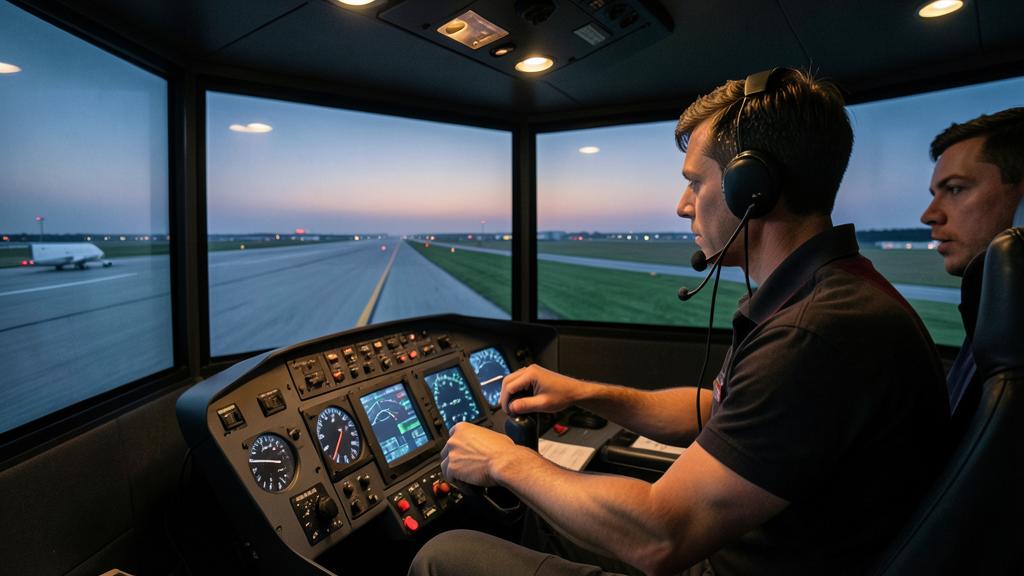
- For a pilot transitioning from a Boeing 737 to an Airbus A320, the type rating covers the fly-by-wire systems and side-stick handling, while the operator conversion covers the airline’s specific procedures for handling a rejected takeoff at a busy airport like London Heathrow.
Between regulators, the vocabulary and the packaging differ more than the substance. The European structure keeps the licensing course and the operator conversion visibly separate, delivered by a training organisation and an operator respectively. The United States folds the equivalent content into the certificate holder’s approved curriculum, with the type rating issued out of that training, and offers an advanced qualification programme as an alternative in which fixed programmed hours are replaced by validated proficiency objectives specific to the operator’s fleet and operation. The gates are recognisably the same gates. What differs is who owns each one, how the hours are counted, and how much freedom the operator has to prove that a different distribution of training produces the same competence.
Whichever framework applies, the underlying logic does not move: knowledge is built where it is cheap, procedure is built where it can be repeated, judgement is built where it can be observed, and exposure to reality is added last and under supervision. A course that reorders those steps does not save time. It simply loses the ability to assess the step it skipped.


Leave a Reply
You must be logged in to post a comment.