
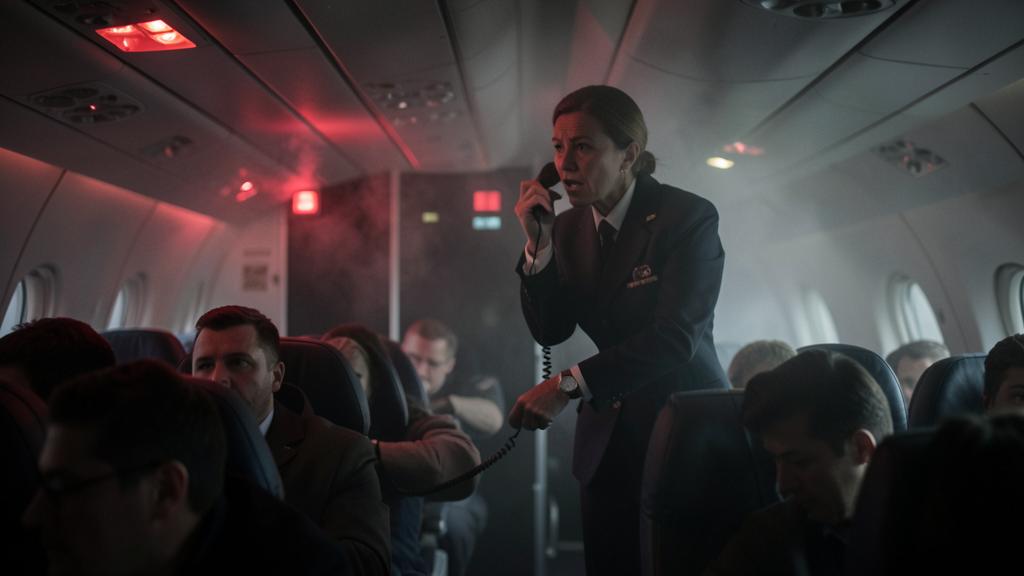
An evacuation order is one of the very few commands in commercial air transport that can legitimately originate at either end of the aeroplane. It normally comes from the flight deck, and every operations manual says so. Every one of those manuals also describes the case where it never comes — and where the senior cabin crew member has to act without it. That case is narrower, better defined and far more defensible than crews usually think.
An evacuation order is a transfer of authority, not a piece of information
The command « evacuate » does not tell the cabin something it does not already know. In most events the cabin has seen the fire, felt the collapse, or smelled the smoke long before the flight deck says anything. What the command does is authorise: it converts a cabin held in a disciplined « brace, remain seated » state into one that opens doors, inflates slides and puts a full load of passengers onto a live apron as fast as the exits allow.
That framing explains why the default is restraint. ICAO standards give the commander final authority over the disposition of the aircraft and responsibility for the safety of everyone on board, and the operator’s manual translates that authority into a single ordered act. Unordered evacuations are not free: slide-related fractures, passengers running into running engines, people descending onto a taxiway with traffic, hold baggage retrieved and thrown down a slide. An evacuation that was not needed still hurts people. So the system deliberately makes « stay seated » the resting state and « evacuate » an exception that someone has to declare.
The consequence for cabin crew is uncomfortable but correct: silence from the flight deck is, most of the time, an instruction. It usually means the aeroplane has stopped, the crew is working a checklist, and the situation is under control. The professional problem is not learning to obey that silence — it is knowing precisely when it stops being an instruction and becomes a symptom.
The flight deck usually stays quiet during an emergency because they’re working to make the evacuation safer. But if the cabin crew sees a fire spreading or the plane breaking apart, they must act without waiting for orders.
On a Boeing 737 with a fire in the rear galley, the cabin crew waited 45 seconds for orders but saw flames spreading. They evacuated without waiting, preventing injuries from smoke inhalation.
Why silence is data rather than a gap
After an abnormal landing or a high-speed rejected take-off, there are only three plausible reasons why nothing is heard from the flight deck.
- The crew is working. An evacuation checklist is not a single switch: it involves stopping the aeroplane, setting the parking brake, shutting down engines, pulling fire handles or discharging bottles, depressurising where applicable, and only then commanding the evacuation. Depending on the type and on what failed, that sequence takes real time — and it is time being spent making the evacuation survivable, notably by making sure the engines are no longer turning when doors open.
- The crew cannot answer. Incapacitation, a jammed or deformed flight deck door, an impact that has disabled the forward section.
- The message is not getting through. Total or partial electrical loss, an interphone handset off its cradle, a public address system inaudible over an evacuation-level noise floor, a wrong selector position.
These three cases demand opposite responses. Waiting is right in the first and lethal in the second and third. The whole design of a cabin-initiated evacuation procedure is a device for discriminating between them quickly, with the poor information available at a bulkhead.
The right reflex. Do not treat the wait as an open-ended judgement call. Treat it as a bounded loop: attempt contact by the primary means, attempt by the secondary means, look for the conditions that override the wait entirely — and know before the flight what your operator’s bound actually is.
What legitimately overrides the wait
Operators word this differently, but the conditions that authorise a cabin-initiated evacuation cluster into three families. None of them is a judgement about whether the flight deck is doing its job; all of them are observations about the aeroplane.
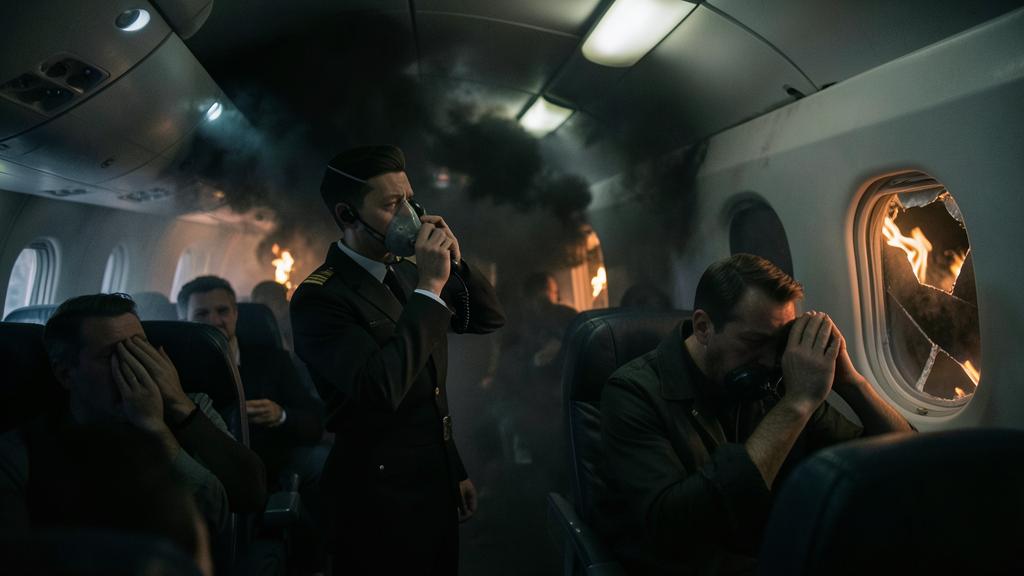
The cabin has become uninhabitable
Fire in the cabin that is not being extinguished, dense smoke that is defeating the available protection, or a fuel-fed fire visible against the fuselage. The clock here is not the crew’s — it is the fire’s. A cabin fire that is winning removes the option of waiting, because in a very few minutes there will be no useful decision left to take.
The aeroplane has failed structurally
A broken fuselage, a wing separated or a gear collapse with the fuselage on the ground, a ditching that is evident from the cabin. In these cases the aeroplane has already told everyone what it is: the absence of a verbal confirmation adds nothing.
The flight deck is demonstrably unreachable
Repeated attempts on the interphone and on the alternative means produce nothing, and there are visible signs of a serious event. This is the only one of the three that rests on inference, and it is the one that has to be bounded by the manual rather than by nerve.
| Origin of the order | Basis | Typical means | What the manual normally requires |
|---|---|---|---|
| Commander | Final authority over the aircraft and occupants | Public address, evacuation signal where fitted, interphone | Standard wording, so that it cannot be confused with any other announcement |
| Other flight crew member | Delegated by the commander, or on commander incapacitation | Same as above | Delegation defined in advance, not improvised |
| Senior cabin crew member | Defined overriding conditions, no order received | Public address, then direct voice and megaphone | Contact attempts made, conditions met, announcement in standard wording |
| Individual cabin crew member at a station | Where the operator provides for it, an immediately life-threatening condition at that exit | Direct voice, station commands | Alerting the senior cabin crew member as soon as physically possible |
The fourth line matters as much as the third. Even in a fully commanded evacuation, the decision to use a given exit never leaves the crew member at that door. That is the part of the authority that is permanently decentralised, and it is why the assessment discipline described below is trained separately from the decision to evacuate at all.
Assessment is not deliberation
The two acts get confused, and the confusion costs seconds. The decision to evacuate is a single event, taken once, for the whole aeroplane. The assessment of an exit is a distinct, mandatory act performed at each door immediately before opening it, in every evacuation, ordered or not.
What the assessment covers is consistent across operators: fire or fuel outside the door, the attitude and height of the fuselage, whether an engine on that side is still turning, obstructions on the ground, water, and the serviceability of the slide once inflated. The output is binary and local — this exit is usable, or it is not and passengers are redirected.
It is worth remembering where the familiar performance expectation comes from. Large aeroplanes above a defined seating capacity are certified against a demonstration in which the full certified capacity leaves through half the exits within ninety seconds, under prescribed conditions: darkness, a defined crew complement, no prior briefing on which exits will be used. That demonstration is a certification comparison, not a forecast of a real accident. Real events involve luggage, injuries, fire, disorientation and passengers who did not listen to the briefing. Reading the ninety seconds as an operational promise is one of the more persistent errors in cabin training.
The trap. Treating the ninety-second figure as time available. It is a certification demonstration with half the exits blocked and no fire; it says something about the aeroplane’s exit architecture, and almost nothing about how long a cabin fire will let you keep working.
The 90-second rule is just a test for plane design, not a real-world target. In an actual emergency, you have much less time because of fire, injuries, and chaos.
Communication paths, and the way each one fails
An evacuation decision travels along a small number of physical paths, and each has a characteristic failure that changes what silence means.
| Path | Normal use | Failure mode | What its silence means |
|---|---|---|---|
| Cabin interphone | Two-way, station to station and to the flight deck | Electrical loss, handset out of cradle, wrong station selected, damaged wiring | Ambiguous: the crew may be answering into a dead line |
| Public address | Command to the whole cabin | Loss of power, unintelligible against noise, passengers shouting over it | Ambiguous: the order may have been given and not heard |
| Evacuation signal system, where fitted | Dedicated aural and visual alert | Not installed on all types; can be triggered from the cabin on some types | Type-specific; must be known before the flight, not looked up during it |
| Direct voice through the flight deck door | Last resort, close range | Locked or deformed door, high noise level | Strong signal if there is genuinely no response at close range |
| Megaphone | Cabin command with no electrical power | Stowage inaccessible after impact, battery condition | Not a path from the flight deck, but the fallback for the cabin’s own order |
Two practical consequences follow. First, an unanswered interphone call proves very little on its own; an unanswered shout at the flight deck door, at close range, proves considerably more. Second, the presence or absence of a dedicated evacuation signal system is a type difference that materially changes the procedure — which is exactly the sort of detail that gets flattened when crews fly mixed fleets.
Making the decision defensible
A cabin-initiated evacuation will be examined afterwards. That is normal and it is not hostile: the investigation’s question is not whether the senior cabin crew member was brave, but whether the sequence was consistent with the manual and with what was observable at the time. What makes the answer easy is that the decision leaves traces.
| Trace | Where it comes from | What it establishes |
|---|---|---|
| Standard announcement wording | Public address, normally recorded on the cockpit voice recorder | That an order was given, when, and by whom |
| Interphone calls | Cabin interphone, recorded with the flight deck audio on most types | Number and timing of attempts to reach the flight deck |
| Aircraft state | Flight data recorder and maintenance systems | Engine shutdown and, depending on the type, brake and door parameters |
| Cabin crew reports | Written as soon as practicable after the event | What was seen at each station: fire, smoke, structural damage, water |
| Occurrence report | Operator’s reporting system, forwarded to the authority | That the event entered the safety management system rather than the rumour mill |
Three habits make those traces usable. Use the standard wording even when improvisation feels faster: the recorded phrase is unambiguous, and it is what the rest of the crew is trained to react to. Say what you saw, in the report, before you say what you concluded — observations age well, conclusions do not. And write the report while the sequence is still ordered in your memory, because one of the first numbers the investigation will look for is the interval between the aeroplane stopping and the doors opening.
Training the decision, not only the drill
Recurrent training reliably rehearses the actions: commands, door operation, assessment, redirection, disabled passengers, able-bodied passengers at the overwing exits. It much less reliably rehearses the decision, because the decision only exists in a scenario where the flight deck stays quiet — and quiet scenarios are awkward to run and uncomfortable to debrief.
Operators that take this seriously do three things. They run joint exercises with flight crew present, so that both sides hear how long an evacuation checklist actually sounds from the cabin. They brief the delay explicitly at the crew briefing on types where the flight deck workload after a rejected take-off is long. And they debrief cases where the cabin waited correctly, not only those where it acted — because a procedure that only ever rewards initiative will eventually produce an unnecessary evacuation and a broken leg on a slide.
The commander’s pre-flight briefing is the cheapest instrument available. A single sentence stating who will give the order, by what means, and what the cabin should do if nothing is heard converts an abstract manual paragraph into a shared expectation for that specific flight, on that specific type, with that specific crew. Discussions of how different operators word that briefing are a recurring subject on the FL330 professional forums, and the variation between manuals is wider than most crews assume.
What the manual has to contain for any of this to work
None of the above is a personal doctrine. It only functions if the operations manual has already answered four questions, in writing, before the day of the event: which conditions authorise a cabin-initiated evacuation; how many contact attempts, by which means, before the flight deck is considered unreachable; what wording the senior cabin crew member uses; and who assesses each exit. Where any of those four is missing or vague, the gap will not be filled by courage on the day — it will be filled by hesitation, and the hesitation will be measured afterwards to the second.
That is the real reason the topic belongs to procedure rather than to temperament. The senior cabin crew member who evacuates without an order is not exceeding their authority. They are exercising an authority the operator granted in advance, under conditions the operator defined in advance — provided the operator did the work of defining them.


Leave a Reply
You must be logged in to post a comment.