
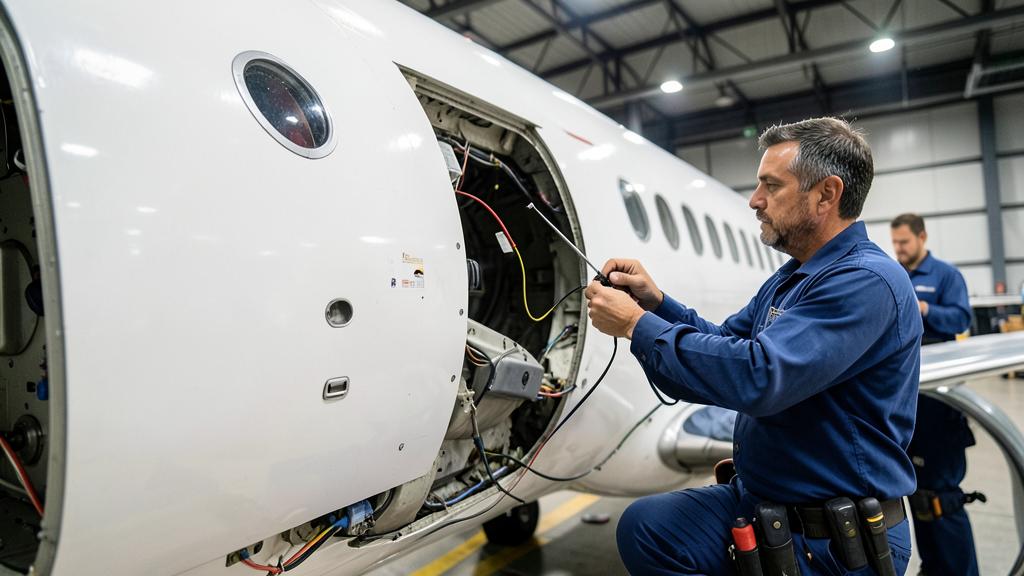
Two cabin projects land on the same desk. One reupholsters three hundred seats across a fleet: months of work, a warehouse of material, a large invoice. The other adds a single small antenna to the crown of the fuselage: two days on the aircraft. The second one is almost certainly the major change. The classification of a retrofit is not decided by how much work it represents, and teams that discover this late pay for it in schedule.
Classification is a regulatory act, not an engineering opinion
The first thing to get straight is what classification is. Calling a change major or minor is not a project label and not a judgement of complexity. It is a formal determination that decides who is allowed to approve the change, what evidence must exist before it flies, and what the operator inherits afterwards.
The framework is the design side of the rules — Part 21 in Europe, the corresponding subparts of 14 CFR Part 21 in the United States. Both draw the same line in almost the same words: a change to type design is major when it has an appreciable effect on a defined list of characteristics, and minor when it does not. Everything else in a retrofit project — cost, downtime, number of parts, number of aircraft — is invisible to that test.
The practical consequence is that classification must happen at the beginning. A project that is scoped, quoted and slot-booked before someone asks the question is a project that will either be re-planned or, worse, embodied on the wrong approval basis.
What the rule actually asks
The test is an effect test. The question is not « is this complicated? » but « does this change appreciably affect mass, balance, structural strength, reliability, operational characteristics, noise, fuel venting, exhaust emissions, or any other characteristic affecting the airworthiness of the product? »
Two words in that sentence do the work. Appreciable means the effect has to be demonstrable, not theoretical: every change moves mass by some amount, and the question is whether the amount matters against the substantiation that already exists. And effect means downstream consequence, not the physical act. Removing a bracket is trivial; removing a bracket that was part of a load path is not.
This is why volume of work is such a poor predictor. Repeating a well-understood, already-substantiated operation three hundred times adds cost and schedule but produces no new effect. Doing one small unprecedented thing to a system with a certified safety objective produces a new effect on the first unit.
The classification of a retrofit depends on whether it changes how the aircraft behaves, not how much work it takes. A small change that affects safety or performance is major, while a big job that doesn’t change anything important is minor.
Installing a new antenna on an Airbus A320 requires a major change because it affects structural integrity, aerodynamics, and electrical systems. Reupholstering seats with the same material is minor because it doesn’t change anything critical.
| Retrofit | Work volume | Effect that decides the classification | Typical outcome |
|---|---|---|---|
| Reupholstering existing seats with a qualified material, same fit | Very high | Flammability already substantiated, no change to mass distribution or attachment | Minor, if genuinely within the existing approval |
| New seat model in the same positions | High | New attachment loads, new dynamic substantiation, new occupant-injury evidence, evacuation flow | Major |
| External antenna for connectivity | Low | Structural cut-out, pressure-vessel reinforcement, aerodynamic and drag effect, lightning and static protection | Major |
| Replacing a display with a form-fit-function equivalent part | Low | None, if the part is approved for the installation and the interfaces are identical | Minor |
| Adding a network link between cabin systems and an aircraft data bus | Low to moderate | Segregation, integrity of aircraft systems, security of the data network | Major, and often with special conditions |
| Moving a monument or a class divider | Moderate | Exit access, evacuation assumptions, emergency lighting, mass and balance | Major more often than teams expect |
Where retrofits are most often misjudged
Three patterns account for most late reclassifications.
The cabin monument that moves a few centimetres. The aircraft’s evacuation demonstration and its exit-access assumptions were established on a specific interior arrangement. Shifting a galley, a lavatory or a divider touches those assumptions, and a change of a few centimetres either invalidates them or requires an argument that it does not. Either way, someone has to make that argument formally.
The « cabin-only » system that is not. A retrofit is often justified internally as passenger-side only: it powers from a cabin bus, it talks to nothing critical. Then the design needs a discrete from an aircraft system — a weight-on-wheels signal, an altitude source, a door status — and the change stops being cabin-only. It now sits at an interface, and interfaces are precisely where the effect test bites.
The change that is small on one aircraft and not on another. Classification attaches to a change to a specific type design, in a specific configuration, sometimes in a specific range of serial numbers. The same modification kit can be minor on one variant and major on another because the structure, the electrical load margin or the certification basis differ. A classification obtained for a previous programme is a useful precedent and nothing more.
The trap. Treating a classification as portable. « We did this on the other fleet and it was minor » is not an argument — it is a hypothesis about a different type design. The classification statement must name the aircraft type, the configuration and the change, or it means nothing.
The second question: significant or not
Once a change is major, a second determination follows, and it is the one that actually drives cost. The rules on changed products ask whether the change is significant — broadly, whether the general configuration or the principles of construction are changed to the point that the assumptions used for certification no longer hold.
The answer sets the certification basis. A major change that is not significant is normally certified against the existing basis of the product. A significant change pulls parts of the design towards the current requirements, which may be several amendments newer than the ones the aircraft was certified to. That single word can move a programme by a year, because it changes not what has to be built, but which rule text has to be met.
At the far end sits the change so extensive that it is no longer a change at all: a new type certificate is required. Few cabin retrofits reach that point, but re-engining, major structural redesign or a substantially new configuration can.
| Classification | Who may approve | Evidence typically required | Main schedule driver |
|---|---|---|---|
| Standard change (only for the light aircraft each published change names) | Embodied under the published standard-change conditions | Compliance with the published conditions, recorded in the aircraft records | Availability of the slot |
| Minor change | Approved by an approved design organisation under its own privileges, or by the authority | Justification of the classification, compliance data, updated documentation | Internal design office capacity |
| Major change, not significant | Type certificate holder as a design change, or a third party through a supplemental type certificate | Certification programme, compliance demonstrations against the existing basis, instructions for continued airworthiness | Authority involvement and test or analysis campaigns |
| Major change, significant | Same routes, with a reopened certification basis | Compliance against later requirement amendments, potentially new tests | Establishing and negotiating the basis |
| Substantial change | New type certificate | Full certification programme | Everything |
Who is allowed to say it, and who is not
Classification is not a majority view held by the project team. It is made by a design organisation holding that privilege, or by the authority where no such privilege applies; and once a change has been classified major, its approval belongs to the authority. An approved design organisation may classify changes and approve minor ones within the scope of its terms of approval; that scope is limited and it is written down. A maintenance organisation may embody an approved change with great competence and no authority whatsoever to classify it.
This matters for the operator, because the operator is the one who ends up holding an aircraft with a modification in it. The question to ask a supplier is not « is this minor? » but « who classified it, under which approval, and can I see the classification statement and the approval reference for this type and configuration? » A supplier who cannot produce that in a week probably does not have it.
The right reflex. Put the classification statement in the contract as a deliverable with a date, before design freeze. It costs nothing when the answer is minor, and when the answer turns out to be major it exposes the real schedule while there is still time to act on it.
How the effect is demonstrated
Saying a change has no appreciable effect is a claim that has to be substantiated, and the substantiation is what fills a retrofit programme. For a modern cabin or avionics retrofit the recurring workstreams are predictable.
- Structure. Static and fatigue substantiation for attachments, cut-outs and reinforcements, plus the effect on the pressure vessel for anything penetrating the skin.
- Mass and balance. The change in empty mass and the shift in the centre-of-gravity envelope, which flows into the loading documentation and sometimes into the flight manual.
- Systems safety. The failure analysis expected by the general systems requirement of the certification specification, with the assurance levels for software and airborne electronic hardware following from it.
- Environmental and electromagnetic qualification. Equipment qualified to the applicable environmental categories, plus installed-level electromagnetic compatibility, lightning and high-intensity radiated field aspects for anything with an antenna or a long cable run.
- Cabin safety. Flammability and heat-release properties of materials, emergency lighting and marking, exit access, and the occupant-protection evidence for anything a passenger sits in or is thrown against.
- Human factors and flight-deck effect. If anything reaches the flight deck, the evidence set grows again: display integration, alerting, and crew procedures.
Notice how little of that scales with the number of aircraft. That is the structural reason the two-day antenna beats the three-hundred-seat reupholstery on classification: the antenna touches most of these workstreams at once, the reupholstery touches part of one.
What happens after the approval
The approval is a milestone, not the end. A major change generates a tail of obligations that operators routinely under-budget, and that live on the continuing-airworthiness side of the house rather than the design side.
The instructions for continued airworthiness arrive with the change and have to be integrated into the aircraft maintenance programme, which means the continuing-airworthiness management organisation revises the programme and gets it approved. New tasks may need new tooling and new authorisations in the Part-145 organisation that will perform them. The minimum equipment list may need a supplement, because a system that has no dispatch relief grounds the aircraft the first time it fails. Mass and balance documentation is revised, and depending on the change the aircraft may need reweighing. If the change affects what the crew sees or does, flight crew and cabin crew procedures and training follow. And the aircraft records have to show the whole chain: the approval, the embodiment, the configuration.
| Deliverable | Owner | What goes wrong when it is late |
|---|---|---|
| Instructions for continued airworthiness | Design approval holder | The maintenance programme cannot be revised; the aircraft flies with an unscheduled task |
| Maintenance programme revision | Continuing-airworthiness management organisation | Approval delay, findings at the next audit |
| Minimum equipment list supplement | Operator, against the master list | First failure of the new system becomes an aircraft on ground |
| Revised mass and balance data | Operator, with the design data | Loading computed on stale figures |
| Crew procedures and training | Operator flight and cabin operations | Crews meet the modification in service without briefing |
| Configuration record | Operator records | The modification is invisible at the next lease return or sale |
Europe and the United States do not do this identically
The classification test is close to identical on both sides, but the machinery around it is not, and cross-border retrofit programmes get caught by the difference.
In Europe, major changes go through a design organisation’s certification programme and are approved by the agency, either as a change to the type certificate or as a supplemental type certificate. In the United States the supplemental type certificate route exists in the same shape, but there is also a field-approval mechanism for major alterations, documented on the FAA’s major repair and alteration form, which has no direct European equivalent. Approvals cross the Atlantic through the bilateral arrangements, and that acceptance is neither automatic nor instantaneous: some approvals are accepted, some require validation, and the answer depends on the category of the change.
For an operator with a mixed-registry fleet, the practical rule is to establish the acceptance path before selecting the supplier, not after. A supplemental type certificate issued in one system is an asset in the other only to the extent that the bilateral arrangement says so.
Governing classification inside a project
Programmes that handle this well share a small number of habits, none of which are expensive.
- Ask the classification question at concept stage, in writing, and record the answer with its reasoning — not just the verdict.
- Describe the change functionally, including every interface, before asking anyone to classify it. Most misclassifications trace back to an incomplete description rather than a wrong judgement.
- Re-open the classification whenever the design changes. The one added discrete signal is exactly the kind of late change that flips the answer.
- Budget the continued-airworthiness tail as part of the project, with named owners on the operator’s side.
- Keep the classification statement, the approval and the embodiment record together. The next lease return, sale or audit will ask for all three at once.
The underlying discipline is simple to state and hard to hold: the question is never how much work the modification represents, but what it changes about how the aircraft behaves, degrades and fails. Answer that question honestly at the start and the classification usually answers itself — and the programme, discussed among engineers on the FL330 forums or run inside a design office, stops producing surprises at the worst possible moment.


Leave a Reply
You must be logged in to post a comment.