
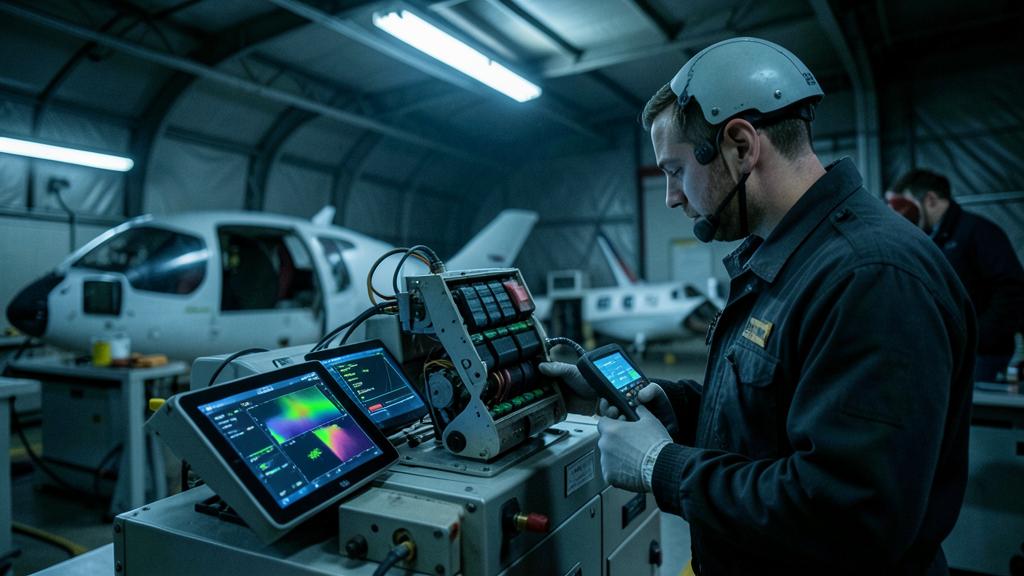
Maintenance planning has been built for decades on two counters: flight hours and flight cycles. They work because the things they count are the things that consume the part — thermal cycles on a turbine disc, pressurisation cycles on a fuselage, running time on a bearing. Put an electric propulsion system on the aircraft and one component breaks that contract completely. A battery pack degrades according to a history the counters cannot see, and its serviceability has to be established by measurement rather than deduced from a total. That single change moves the removal decision out of the planning office and into the workshop, and it drags contract terms, spares policy and asset value along with it.
What a potential actually assumes
A hard-time limit is a statistical statement dressed as a number. It says: for this part, in this application, a degradation mechanism accumulates in proportion to a countable event, the dispersion around that law has been characterised, and a limit has been set far enough below the failure distribution that removing at the limit is conservative for practically every unit. Low-cycle fatigue on rotating parts is the archetype: fatigue damage accumulates cycle by cycle, so counting cycles is counting damage.
Three conditions make this work. The damage driver must be the counted event; the population must be homogeneous enough that one limit fits all units; and the units must not accumulate damage while they are not being counted. A turbine disc parked in a hangar is not consuming its life. This is so obviously true for mechanical parts that it is rarely stated — and it is exactly the assumption an electrochemical energy store violates.
Traditional maintenance counts hours and cycles because mechanical parts wear out predictably when in use. But batteries degrade even when parked, so their health can’t be guessed from simple counters alone.
A pack ages on the ground
Battery degradation splits into two families that are usually described together and behave differently. Cycle ageing accumulates with charge and discharge: it depends on how deep the discharge goes, how fast energy is pushed in or drawn out, and at what temperature. Calendar ageing accumulates with time alone, and is governed principally by temperature and by the state of charge at which the pack sits. A pack left full on a hot apron for a season is degrading, and the aircraft has not moved.
The consequence for planning is blunt. Two aircraft delivered on the same day with identical hours and identical cycles can present packs in materially different condition, because one operated short sectors with high charge rates and turnarounds at high ambient temperature, and the other did not. There is no counter on the aircraft that distinguishes them. There is a data record — thermal history, state-of-charge history, charge-rate history — but that is not a potential, it is a dossier.
| Degradation driver | Visible to an hour meter? | Visible to a cycle counter? | Where it is actually recorded |
|---|---|---|---|
| Depth of discharge per flight | No | Partly — a cycle is not a depth | Battery management system energy log |
| Charge and discharge rate | No | No | Current and power history |
| Cell temperature during use | No | No | Thermal management records |
| Storage temperature and duration | No — the aircraft is not flying | No | Ground and parking records, if kept |
| State of charge while parked | No | No | Ground handling procedure compliance |
| Abuse events (over-temperature, deep discharge, impact) | No | No | Fault log and occurrence reporting |
The trap. Treating the parking configuration as a ground-handling detail rather than as an airworthiness-relevant action. The state of charge and the temperature at which a pack is left between flights is a degradation input on the same footing as the flights themselves — and unlike the flights, nothing on the aircraft records it unless the procedure says it must be recorded.
Imagine an aircraft fitted with a battery-powered electric taxi system, with two identical battery packs after 1,000 flights. One, used for frequent short taxi operations in Dubai’s 45°C heat, could show 15% capacity loss due to high temperature and rapid cycling. The other, used in cooler climates for longer taxi runs, might only show 5% loss. Neither counter reveals this difference.
State of health is an estimate, not a reading
The phrase state of health suggests a gauge. It is not one. No instrument reads the remaining life of a cell directly; what the battery management system produces is an estimate, derived from measurable quantities — voltage response, current, temperature, accumulated charge — through a model that has been fitted to test data and that drifts as the pack departs from the population the model was built on.
Two practical consequences follow. First, the quality of the estimate depends on the operating envelope actually visited: an estimator that needs to observe a wide state-of-charge excursion to recalibrate will drift on an operation that never discharges deeply. Second, the estimate has an uncertainty, and the fitness criterion has to be applied to the confidence bound rather than to the point value — which is the same discipline as applying a performance limitation to a certified value rather than to a measured best case.
The reference measurement, a controlled charge and discharge under defined conditions, is far more accurate. It also occupies the pack for a significant period, requires equipment the line does not have, and — the awkward part — is itself a cycle, so measuring the pack ages it slightly. The maintenance programme therefore ends up with a two-tier scheme: continuous on-wing estimation for trending, and a periodic reference measurement to re-anchor the estimate.
Two fades, and only one of them is intuitive
Capacity fade — the pack stores less energy than when new — is the degradation everybody pictures, because it is the one consumer electronics makes familiar. It maps onto range, reserves and diversion capability, and it is what an energy-based fitness criterion measures.
Power fade is the other one, and operationally it is often the constraining one. As internal resistance rises with age and falls with temperature, the pack becomes less able to deliver a high instantaneous power draw. The demanding cases in flight are not cruise; they are the ones that combine peak power demand with a low state of charge and an unfavourable temperature — a go-around after a long sector, or a climb-out in cold conditions after a cold soak. A pack can hold ample energy and still be unable to guarantee the power the flight manual assumed at the worst point of the envelope.
This is why a single percentage of remaining capacity is an incomplete criterion. The certified performance depends on both, and the fitness statement has to cover the pack’s ability to deliver energy and power at the conditions the certification basis assumed, not at benign bench conditions.
| Capacity fade | Power fade | |
|---|---|---|
| Physical picture | Less usable energy stored | Higher internal resistance, less deliverable power |
| What it limits | Range, reserves, diversion options | Peak-demand phases: go-around, climb, single-failure cases |
| Worst conditions | End of a long sector | Low state of charge combined with unfavourable temperature |
| How it is seen | Energy accounting, reference discharge | Impedance response, power capability test |
| Failure mode if ignored | Reserve erosion, gradual and visible | Loss of a certified capability at the moment it is called for |
The fitness criterion becomes a measurement
Once the criterion is a measured quantity rather than a counted one, the whole vocabulary of the maintenance programme shifts. In the process-oriented classification still used to describe how an item is controlled, an item is managed as hard time, on-condition, or condition monitoring. An energy store with a measurable degradation parameter and a defined threshold is a textbook on-condition item — with the qualification that the condition is not inspected visually but computed, and that the computation itself is part of the approved data.
- What exactly is measured
- With what stated uncertainty
- Against which bound the threshold is applied
Where is the threshold written? Not in a general rule. There is no long-settled airworthiness code purpose-built for large electric propulsion; certification is proceeding through special conditions attached to the type certification basis of each project, and the end-of-life criterion, the monitoring means and the required accuracy of the estimate are established there, project by project. Anyone quoting a universal remaining-capacity figure as a regulatory limit is quoting something that does not exist. The number is a design and certification output for one aircraft, and it belongs to that aircraft’s approved maintenance data.
What is stable across projects is the structure of the requirement: a defined parameter, a threshold at which the pack is no longer eligible for the certified performance, an approved means of establishing the parameter, and a record that shows it was established when the rules said it should be.
The right reflex. When reading a proposed maintenance programme for an electric propulsion system, look for three things in sequence: what exactly is measured, with what stated uncertainty, and against which bound the threshold is applied. A programme that names a threshold but not an uncertainty has not finished defining its criterion.
The removal decision leaves the planning office
Under a hard-time regime, a removal is a date. It is known months in advance, it goes into a slot, the spare is ordered against it, and the finance function can forecast it. The workshop executes a decision that planning made.

Under a measured criterion, the removal is a forecast with a confidence interval, and the entity that can shrink that interval is the one holding the measurement equipment and the data history. Planning no longer receives a date; it receives a prediction that firms up as the threshold approaches. Three things change in practice.
Spares provisioning becomes probabilistic. The question is no longer how many packs reach their limit next quarter, but what fraction of the fleet crosses the threshold within a window, given a usage forecast. That is a pooling problem, and it favours operators large enough to average across a fleet, or arrangements that pool across operators.
The pack’s data record becomes part of the asset. A pack whose history is complete can be assessed; a pack whose history has a hole cannot be trusted to a model calibrated on a continuous record, and its residual value reflects that. Lease return conditions written in hours and cycles do not describe this asset at all — the meaningful condition is a state-of-health floor, measured by an agreed method, which means the method has to be agreed before the lease starts rather than at its end.
Configuration control moves down a level. If a pack can be repaired by replacing modules, the pack becomes a mixed population of ageing states, and the weakest element governs what the assembly can deliver. Module-level traceability and a rule on mixing ages stop being paperwork refinements and become the thing that determines whether the assembled pack still meets its criterion.
| Question | Hard-time regime | Measured-criterion regime |
|---|---|---|
| When does it come off? | A date, known long in advance | A forecast that narrows as the threshold approaches |
| Who owns the decision? | Planning, from the counters | The workshop and continuing airworthiness, from the measurement |
| Spares policy | Deterministic, per-unit | Probabilistic, pooled across a fleet |
| Records that matter | Hours, cycles, last shop visit | Thermal, charge and state-of-charge history; measurement provenance |
| Contractual expression | Time remaining to limit | State-of-health floor with an agreed measurement method |
| Failure of the record | Recoverable by inspection | Degrades the asset: the model has lost its calibration history |
What the counters still govern
None of this abolishes hours and cycles for the rest of the propulsion system, and any account that says otherwise is overreaching. The electric machine has bearings and seals; the reduction gearbox, where there is one, has a wear and lubrication regime; the power electronics have solder joints and capacitors that fatigue with thermal cycling; the propeller or rotor system keeps its own life limits. All of these accumulate damage in proportion to countable events, and the classical planning model handles them well.
The correct description is therefore not that electric propulsion replaces counting with measurement, but that it splits the system into two populations with two different logics under one installation. The planning function has to run both simultaneously, and the interesting difficulties are at the interface: a shop visit driven by a measured pack condition that arrives out of phase with a gearbox interval, and the trade between deferring one and bringing the other forward.
What to fix before the fleet arrives
The preparation work is unglamorous and entirely front-loaded. Define who owns the data record and where it lives, because a pack that changes aircraft or operator has to take its history with it. Write the parking and storage procedure as an airworthiness-relevant procedure with a recorded compliance, not as a handling convenience. Agree the reference measurement method, its equipment and its periodicity before writing any contract that references a state-of-health figure. And build the planning tool around a distribution rather than a date, because that is the shape of the information it will be given.
Operators comparing early implementations, and the contractual language emerging around state-of-health floors, are worth following on the FL330 forums as the first fleets accumulate real service history.


Leave a Reply
You must be logged in to post a comment.