
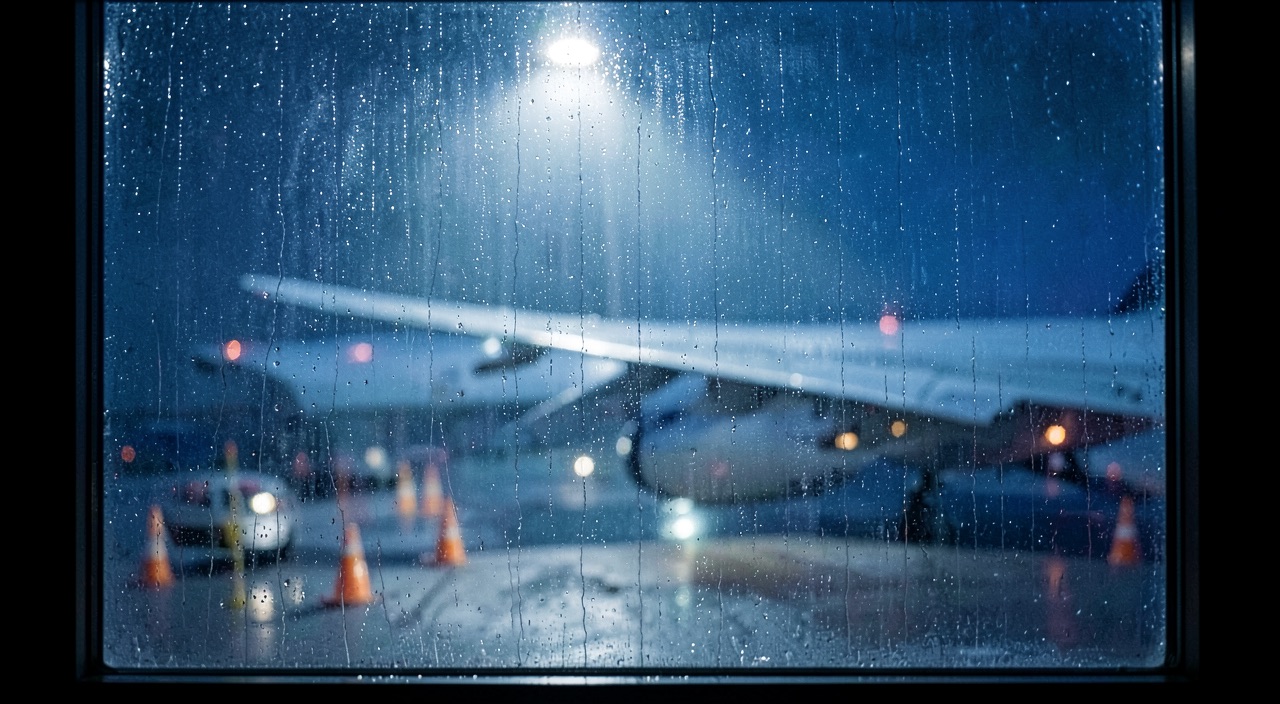
Holding under a stratiform layer, with an outside temperature a few degrees below zero, the deicing boots function correctly and the leading edge clears with each inflation. Then a matte stripe appears on the upper surface, behind the deicing line, and streaks begin to run down the side window before freezing in place. None of this is cosmetic: together these signs indicate that the droplet population has changed in nature and that the installed protection no longer covers where ice forms.
What changes the size of the droplets
A droplet follows the airflow as long as its inertia is low compared to the aerodynamic forces dragging it. This occurs with the classic cloud population, whose median volumetric diameter is measured in tens of micrometers. As it approaches the leading edge, the flow lines diverge, the droplets diverge with them, and only those that present themselves in a narrow flow tube end up touching the skin. The impact zone is short, centered on the stagnation point, and it is exactly over this length that the manufacturer has sized the pneumatic boot or heated panel.
Multiply the diameter by ten and the reasoning is reversed. The mass grows as the cube of the diameter, while the aerodynamic force that slows the droplet grows much more slowly: the ratio between inertia and aerodynamic restoring force increases sharply, and the trajectory stops obeying the flow. The large droplet continues straight ahead. It touches the surface where its almost rectilinear trajectory takes it, i.e., well behind the stagnation point, both on the upper and lower surfaces. The local capture efficiency increases, the impact limit retreats, and it retreats even more the larger the chord is compared to the droplet. The same reasoning applies to masts, antennas, rotor blades, and air intake lips, with very different radii of curvature and, therefore, very different thresholds.
The conventional limit is around fifty micrometers of median volumetric diameter. Below this, we stay within the historical icing envelope of the certification specifications, the one within which the vast majority of protection systems have been demonstrated. Above this begins the domain of large supercooled droplets: first freezing drizzle, then freezing rain, with diameters measured in hundreds of micrometers. A separate annex has been added to the certification specifications to describe this domain, following accidents attributed to these conditions. It has not made aircraft capable of flying in it: it has made explicit the fact that most are not certified for it.
Big droplets don’t follow the air flow like small ones. They hit the wing further back where protection systems don’t work, forming dangerous ice ridges.
On a Boeing 737 with a 50μm droplet size, ice forms only at the leading edge. But in 200μm freezing drizzle, ice builds up 10cm behind the heated zone, reducing lift by 15% before stall warnings activate.
Three ways to deposit ice outside the protected zone
The deposition outside coverage does not proceed from a single mechanism, and the three paths do not have the same signature or the same remedy.
- The first is the direct impact described earlier: the ballistic trajectory takes the droplet beyond the rear limit of the protection.
- The second is splashing. A large droplet that hits a surface does not always spread over it; it bursts, a fraction of its mass returns as daughter droplets that the boundary layer drags downstream, and these redeposit further back. The phenomenon is more pronounced the more oblique the impact: it explains deposits located much further than what the trajectory alone would predict.
- The third is runoff. A heated leading edge that does not operate in evaporative mode leaves a liquid film; this film migrates aft under the action of the airflow and freezes as soon as it leaves the heated region. The result is a ridge, sometimes a simple bulge of a few millimeters, whose position depends on the available power and the flow of water intercepted.
None of the three is treated by a pneumatic boot, which expels the ice deposited on its skin and nothing more. The third is even worsened by an undersized heated leading edge for the water it receives. This leads to a counterintuitive situation: the better the system works in the visible zone, the less the crew sees what is forming behind it.
| Criterion | Historical envelope | Large supercooled droplets |
|---|---|---|
| Median volumetric diameter | a few tens of micrometers | beyond fifty, up to several hundred |
| Impact limit | short, around the stagnation point | further aft, upper and lower surfaces |
| Where harmful ice forms | in the protected zone | behind the protected zone |
| Effect of the protection system | removes or prevents deposition | leaves the deposit in place, or even feeds the runoff |
| Signature for the crew | visible ice on the leading edge | clean leading edge, deposits where you don’t look |
| Expected behavior | authorized flight within the demonstrated envelope | recognition and then exit, unless capability is demonstrated |
What a ridge does to lift and controls
The ridge forms a few percent of the chord behind the leading edge, i.e., in the suction peak region of the upper surface. As the angle of attack increases, this peak moves forward and deepens; the ridge triggers a local separation that, instead of reattaching, spreads toward the trailing edge. The consequence is not a progressive degradation, but a loss of maximum lift and a reduction in the stall angle of attack, without the drag having increased much beforehand. The usual indicators, increasing pitch attitude and thrust that must be increased, therefore poorly predict the event.
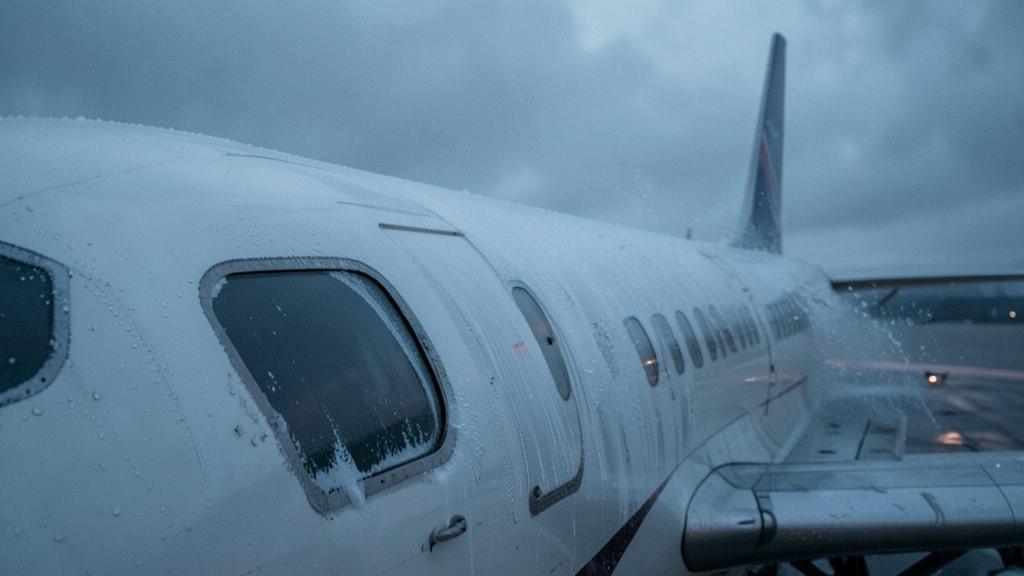
The two stall warnings weaken at the same time. The precursor buffet may be missing because a separation caused by a ridge near the leading edge does not excite the tailplane as a separation at the trailing edge does. And the angle of attack warning is calibrated on a scale established for the clean wing; some types switch to an icing scale as soon as the deicing system is turned on, but this scale covers the historical envelope, not a ridge formed behind the protection. The wing can lose lift before anything activates.
The second effect is lateral and much less taught. A ridge located upstream of an aileron modifies the flow over the control surface, and therefore its hinge moment. The control surface may stop following the balance and begin to act against it: effort on the control column that lightens and then reverses, sudden deflection, uncommanded roll. The first symptom is then not a stall, but a control that no longer responds as usual.
The trap. The autopilot maintains the attitude and symmetry by silently consuming control and trim efforts. It exactly masks the first two signs of asymmetric contamination: the increasing effort and the control surface approaching its stop. When it disconnects because it has reached its limit, it returns an already unbalanced aircraft. That is why many flight manuals require manual flight as soon as large droplets are recognized.
Visual indicators, and those that prove nothing
Recognition is not based on a sensor, but on an inspection, and this inspection focuses on areas that are not observed spontaneously. The signs retained by the type documentation are consistent: ice on the upper or lower surface behind the protected zone; ice on the propeller spinner further back than usual; beads or streaks of water running on the non-heated part of the windshield or side panel, then freezing in place; deposits on surfaces that never carry them, struts, windshield wipers, antennas. These are not indicators of severity, but of droplet size, and the difference is operational: severity is debatable, size dictates behavior.
Conversely, several reassuring observations prove nothing. A clean leading edge after cycling says nothing about what is happening a few decimeters further aft. A silent ice detector does not either: most probes measure an accumulation rate on an exposed element, without distinguishing diameters. Finally, the absence of visible moisture is not a criterion, since freezing drizzle falls below the base of the cloud, in clear air: one can believe that one has exited while flying in the precipitation.
| What is seen | What this indicates | What this does not say |
|---|---|---|
| Ice on the upper surface behind the protected zone | impact or runoff outside coverage, ridge forming | nothing about the thickness reached at the aileron height |
| Streaks or beads on the non-heated side window | droplets large enough to run before freezing | not the liquid water content of the layer |
| Deposit on the propeller spinner further back than usual | impact limit further aft, therefore large diameters | not the horizontal extent of the crossed zone |
| Clean leading edge after the cycle | that the system does what it is designed to do | strictly nothing about the rear of the protection |
| Silent ice detector | low accumulation on the probe itself | neither the diameter of the droplets nor the state of the wing |
The correct reflex. Designate the observer and the observation points before entering the layer, not when doubt arises. A light directed at the side window and the part of the wing visible from the cockpit, a look at fixed intervals, the outside temperature noted with the level: these three actions turn an impression into a dated observation, and it is this that makes a request for a level change credible with air traffic control.
Why the exit is rarely downward
The reflex to descend comes from ordinary icing, where warmer air is sought below. It is poorly adapted here, because the two mechanisms that produce large supercooled droplets place the problem below the aircraft.
The first is that of the warm layer. Snow falls from an upper layer, passes through a layer whose temperature is above zero, melts there, then falls again to a cold layer near the ground where it becomes supercooled again. Descending means diving into this cold part, which extends to the ground, with freezing rain at the end and a runway that also receives it. The second mechanism does not involve any warm layer: in a thin stratiform cloud whose upper part is not very cold, the droplets grow by collision and coalescence until they form drizzle, which falls below the base. Descending then exits the cloud without exiting the precipitation.
In both cases, the usable indicator is the trend of the outside temperature. If it warms while climbing, there is a warm layer above, and climbing is the shortest exit. If it cools regularly, you must aim for the top of the layer, often low when the drizzle comes from coalescence, or you must abandon the vertical axis. The only option whose content is already known remains: the return.
Descending becomes the correct option in a specific case: when you have a positive element about the lower layer, airport temperature clearly above zero, a report from a crew that has just exited. The difference is not technical, it is informational. Descend because you know, yes; descend because it is the habitual gesture, no.
The window closes while you think
The particularity of this decision is that it degrades by itself. The ice deposited behind the protection adds drag, mass, and roughness; the available climb rate decreases at the exact moment when it is needed. The reasoning also applies to the angle of attack: climbing demands more of it, and it is precisely the resource that the ridge is destroying. An early decision to climb is a routine maneuver; the same, ten minutes later, may require a margin that the aircraft no longer has.
Speed does not offer a discreet exit. Accelerating reduces the angle of attack, which shifts the stagnation point toward the lower surface and decreases the proportion of deposit on the upper surface, but at the same time increases the capture efficiency: the phenomenon is not eliminated, its distribution is shifted. The only parameter that really acts on the amount of ice intercepted remains the time spent in the layer.
This has a practical consequence in the dialogue with air traffic control. A request for a level change formulated as a preference is treated as such and can wait. A request motivated by recognized icing conditions, accompanied by the desired level and the direction of the maneuver, is treated differently. And if the response is delayed beyond what the observation allows, exiting the layer stops being a request to become an action, announced.
The same droplet population awaits you on the ground
Freezing drizzle does not turn into another phenomenon because the aircraft is stationary. Deicing fluid holdover time tables generally treat it as a distinct case from snow, and also distinguish light freezing rain; beyond a certain intensity, no holdover time is published, which is not an omission, but a refusal. The reason is the same as in flight: a large droplet penetrates the film instead of being absorbed by it, dilutes it faster than the tables predict, and reaches surfaces that the treatment has not covered.
The visual inspection of the representative surface, therefore, focuses on the same question as in flight: not how much ice, but where. A wing whose leading edge shines with fluid while the upper surface carries a matte veil is not ready, no matter the duration shown in the table.
What you need to read in your own documentation
Four points deserve an item-by-item check before the next cold season. The certification status of the type first: demonstrated capability in the domain of large droplets, capability limited to detection and exit, or no mention—these three situations do not impose the same behavior. The list of visual indicators next, since it is specific to the type and designates precise physical references, a window frame, a visible part of the wing. The associated restrictions: use of the autopilot, speed increments, landing configuration, because a manual that limits flap extension does so for reasons of longitudinal balance that no reasoning about the wing replaces. The status of the ice detector in the minimum equipment list finally, which indicates whether it is a primary means or an aid.
A gray area remains, and it is better to name it than to avoid it. Icing forecasts have a grid and granularity that do not go down to the level of a freezing drizzle layer a few hundred feet thick; the pilot report remains the instrument that really sees it, and is only useful when it is issued. For those preparing a type rating or line training, this is the step where the examiner expects a procedure rather than a recitation: recognize, qualify, choose an exit axis, announce. The FL330 preparation courses treat this sequence as a separate exercise, and the crew exchanges published in the professional forum show that the difficulty is almost never technical: it lies in the delay that one allows before acting.
In all the points mentioned here, the applicable text, the type flight manual, and the operator’s approved documentation prevail over this article, which describes a mechanism and not a procedure.


Leave a Reply
You must be logged in to post a comment.