

A dead entertainment screen produces a conversation that cabin crew have every week and that recurrent training rarely covers in full. The passenger is not asking for a film. They are asking for the part of the fare they believe bought that film, and they are asking a crew member who has no authority to give it back and every incentive to say something reassuring. That gap between what is being claimed and what the crew can actually settle is where the avoidable damage happens: in a sentence offered in good faith at row 34 that the airline then has to honour or repudiate weeks later. This is how to place the failure in the right framework, triage it before serving anything, and answer without promising what is not yours to promise.
What the passenger is actually claiming
Listen to the wording. « The screen is broken » is a report of a defect. « I paid for this » is a claim about the contract. « This is unacceptable in business class » is a claim about the cabin as it was sold. « I need the captions » is not a service complaint at all. Four different sentences, four different obligations, and only the first is a technical matter.
The distinction matters because the crew’s response has to match the register. A defect report is answered with an action and a log entry. A contractual claim is answered with a route to the people who settle contractual claims, and nothing else. A claim about the cabin as sold is answered with acknowledgement and with whatever the operator’s service recovery policy actually authorises. An accessibility request is answered as an accommodation, urgently, because a passenger who cannot follow content without captions may also be a passenger who cannot follow a safety briefing without them.
The mistake made under pressure is to answer all four in the same register, usually the third, because it is the one that makes the conversation stop. It stops the conversation on board and restarts it, larger, in the customer relations queue.
Passengers ask for different things when their entertainment system fails. Some want a fix, others want a refund, and some need help with accessibility. Crews must respond correctly to each type of request to avoid bigger problems later.
On a Boeing 787, a passenger in seat 12A complains their screen is dark. The crew checks and finds the entire row 12 is affected. This is likely a shared seat electronics unit failure, not just one seat. The crew records the issue, checks if in-seat power is also affected, and logs it for maintenance.
Three kinds of promise, and only one of them is yours
Entertainment reaches passengers through one of three commercial routes, and the route determines who owes what. It is worth knowing which one applies on your aircraft and in your cabin before the failure happens, because it cannot be worked out in the aisle.
| Commercial route | What the passenger holds | Who settles | What the crew can properly say |
|---|---|---|---|
| Included in the fare as a cabin amenity | An expectation created by marketing, not a separately priced item | Customer relations, under the operator’s service recovery policy | Acknowledge, describe what is known, give the claim route, offer only what policy authorises |
| Sold separately on board or before flight: a connectivity pass, premium content, a headset | A paid item, identifiable by a transaction | The seller, which may be the airline or a third-party provider through its own portal | Identify the seller, explain the refund route, never quote an amount |
| Part of what defined the cabin at the point of sale, typically premium cabins | A stronger expectation, sometimes an explicit description in the fare conditions | Customer relations, usually with a higher recovery band | Acknowledge without conceding a breach, record fully, escalate before landing |
The second row is the one crews get wrong most often, and it is the easiest to get right. Where connectivity or premium content was bought through a provider’s own portal, the money never touched the airline’s account, and a crew member who says « we will refund that » has committed the airline to a payment it did not receive. The correct sentence is a factual one about where the transaction lives.
Where the passenger rights rules stop
This is worth being precise about, because passengers frequently invoke rules that do not apply and crews are rarely equipped to say so calmly. In Europe, Regulation (EC) No 261/2004 addresses denied boarding, cancellation and long delay. It does not address the quality of what was provided on board. The Montreal Convention addresses death and injury, baggage and delay. It does not address an amenity that failed to work. A broken screen is not a compensation event under either instrument, and telling a passenger otherwise, or letting them believe it, sets up a refusal later that will feel to them like a reversal.
What does apply is the contract of carriage together with general consumer protection law, and that varies by State and by point of sale. A paid item not delivered is, in most consumer law systems, refundable. An amenity described in marketing that failed on one flight is a much weaker claim, and it is settled commercially rather than legally. None of this is the crew’s determination to make on board. The useful crew knowledge is only the boundary: this is not a delay compensation matter, it is a service and contract matter, and it is handled after the flight by people whose job it is.
Never name an amount, a percentage or a certainty. « You will be refunded », « they normally give around », « that is worth about » are the three sentence shapes that cost the airline money and cost the passenger trust. The crew member who says them will not be present when the actual offer arrives, and the difference between the two figures becomes a second complaint about being misled, which is harder to settle than the first.
Triage before service
The instinct is to look at the screen. The better instinct is to establish the scope first, because the scope changes what the failure is. A single seat is a defect. A block of seats is usually one seat electronics unit. The whole cabin is a system event. And some symptoms are not entertainment problems at all.
| What is observed | What it usually is | Cabin significance | First action |
|---|---|---|---|
| One screen dark, neighbours working | Single seat unit or its connection | Service only | Note the seat number, try the seat reset if procedures allow, offer reseating if load permits |
| A run of consecutive seats dark | One shared seat electronics unit or a power group | Service, plus in-seat power may be lost with it | Record the seat range, check whether in-seat power in the same block is affected |
| Whole system dark or cycling | System-level failure | Service, but check what else the system carries | Follow the operator’s system reset procedure, inform the flight deck, prepare a cabin announcement |
| Audio absent, picture present | Headset, jack, or audio distribution | Service; often a seat-level item | Try a replacement headset first, then treat as a seat defect |
| Safety briefing video unavailable | System or media failure affecting a required briefing | Operational, not service | Tell the flight deck; the briefing is delivered manually, per the operations manual |
| Passenger address, interphone or cabin lighting also degraded | Cabin management system, not entertainment | Operational and potentially significant | Report to the flight deck immediately; do not treat as an entertainment fault |
| Hot seat unit, burning smell, discoloured panel or smoke | Electrical fault | Safety event | Apply the smoke and fumes drill, isolate if the procedure provides for it, move the passenger |
The last two rows are the reason triage comes first. On many aircraft the entertainment system shares hardware, power and cabling with the systems that deliver announcements, the safety briefing and cabin lighting. A crew that has categorised the event as « the films are not working » may under-report a fault that has operational consequences, and the flight deck learns about it late.
The reset, and the limits the manual puts on it
Every crew knows the system reset sometimes works, and that knowledge is a hazard when it is not paired with the limits. Operators authorise resets in defined circumstances: a stated number of attempts, outside critical phases of flight, from a specified panel, and often only by a designated crew member. The limits are not bureaucratic. Repeated cycling of a system that is failing for an electrical reason is precisely the wrong response, and a reset performed during a phase where crew attention belongs elsewhere is a distraction with no upside.
The number of attempts, the panel and the authority are in your operations manual and your cabin crew manual, and they differ between operators and between aircraft types within the same operator. If you cannot state them from memory for the type you are flying today, that is the item to look up on the next sector, not the one to improvise at row 34.
Announce once, early, and factually. A single clear announcement made as soon as the scope is known prevents thirty individual conversations. Say what is affected, say what has been tried, say what alternatives exist on board, and say where a claim is made after the flight. Do not estimate a repair time and do not apologise for a cause you have not established.
Accessibility is not a service complaint
When captions or audio are unavailable, the failure has removed something a passenger relies on rather than something they enjoy. In several States the rules on accessible air travel require entertainment content to be offered with captioning and audio description, and where such a rule applies the failure is a compliance matter, not an amenity matter. The registers are different and so are the response times.
The immediate cabin obligation is easier to state than the legal one. A passenger who depends on captions for the safety briefing must receive that briefing in a form they can follow: an individual briefing by a crew member, and the safety card, delivered before departure rather than when convenient. A passenger who depends on an audio channel that has failed needs a crew member to establish what they can use instead. And the event needs recording specifically as an accessibility failure, because that is a different queue on the ground from a broken screen.
What to say, and what it costs to say it differently
Most damage comes from three or four sentence shapes that feel helpful. The pattern that works is consistent: acknowledge the loss without adjudicating it, state only what has been established, give a concrete route, and stop.
- Acknowledge the specific thing, not the general inconvenience. « The system is out for the whole cabin, so there is nothing I can switch on for you » is better received than « I am sorry for the inconvenience », because it tells the passenger they have been heard accurately.
- Say what has been tried. A passenger who knows a reset was attempted and failed stops asking for a reset. A passenger who does not know assumes nobody tried.
- Give the route, with the reference. The claim reference, the seat number recorded, the flight and date, and where to submit. A passenger holding a reference stops litigating in the aisle.
- Offer only what you can deliver now. Reseating if the load allows it, a replacement headset, whatever alternative the aircraft actually has. Offering something you then cannot find is worse than offering nothing.
- Do not explain the cause. Naming a supplier, a maintenance decision or a deferred defect gives the passenger a grievance with a target, and the crew member has no way to know whether the explanation is true.
The log entry is the part that outlives the flight
The conversation ends at the door. The record does not, and it is the only part of the event with any leverage on whether it happens again. A cabin defect that is not written down does not exist for the maintenance organisation, and a system that fails on every rotation without ever being logged will keep failing, because the fault appears nowhere in the reliability data that drives rectification priority.
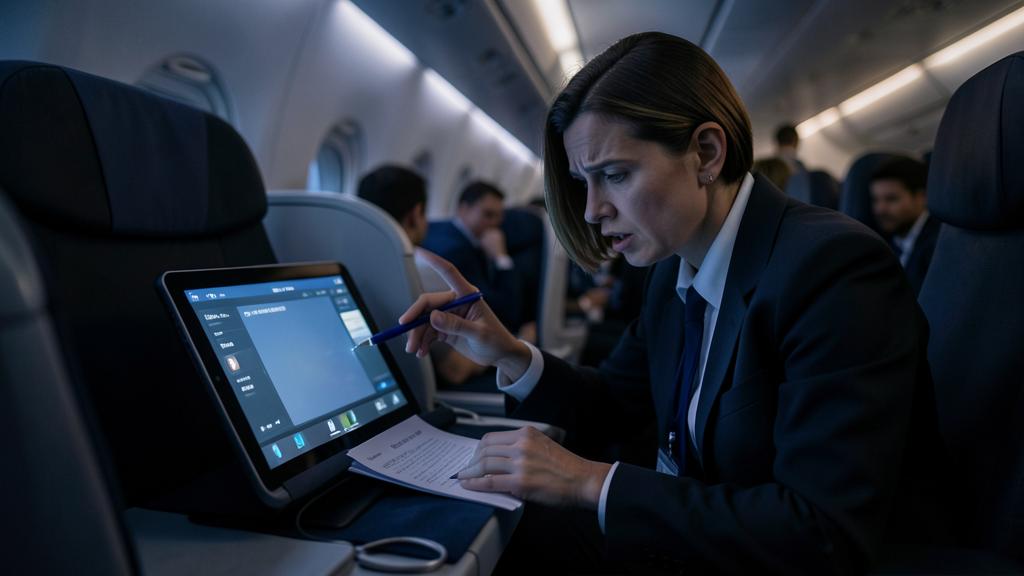
A usable entry is specific: seat numbers or the affected range, the symptom in behavioural terms rather than a diagnosis, whether a reset was attempted and what happened, whether in-seat power or other cabin systems were involved, the phase of flight, and the number of passengers affected. « IFE unserviceable » is a sentence that guarantees the same entry next week. And where the failure had operational or accessibility consequences, that has to appear in the entry too, because the routing on the ground differs.
The honest summary for a cabin crew member is short. You cannot fix the screen and you cannot settle the claim, and pretending otherwise is the only way to make the flight worse than it already is. What you can do is establish what actually failed before you answer, keep the answer inside what the operator has authorised, deliver whatever alternative genuinely exists on board, and write an entry precise enough that somebody on the ground can act on it. Service topics and cabin procedures are discussed further in the crew community at the FL330 forums.


Leave a Reply
You must be logged in to post a comment.