
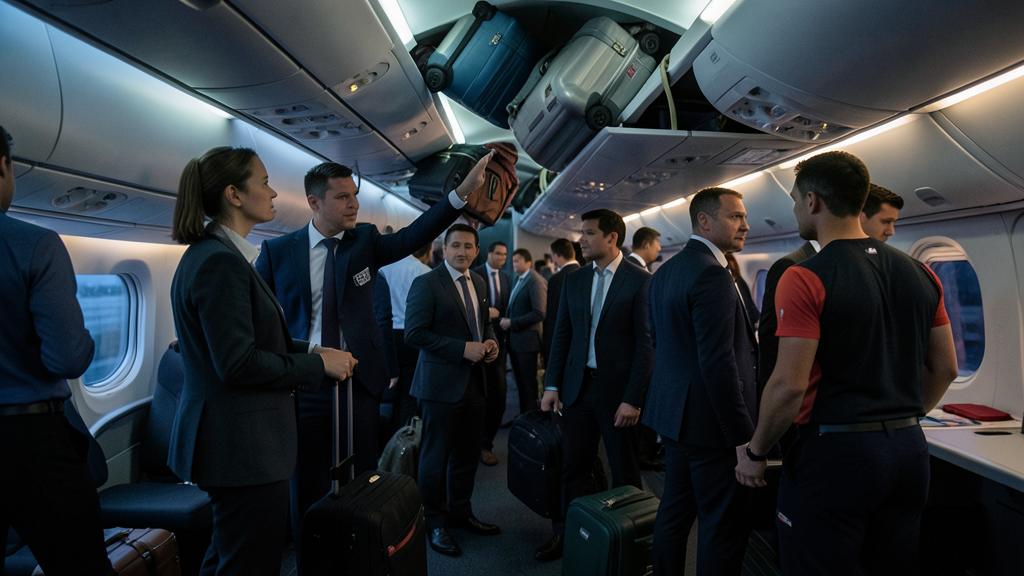
The loadsheet does not describe the aircraft that is actually about to take off. It describes a statistical one: passengers of an average mass, carrying an average amount of hand baggage, seated where the boarding system says they are. Cabin crew are the only people on board who can see the difference between that model and the real cabin — and the window in which telling anyone is still useful closes when the door does.
What a standard mass actually promises
Weighing every passenger before every departure is impracticable on scheduled operations, so the rules allow operators to use standard mass values instead. The permission is conditional. It depends on the size of the aircraft — below a certain number of passenger seats, actual or corrected masses are required — and it comes with obligations attached to the values themselves: the operator has to justify them for its own traffic, survey them periodically, and revise them when a survey shows the population it carries no longer matches the table.
What a standard mass promises is therefore a statistical guarantee, not an individual one. Across a full cabin, individual differences are expected to cancel out, and what scatter remains stays small in relation to the limits. That reasoning is sound and it works, but it rests on an assumption that deserves to be said out loud: that the actual population boarding this flight resembles the population the values were derived from. Where it does not — a sports team, a military charter, a pilgrimage flight, a diving group, an expedition, a musicians’ tour — the cancellation does not happen, because the deviation is in the same direction for everyone on board.
Standard masses are averages that work because most people are close to average. But if everyone on a flight is very different (like a sports team), the average doesn’t work anymore.
The tables themselves are not universal. EASA and the FAA publish different values, derived from different populations by different methods, and they differ again by category: adults, children, and in some schemes males and females separately, with specific values for particular operation types. Checked baggage standard values also vary with the type of route. An operator’s own approved figures are the only ones that matter on a given flight, and they live in the operations manual, not in a general reference.
Hand baggage sits inside the passenger figure
Here is the point that changes how the cabin should read its own aircraft. Under the European scheme, the standard mass value for a passenger includes hand baggage — the passenger and what they carry into the cabin are one number. The FAA system works on the same principle, with an allowance for a carry-on bag built into the average weights it publishes.
That construction was stable as long as commercial practice was stable. It is no longer. Fares that price the hold bag separately have pushed a large share of baggage into the cabin; wheeled cabin bags sized to the maximum permitted dimensions have replaced soft bags; and the aircraft themselves have been re-equipped with larger overhead bins precisely because more baggage now travels upstairs. Every one of those changes moves real mass from a compartment where it is counted individually into a figure where it is averaged and invisible.
The consequence is not that the aircraft is unsafe. It is that the error is silent. A hold bag that is heavier than standard is at least weighed at check-in on many operations and is recorded in a hold with a known arm. A cabin full of maximum-size wheeled bags produces no document at all. Nothing on the loadsheet distinguishes a flight where every passenger carried a coat from one where every passenger carried a full cabin trolley, because both are described by the same number.
The trap. « The bins are full » is normal and by itself means nothing — bins are designed to be filled. What is worth reporting is the combination: bins full and the passenger profile unusual, or bins full in one part of the cabin and empty in another, or bags being taken back off passengers at the door because there is no space left. It is the deviation from the ordinary pattern that carries information, not the fullness itself.
On an A320 with 180 passengers, if every passenger carries a 12 kg wheeled cabin bag instead of the standard 8 kg, that’s 720 kg of extra mass unaccounted for in the loadsheet. If most of these bags end up in the rear bins, the center of gravity shifts unexpectedly.
Why cabin distribution matters as much as cabin mass
Mass and balance is not only about total mass. The loadsheet distributes payload into zones, each with its own arm, and computes a centre of gravity from which the stabiliser trim setting is derived. Hold loads are distributed into holds whose arms are known and recorded. Cabin loads are distributed into zones whose occupancy is taken from the boarding system.
Two things break that. First, hand baggage stowed overhead acts at the arm of the cabin zone it is stowed in, and it is not counted separately anywhere — it is inside the averaged passenger figure, distributed as though every passenger carried the same amount. If most of the heavy bags end up in the rear bins because the rear rows boarded last and found space there, the model and the aircraft disagree about where a real quantity of mass is sitting.
Second, passengers move. Free seating, a half-empty cabin where people spread out, a family regrouping after boarding, a row abandoned because of a broken seat, a crew rest arrangement — the boarding system recorded an allocation, and the cabin is now in a different configuration. On a large aircraft with wide zones this is usually absorbed. On a regional jet or a turboprop, where zone limits and seating restrictions are genuine operational constraints, it is not, and the cabin is the only party that can see it.
| Loadsheet assumption | Reality the cabin observes | Effect |
|---|---|---|
| Passengers are of average mass for the operator’s population | Group with a uniform, atypical profile | Deviation in one direction, no cancellation |
| Hand baggage is inside the passenger figure and evenly spread | Heavy bags concentrated in one part of the cabin | Mass at an arm the calculation did not place it at |
| Passengers occupy the seats the boarding system allocated | Free seating, spreading out, regrouping after boarding | Zone counts wrong, centre of gravity displaced |
| Cabin equipment is at its standard configuration mass | Extra catering, full water uplift, unoffloaded stock, spares | Mass on board that no document records |
| Late items are handled by the change procedure | Bags taken at the door, extra crew, medical equipment | Change arrives after the figures are computed |
The bin has its own limit, and it is placarded
Separately from the balance question, every overhead stowage compartment has a maximum load, marked on or near the bin, established by the certification of the installation. That limit exists because the bin, its attachments and the surrounding structure have to retain their contents under the emergency landing load factors the type was certified against. A bin loaded beyond its placard is a hazard to the people sitting under it in a rejected takeoff, a hard landing or severe turbulence, and no averaging argument applies to it: this is a local structural limit on a specific compartment, not a statistical figure.
Which is why the two habits belong together. Checking that bin doors latch, that nothing is wedged against the door to keep it shut, that heavy items are not stacked on top of light ones, and that the placarded limit is respected, is a safety-of-flight check in its own right. It also happens to be the moment at which an unusual mass distribution becomes visible.
Reporting: what, to whom, and above all when
The final figures are computed once the passenger and baggage counts are closed. Everything that reaches the flight deck before that point can be incorporated cheaply. Everything that arrives afterwards either forces a change procedure or, worse, is silently absorbed by whoever receives it.
Operators define a limit — a mass, sometimes a number of passengers, sometimes both — below which a late change may be handled by an annotation on the loadsheet, and above which the figures have to be recomputed. The value is specific to the operator, to the aircraft type and sometimes to the configuration. The cabin does not need to know the number. It needs to know the principle: a change reported before the paperwork is closed is an adjustment; the same change reported afterwards is a delay, and the person deciding which it will be is not the person who noticed it.
Timing also runs into the flight-deck workload rules. Once the aircraft is in a critical phase of flight, non-essential communication is precisely what the sterile flight deck rule exists to suppress. A mass observation that would have taken fifteen seconds at the boarding door becomes an interruption during taxi, and an interruption during taxi is exactly the kind of event that generates a different error somewhere else.
The right reflex. Report in figures, in locations, and in facts — never in impressions. « Twenty-two passengers moved to the rear third after boarding, rear bins full, eight bags gate-checked at the door » is usable. « It feels heavy at the back today » is not, because it cannot be entered into anything. Say it before the door closes, or say it knowing it will now cost time.
Saying it in a form the flight deck can use
A report is useful when it converts directly into an input: a zone count, a number of bags, a mass, or a decision to recompute. The translation is not the flight deck’s job to perform under time pressure, and the cabin is better placed to do it because the cabin has the observation.
| What is observed | The figure it affects | Useful form of the report |
|---|---|---|
| Passengers relocated after boarding | Zone distribution, centre of gravity, trim | Number of passengers, origin zone, destination zone |
| Group with a uniform atypical profile | Validity of the standard mass assumption | Size of the group, nature of it, seats occupied |
| Bags taken at the door and loaded late | Hold load, total mass, late change procedure | Number of bags, at which door, whether already loaded |
| Bins saturated in one part of the cabin only | Distribution of unrecorded cabin mass | Which rows, and whether bags are being moved aft or forward |
| Extra catering, unoffloaded stock, full water | Configuration mass against the standard assumption | Which item, which galley, approximate quantity |
| Additional occupants: extra crew, escorts, medical | Passenger and crew counts, seats occupied | How many, which seats, with or without equipment |
Where the responsibility actually sits
None of this makes the cabin responsible for mass and balance. The operator establishes the procedures and the approved mass values; the loading is prepared by the ground organisation; the commander is responsible for satisfying themselves that the aircraft is loaded within its limits before departure. Cabin crew are not being asked to compute anything, and should not be invited to estimate masses they have no means of measuring.
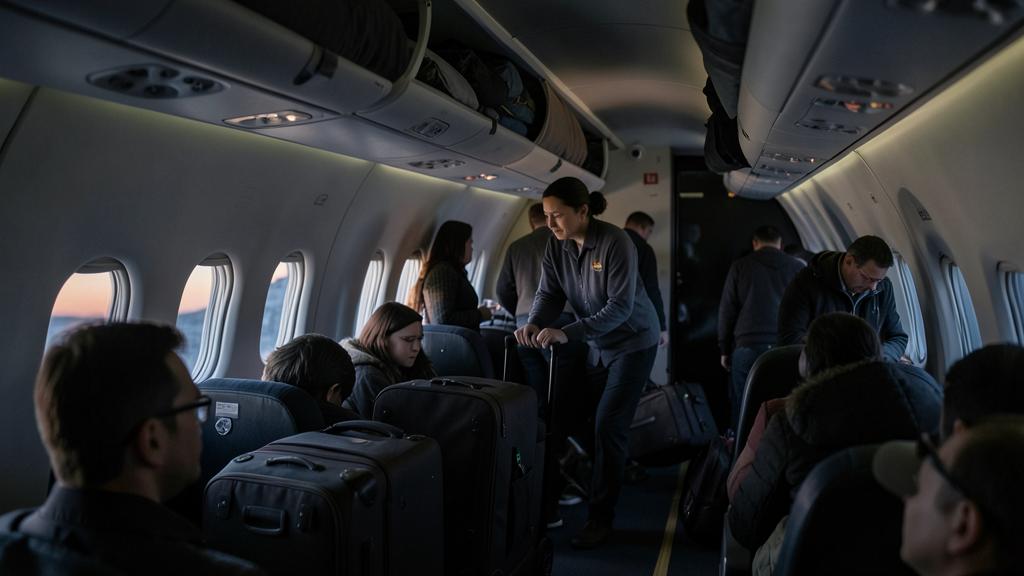
- They hold the observation, and the observation is a genuine input into somebody else’s decision. The whole system rests on the assumption that the real cabin resembles the modelled one; the only people positioned to notice when it does not are standing in it. A crew that reports facts in the right form at the right moment is not second-guessing the loadsheet — it is supplying the one piece of information the loadsheet was never able to contain.
The practical version fits in a sentence and belongs in every pre-departure routine: look at the cabin as it fills, notice what differs from an ordinary day, and say it in numbers before the door closes. Type-specific practice, zone definitions and operator reporting formats vary considerably, and are compared by crews across fleets on forums.fl330.com.


Leave a Reply
You must be logged in to post a comment.