
A passenger may carry a spare lithium battery through the cabin door but must not pack it in a suitcase. The same passenger surrenders a pocket knife at the checkpoint that would have travelled happily in the hold. Read side by side, the two decisions look like two rule-books contradicting each other. They are two rule-books answering two different questions, and only one of them is about fire. Understanding which question is being asked explains almost every argument that happens at a boarding gate.
Two rule-books, two questions
Everything a passenger carries is filtered twice, by two regimes that share an airport but not a purpose.
The first is safety: the dangerous goods regime. Its parent text is ICAO Annex 18 and its operative detail sits in the Technical Instructions for the Safe Transport of Dangerous Goods by Air, restated in operator-facing form by the IATA Dangerous Goods Regulations and then in the operator’s own operations manual. Its question is simple: if this article misbehaves in flight, what happens next?
The second is security: the aviation security regime, descending from ICAO Annex 17 through each State’s national civil aviation security programme, and in Europe through the common basic standards and their implementing measures. Its question is different: if this article falls into the hands of someone who means harm, what can they do with it?
Those two questions have different answers about accessibility. Security wants a potential weapon out of reach of anyone in the cabin, and a hold is the definition of out of reach. Safety wants a potential fire within reach of the only people on board trained and equipped to fight one. The apparent inversion is not an inversion at all. It is two regimes optimising in opposite directions on the same variable, and both of them are right about their own risk.
Safety rules focus on what happens if an item causes a fire, while security rules focus on what happens if someone uses an item as a weapon. The hold is safe for weapons but dangerous for fires, and the cabin is the opposite.
What a crew can actually do to a fire in the cabin
The value of the cabin as a location for a hazardous article is entirely a function of what a human being can do there. That capability is worth listing explicitly, because the whole argument rests on it.
- Detection is immediate and human. Nobody waits for a sensor. Smell, a hiss, a passenger shouting, a seat-back warming: the first indication arrives in seconds and it arrives with a location attached.
- The source can be identified. Not « a fire in the forward hold » but « that power bank, in row 24, seat C ». A fire you can name is a fire you can attack at the right point.
- Agent can be applied repeatedly. A cabin carries several extinguishers and several trained users. One discharge is not the whole story, as it is in a sealed compartment.
- Cooling is possible. This is the decisive one for battery events. Flame knockdown does not stop a lithium cell in thermal runaway; only removing heat does. Water, or any non-alcoholic drinkable liquid in quantity, is available in a cabin and is available nowhere else on the aeroplane.
- The situation can be reassessed continuously. A crew member stays with the device, watches for re-ignition, and reports a changing picture to the flight deck. A hold reports one thing, once.
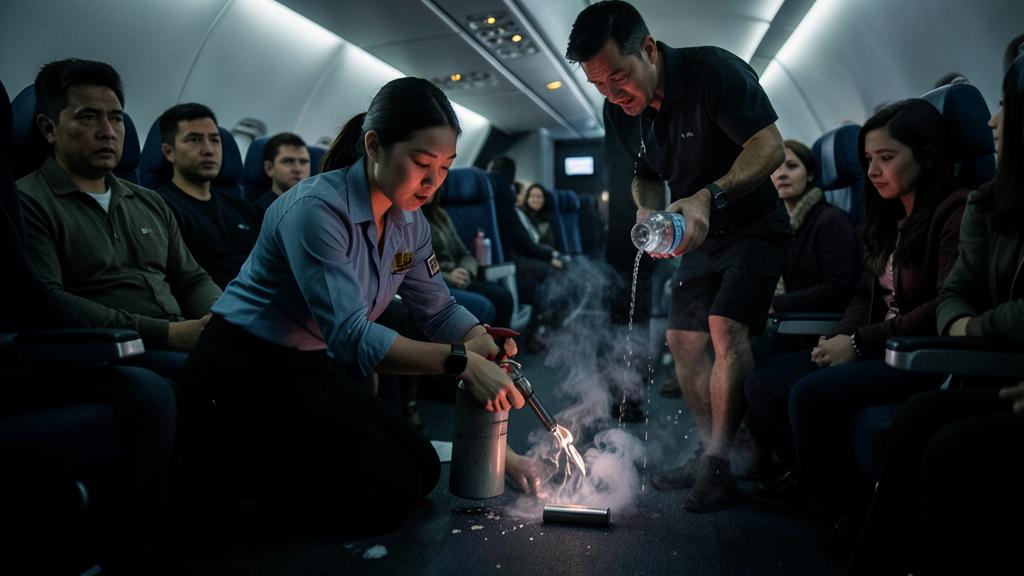
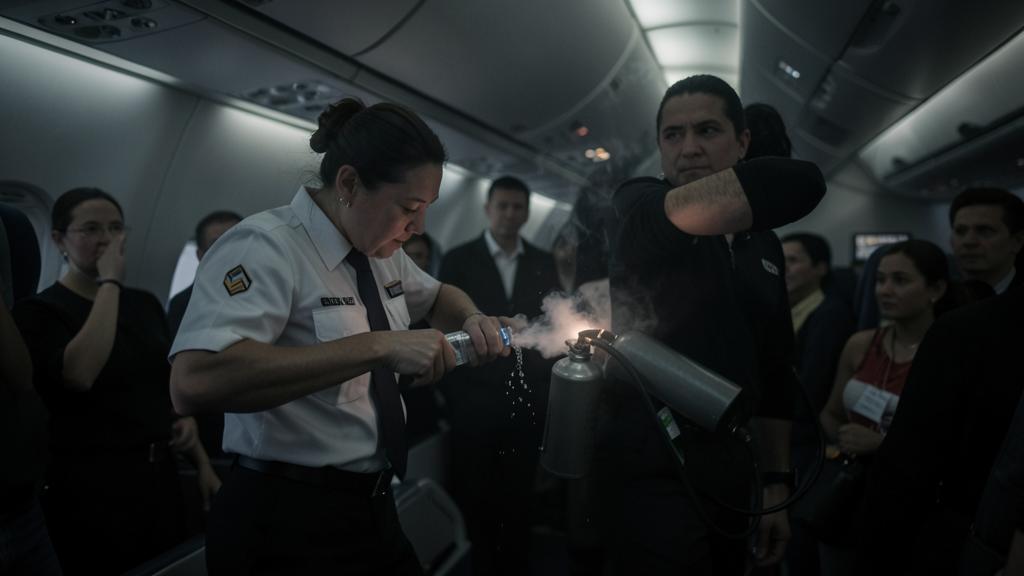
On an Airbus A320, a passenger’s power bank in the cabin catches fire. The flight attendant uses a fire extinguisher to knock down the flames, then douses the device with water from a nearby drink cart. The crew monitors the device for re-ignition until landing, preventing a catastrophic fire.
The published cabin technique for a personal electronic device follows directly from that list, and its order matters: extinguish the flames with the extinguisher, then douse the device with water or another non-flammable liquid to cool it and to slow propagation from cell to cell, then leave it where it is and keep watching it. Ice is not a substitute for water, because it insulates rather than conducting heat away, and moving a device that is still hot invites a burn and a dropped ignition source. Where a thermal containment bag or kit is carried, its use and its timing are set by the operator’s own procedure, and those procedures genuinely differ between operators. The manual on the aeroplane is the applicable text, not the general principle.
What a hold can do, and exactly where it stops
A cargo compartment is not defenceless. It is designed, certified and classified, and the classification tells you precisely how much protection is available and how much is not. The categories used in the certification specifications for large aeroplanes are worth knowing by name, because a crew argument about hold fires is usually an argument about which class the aeroplane actually has.
| Class | Detection | Suppression | Crew access in flight |
|---|---|---|---|
| A | Discovery by a crew member, without a dedicated system | Hand extinguisher | Yes, directly |
| B | Dedicated detection | Hand extinguisher, applied by a crew member | Yes, by design |
| C | Dedicated detection | Built-in suppression, discharged from the flight deck | No |
| D | None required | None built in; containment intended to starve the fire of oxygen | No |
| E | Dedicated detection, main deck of all-cargo aeroplanes | Shut off the ventilating airflow to the compartment | Not in the passenger sense |
Two facts about that table shape the whole subject. First, Class D no longer appears in the certification specifications for large aeroplanes: a fatal in-flight fire in the 1990s showed that starving a fire of oxygen is no strategy when the cargo brings its own oxidiser, and existing compartments had to be converted. Second, the underfloor holds of a modern passenger jet are overwhelmingly Class C. That is genuinely good protection, and it comes with a defined limit that every pilot should be able to state: a knockdown discharge of extinguishing agent followed by a metered flow, sized for a declared duration chosen to match the diversion capability the operator needs. Suppression, not extinction. The system is designed to hold a fire in a survivable condition for long enough to land. It is a clock, not a cure.
The trap. Treating « the hold has fire suppression » as equivalent to « the hold can put a fire out ». It cannot. It buys time on a schedule fixed years earlier by certification, against a fire whose behaviour was assumed at the time to be ordinary combustion. An article that shortens that clock, or that does not respond to the agent at all, has removed a defence nobody on board can restore.
The battery that changed the arithmetic
Everything above was broadly settled long before lithium cells were in every pocket. The reason the passenger rules look strange today is that one class of article breaks the assumption the hold’s defences were built on.
A lithium cell in thermal runaway is not an ordinary fire. Three properties matter. It generates its own heat internally, so removing external flame does not stop it. It releases oxidising species from its own chemistry, so oxygen starvation is a weaker lever than it is against paper or fabric. And it vents a large volume of hot, flammable gas, which can accumulate in a confined space and ignite in a way that produces pressure, not just heat.
Test work by certification authorities has shown the consequence plainly: the extinguishing agent in a sealed compartment suppresses flame, but it does not stop propagation from one cell to the next, and the vented gases can still produce an event a compartment liner was never designed to contain. So the article is placed where the one countermeasure that does work against thermal runaway is available. That countermeasure is cooling with liquid, applied early, by a person. It exists only in the cabin.
That single line of reasoning explains the list of passenger provisions that otherwise looks arbitrary.
| Article | Cabin | Hold | The reason |
|---|---|---|---|
| Spare lithium batteries and cells, loose | Yes, terminals protected | No | Runaway needs human cooling, and the terminals have to be protected against a short circuit |
| Power banks | Yes | No | Same, with a higher energy content than most devices |
| Electronic cigarettes and vaping devices | Yes, no charging and no use on board | No | History of activation and runaway in unattended baggage |
| Device with battery installed, in checked baggage | Preferred | Conditionally, completely switched off and protected | Not sleep or hibernation, and protected against crushing and accidental activation |
| Battery of a mobility aid, where removable | Removed battery carried in the cabin | Aid itself in the hold | The energy travels where it can be watched |
| Knives, tools, sharp articles | No | Yes | Security regime: keep a potential weapon out of reach |
| Liquids above the local screening limit | No, subject to local rules | Yes, within the dangerous goods limits on alcohol and aerosols | Security regime, and the limit is being revised airport by airport |
| Firearms and ammunition, where permitted at all | No | Declared, authorised, conditions apply | Both regimes at once, and State law on top |
The Technical Instructions also set energy thresholds for batteries carried by passengers, commonly expressed in watt-hours, with a band that requires operator approval and a limit on the number of spares above it. The figures are stable across most of the industry, but they are not universal: States impose additional restrictions, operators impose their own, and the applicable text is the operations manual of the operator whose aeroplane is at the gate. Quoting a number from memory in front of a passenger is how a crew member ends up being wrong in public.
The boarding moment where the rule quietly fails
The provisions above assume that a bag which goes into the hold was checked at a desk, by a passenger who was asked a question about its contents. On a full aeroplane, that assumption breaks at the door.
A cabin bag taken at the gate, or taken in the aisle because the bins are full, was packed as a cabin bag. It was packed by someone who correctly put their power bank, their spare camera batteries and their vape in it, because that is where the rules told them to put those things. Handing that bag over the seat backs converts a compliant cabin bag into a non-compliant hold consignment in about four seconds, with nobody having made a decision and nobody having recorded one.
This is the single most common way a prohibited article reaches a cargo compartment on a passenger flight, and it is entirely within the cabin crew’s control. It is also why the operator’s boarding announcement about batteries is not a formality: it is the only screening step that exists at that point in the process. The industry has been tightening around exactly this since a widely reported cabin fire in 2025 in which a power bank stowed in an overhead bin was the suspected source, and a number of operators now require power banks to be kept at the seat and in sight rather than stowed above.
The right reflex. Before a bag leaves your hand for the hold, ask the owner one closed question, in the same words every time: « does this bag contain a power bank, spare batteries or an electronic cigarette? » A closed question gets an answer. « Any dangerous goods in there? » gets a shrug, because the passenger does not think a phone charger is a dangerous good, and until it is in the hold, they are effectively right.
Why the flight deck needs to hear about it
A cabin battery event is a flight-deck event, and the reason is not courtesy. Three things change the moment the commander is told.
The diversion calculus changes. A fire that has been extinguished and cooled, with the device under observation, is a different aeroplane from one where the crew is still fighting. The commander cannot make that distinction without a report that says which of the two is true, and a report that says « we have a fire » without saying what state it is in leaves the flight deck to assume the worse case.
The checklist branches. Smoke, fire and fumes procedures are built around isolating a source. A known, located, non-electrical-system source removes several branches immediately and saves the time those branches would consume.
The obligations start. The commander has reporting duties for a dangerous goods occurrence, to the authority and to the operator, and the useful details are the ones nobody remembers two hours later: the type of device, whether it was charging, which seat, what agent was applied, how long the device kept re-heating. The report is written on the ground and the facts are gathered in the cabin.
The reverse direction matters too. Some articles may be carried only with the operator’s approval, and that approval is not something the person at the door invents on the spot. Operators differ in how far the decision is delegated and in when the commander is told, and crews comparing practice across fleets will find the topic discussed regularly on the FL330 forums.
Where the security regime pulls the other way
The security side deserves the same precision, because crews are asked about it constantly and the honest answer is often « it depends where you are ».
The prohibited articles list applying to cabin baggage is set by the State, within a framework that is regional in Europe and national elsewhere, and it is the checkpoint that applies it. It changes: the limit on liquids, aerosols and gels has been relaxed and reimposed at particular airports as new screening equipment is validated, which is precisely why the applicable text is the local one and not a memory of what happened last month at a different airport. An operator can be more restrictive than the State. A State can be more restrictive than the region. Nothing goes the other way.
What does not change is the underlying logic, and it is the mirror image of the dangerous goods logic. A blade is dangerous because a person can use it. Put it where no person can reach it and the risk goes to nearly zero. A battery is dangerous because of what it does on its own. Put it where no person can reach it and the risk goes up, because you have removed the response, not the hazard.
The one-line version
Put the hazard where the response is. Security removes access to an article that needs a human to become dangerous. Safety preserves access to an article that becomes dangerous without one. The hold gives you detection and a clock; the cabin gives you eyes, hands, an extinguisher and water. A fire in the cabin is a fire being fought. The same fire in the hold is a fire being timed.


Leave a Reply
You must be logged in to post a comment.