
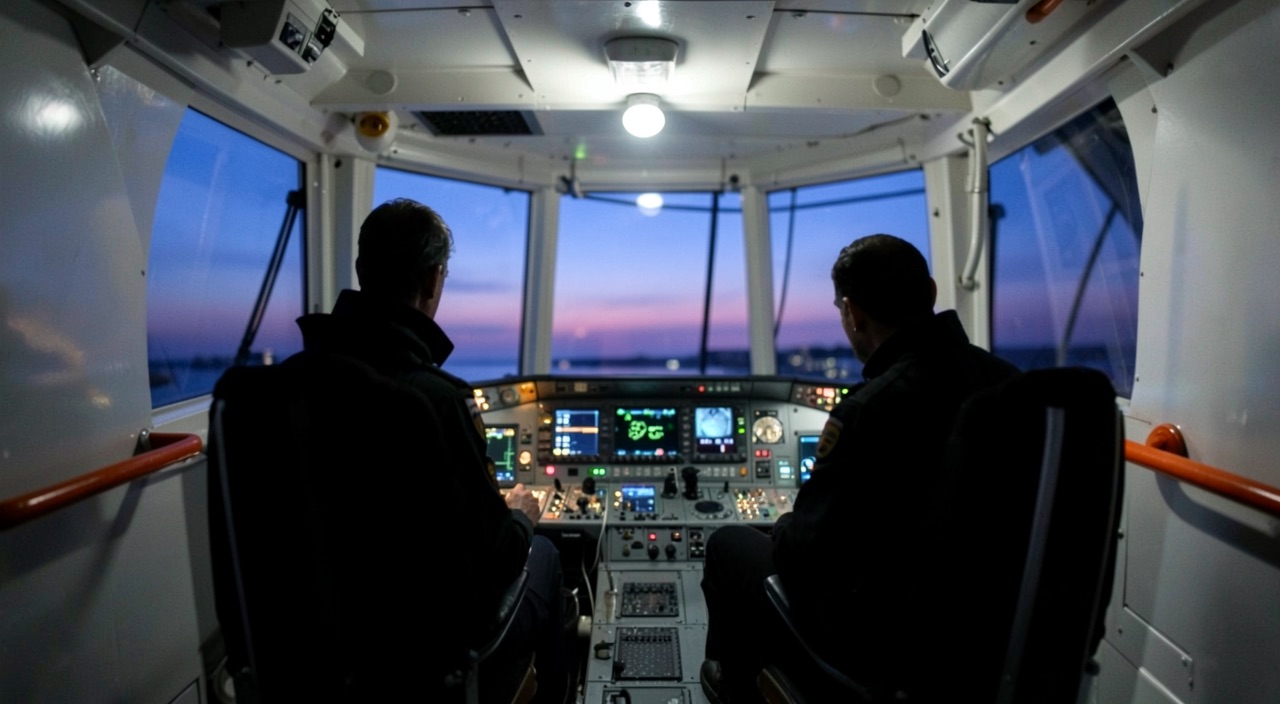
The captain continues the approach, the first officer calls a deviation that is not being corrected, the call is repeated, nothing changes. A few hundred feet remain, and with them a question that is anything but academic: at what point do you stop persuading and start acting? A disagreement on the flight deck is not a relationship problem to be handled with tact. It is an operational sequence, with a clock, with rungs, with mandated wording, and with a written record that outlives it.
A disagreement is two mental models that have diverged
When two people qualified on the same aircraft, with the same documentation and the same briefing, reach two opposite conclusions, the simplest explanation is not that one of them is incompetent. It is that one of them holds information the other does not: a radio call heard while the other was talking to the passengers, a warning light noticed a second earlier, a value read off a display that is not in the line of sight of the opposite seat, a smell perceived on one side of the flight deck only. The objection is therefore, first of all, a piece of data. It costs a few seconds to process, and those seconds are available far more often than the pressure of the moment suggests.
What breaks a crew is not the disagreement: it is its silent resolution. One of the two lets it go, keeps the objection to themselves, and the crew carries on with a single mental model when it had two. The worst of it is that this situation looks exactly like agreement. Nothing distinguishes it, not in the parameters, not in the radio and intercom calls, not in body language. That is why the abandoned objection appears in so many accident sequences: it existed, it was voiced, and nobody did anything in particular to carry it further.
The form of objection that works best sets out the model before challenging the decision. “You are aiming for the runway visually, I am with you; I have an increasing tailwind and a groundspeed that is not coming down” says two things in one sentence: that the plan is understood, and that something does not fit with it. It is incomparably more effective than “I do not feel good about this”, which carries no data and is dealt with in a second by a shrug.
There remains the question of the gradient. A flight deck where the perceived authority gradient is too steep produces a first officer who dares not speak; a flight deck where it is too flat produces two people debating while the aircraft descends. Both extremes let the same errors through, and it is a point that training often neglects: a great deal of work goes into the junior pilot’s assertiveness, very little into the captain’s ability to close a debate.
When pilots disagree, it’s usually because one has information the other doesn’t. The key is to share that data clearly, not just say “I don’t like this.” If one pilot gives in silently, it creates a dangerous situation where the crew thinks they agree when they don’t.
On a Boeing 737 approach to Paris CDG, the first officer notices the groundspeed isn’t decreasing despite a strong tailwind. Instead of just saying “I’m uncomfortable,” they state: “You’re aiming visually, I agree, but we have 25 knots tailwind and groundspeed is 160 knots still decreasing.” This forces the captain to acknowledge the data and either adjust or explain why continuing is safe.
Buying time before looking for who is right
The rule that structures everything else fits in one sentence: you do not resolve a disagreement in a phase where the aircraft is committing itself. A disagreement is dealt with in a flight state that makes time free, and there is almost always a way to get there. A level-off to wait, an extended downwind, a holding pattern, a request for delaying vectors from air traffic control, an interrupted engine start, a stop during taxi. On approach, that means has a name everyone knows and too few use for that particular purpose: the go-around.
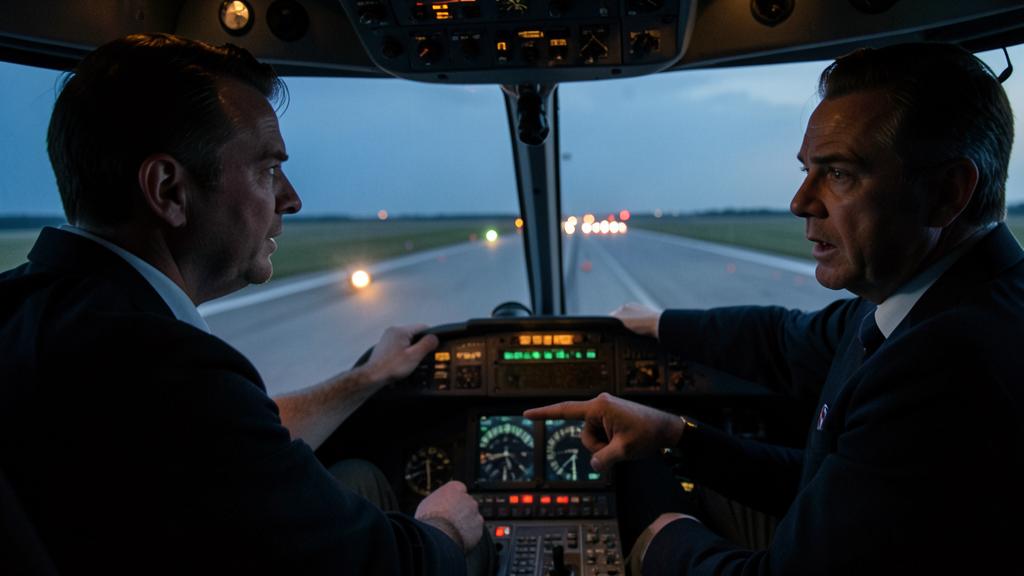
The go-around has a property that no argument possesses: it settles the matter without naming a winner. It gives back energy, it gives back altitude, and above all it gives back the time for each pilot to say what they had to say. If the disagreement was about stabilisation, it has solved the problem; if it was about something else, it will be dealt with in the climb with a few minutes in hand instead of a few seconds. The only case in which it is expensive is the one where it is decided too late.
The right reflex. Before voicing the slightest objection below the stabilisation height, get your hands on whatever buys time. An objection made in an irreversible phase always arrives too late to be discussed: it can only be carried out or ignored, and neither outcome is good.
Not all disagreements run on the same clock, and it is that clock which determines the treatment. Mistaking a disagreement about a flight parameter for a disagreement about the reading of a text is applying an emergency procedure to a library problem, or the other way round.
| Nature of the disagreement | Time available | Immediate treatment | Expected record |
|---|---|---|---|
| Flight parameter: flight path, speed, configuration, energy | A few seconds | Standard call, then second call, then taking over the controls | Report as soon as there has been a takeover or a deviation |
| Tactical decision: diversion, go-around, level, fuel | A few minutes | Buy time, then work through the operator’s decision model out loud | Report if the outcome reduced the margins |
| Reading of a text: minimum equipment list, mass and balance, limitation | On the ground, or in cruise | Go back to the written source, then ask the operator or the maintenance organisation | Report in every case, quoting the reference consulted |
| Allocation of roles, tone, working style | No urgency | Nothing in flight; make a note and keep the thread of the flight | Debriefing, then the human resources channel if necessary |
Climbing the rungs: probe, alert, challenge, act
Verbal escalation is taught everywhere under varying acronyms, and its content does not vary. The first rung asks: “what speed are you aiming for?”. It costs nothing and it resolves the majority of cases, because it immediately reveals whether the other pilot has seen what you have seen. The second states a fact: “speed fifteen knots below target, still decreasing”. It contains no judgement, only a parameter, a deviation and a trend. The third states the consequence and the expected action: “we will not be stabilised, we need to go around”. The fourth acts.
What makes the difference between an escalation that gets somewhere and an escalation that spins in place is that each rung adds new information. Repeating “speed” three times is not an escalation, it is noise; the other pilot has heard it, filed it as a routine reminder, and carries on. Naming the parameter, the deviation, the consequence and the action requested, in that order, forces the other pilot to answer on the substance or not to answer at all — and that absence of an answer is precisely the signal you are waiting for.
The two-call rule, present in many manuals in one form or another, does not say that you count to two. It says that after two complete attempts left without an adequate answer, the problem is no longer one of persuasion. An adequate answer can perfectly well be a refusal: “I see it, I accept the deviation, I will correct at five hundred feet” is an answer. It restores the shared mental model, it gives a verifiable criterion, and it leaves the objection open. What triggers the next rung is silence, an empty acknowledgement, or an answer unrelated to what was said.
Taking over the controls: three conditions and one phrase
Taking over the controls is the only moment at which a crew member overrides another’s decision. It requires three conditions together: the safety of the flight is immediately at stake, verbal escalation has been carried through to the end and has produced nothing, and the person taking over is fit to fly. If one of the three is missing, it is not a takeover, it is a conflict that has changed seats.
The framework that makes this act workable is that of incapacitation. A pilot who does not respond adequately to two successive calls about a critical parameter must be treated as potentially incapacitated, and that sentence is not a figure of speech: it moves the problem out of a register where you would have to judge the other person and into one where a procedure already exists, written, trained, and which nobody takes personally. Subtle incapacitation does not look like a collapse; it looks like someone who carries on flying while ignoring what is being said to them.
The handover phrase appears in the operations manual, it is short, it is unique, and it is not negotiated in the moment. It is said once, loudly, and it is followed by a visible action on the controls. What matters next is the order of operations: you secure first, you explain afterwards. A crew that debates during the manoeuvre has simply moved the disagreement.
The trap. The most dangerous way out of a disagreement is not taking over the controls, it is flying by two. Two people acting simultaneously on the controls produce, depending on the architecture, either a sum of inputs or mutual cancellation, and in both cases a flight path that nobody intended. At every moment, one single person is flying. If you are not certain you have the controls, you do not have them.
When the other person holds the formal authority
The commander has final authority over the conduct of the flight: that is what the regulation says, not an internal convention. That authority settles the question of who decides, and it does not settle the question of who is right. A first officer who still disagrees after a decision has been made does not have to win the argument to have done their job: they must have voiced their objection once, clearly, with their data, and they must then carry out the decision — unless the action requested is manifestly dangerous or unlawful, in which case we are back to the previous section.
Symmetrically, the decision-maker takes on an obligation. A decision made against an explicit objection must be acknowledged, settled out loud and justified in one sentence: “I heard you, I am continuing, because I have the runway and the fuel for a go-around”. That sentence is not politeness. It closes the shared mental model again, it gives the other pilot a criterion for monitoring what follows, and it is what will be read again in the report.
Two configurations distort this allocation and are worth anticipating. In line training, the person who decides is also the person who assesses: an objection costs more there than anywhere else, and that is precisely why it is expected there. An instructor who lets a deviation develop is almost never testing the flight path, they are testing the call; the trainee who says nothing so as not to antagonise their assessor fails the only exercise that mattered. In an augmented crew, conversely, the presence of an additional pilot does not create an arbiter: it adds a witness, whose objection is worth as much as anyone else’s but whose position, away from the controls and often out of the loop for some time, makes the last rung impracticable. That pilot alerts, they do not take over — and they therefore have all the more reason to alert early.
This allocation also exists outside the flight deck, and it does not always run in the same direction. A disagreement with certifying staff about a release to service is not settled on the flight deck: the signature belongs to the person who puts their name to it, and the commander decides only whether to accept the aircraft in the condition in which it is handed over. A senior cabin crew member who reports a smell, smoke or a passenger whose condition is deteriorating is passing on an observation of which they are the only witness; treating it as an opinion means losing the only data available on what is happening down the back.
After the flight: what is erased and what remains
Three recordings coexist, and they do not preserve the same things. Flight data records parameters for the whole duration of the flight: it will show a speed, a configuration, a deviation, never a sentence. The voice recording keeps the voices on a loop whose duration, on many installations in service, remains of the order of a few hours — longer on the most recent equipment. On a long rotation, a disagreement that occurred at departure has been overwritten well before landing. The third medium is the one you write yourself, and it is the only one that covers the whole flight.
Before the written report comes the immediate debriefing, the one held before the crew disperses. Its purpose is not to establish responsibilities: it serves to check that the two people are telling the same sequence. It frequently happens that one of them heard a call the other is certain they never made, or that a word was understood in the opposite sense. That check can only be done straight away, and it often changes the substance of the report. Crew feedback shared on professional spaces such as the FL330 forum shows, moreover, that divergence of accounts is more frequent than divergence of decisions.
The trap. Announcing in flight that you will file a report instantly turns a technical disagreement into a power struggle. From that sentence onwards, everything the other person says is built for the written record, and what cooperation remains disappears at the precise moment you need it most. The report is written afterwards, without warning and without threat.
Writing a report that is actually useful
A useful report fits on one page and contains no adjectives about character. It gives the phase of flight, the time, the configuration, the state of the automation, what was called and in what terms, the answer obtained, the final action and the resulting deviation. It distinguishes what was observed from what was inferred. It qualifies nobody: “the second call went without an answer” is a verifiable fact, “he refused to listen” is an interpretation that will not survive the first reading and that weakens the whole rest of the document.
The question of whether to write is settled on a single criterion: did the outcome reduce the margins, or did the process fail? A disagreement voiced, heard, settled and carried out is not an occurrence, it is the normal functioning of a two-pilot crew. An objection that produced no answer, a takeover of the controls, a knowingly accepted deviation: those are occurrences, and the European occurrence reporting framework exists precisely so that they are reported without their author paying the price, short of wilful misconduct or a manifest and serious disregard of risk.
The most useful line in the document is often the last one, and it is the one that gets forgotten: what would have prevented the sequence? A briefing that would have named the criterion in advance, a standard call that is missing from the manual, a decision height that was not shared. It is that line which turns a flight deck incident into a change to the documentation, and it is the only part of the report that has any chance of changing something for other crews.
The right reflex. Write the report as though it were going to be read by someone who will find against you. If it stands up under that assumption, it will stand up under all the others: it is the quickest test for eliminating judgements and keeping only dated facts.
What to check in your own documentation
Four points are worth looking up before your next flight, and they are not in the same place from one operator to another. The first is the exact wording of the transfer of controls and the way it is acknowledged: many manuals require a reply, and omitting it is already an anomaly. The second is whether or not a two-call rule is written down in black and white; where it does not exist, escalation rests on the judgement of the person challenging alone, which is a known weakness. The third is the deadline for filing the report and its actual recipient. The fourth is the most interesting.
The grey area is here: most incapacitation procedures describe a physical incapacitation — the crew member stops responding, slumps, becomes manifestly unfit. Few describe functional incapacitation, that of the perfectly conscious pilot who pursues a plan while ignoring the calls. Yet it is the most frequent form, and the one that leaves the practitioner without a text at the moment they would need one. Look at whether yours covers non-response, and if it does not, know that you will have to reason by analogy, in full awareness of the fact.
For anyone preparing a rating or a revalidation, this subject has a direct consequence on how you are marked. The examiner is not trying to find out who was right about the flight path: they look at whether the objection was voiced with data, whether the escalation followed its rungs, whether the decision was acknowledged and settled out loud, and whether the flight continued on a common plan. A candidate who is wrong but whose process holds up is assessed better than a candidate who is right in silence — it is one of the points that the FL330 preparation modules work on in session, because it is not acquired by reading about it.
Nothing in the above replaces a text: the applicable regulation and your operator’s approved documentation prevail in all circumstances over this article, including where their wording differs from the one used here.
Questions fréquentes
How many calls should you make before taking over the controls?
The number matters less than the nature of the answer obtained. The two-call rule, present in most manuals in one form or another, holds that after two complete attempts — parameter, deviation, consequence, action requested — left without an adequate answer, the problem is no longer one of persuasion. A reasoned refusal is an adequate answer and does not open the next rung; silence, or an answer unrelated to the call, does. Check the wording adopted by your operator, because it determines what will be held against you afterwards.
Can you refuse to carry out a decision of the commander?
Final authority over the conduct of the flight belongs to the commander, and a persistent disagreement does not suspend it. A first officer who has voiced their objection once, clearly and with their data, has done their job even if the decision goes the other way: they then carry it out. The only exception is a manifestly dangerous or unlawful action, which then falls under the procedure for taking over the controls and not under debate. In every case, an objection that was not accepted is recorded after the flight.
Should a report be written for every disagreement?
No, and the criterion is simple: did the outcome reduce the safety margins, or did the process fail? A disagreement voiced, heard, settled and carried out is the normal functioning of a two-pilot crew and does not have to be notified. An objection left without an answer, a takeover of the controls or a knowingly accepted deviation are, on the other hand, occurrences. The European occurrence reporting framework exists so that they are reported without prejudice to their author, short of wilful misconduct or a manifest and serious disregard of risk.
Does a disagreement on the flight deck show up in the flight recordings?
Flight data records parameters, not words: it will show a speed off target or a late configuration, never the call that preceded it. The voice recording runs on a loop whose duration, on many installations in service, remains of the order of a few hours, longer on recent equipment. On a long rotation, an exchange that occurred at departure has therefore been overwritten before landing. The written report is the only medium that preserves what was said.
How do you announce that you are taking over the controls?
With the exact wording from the operations manual, said once, out loud, and immediately followed by a visible action on the controls. Most manuals also require an acknowledgement from the other pilot; omitting it is already an anomaly to be noted. The order of operations is then invariable: you secure the flight path first, you explain afterwards. Two people flying simultaneously is the most dangerous way out of a disagreement.
What do you do with a disagreement about the reading of a text on the ground?
This case has no clock, and that is precisely why it must not be settled verbally. You go back to the written source — minimum equipment list, mass and balance data, applicable limitation — and then ask the operator or the maintenance organisation concerned. Where the subject touches on release to service, the signature belongs to the certifying staff and the commander decides only whether to accept the aircraft in the condition in which it is handed over. The report then quotes the reference consulted.


Leave a Reply
You must be logged in to post a comment.