
Fourth line sector, aircraft nominal, weather without a story. Eight miles from the threshold, ATC offers the other runway and the captain accepts. The first officer under line training knows perfectly well how to do everything that follows — reprogram, recompute, rebrief, redescend — and yet he drops out for some twenty seconds. Nothing that has just happened was a technical difficulty. It is precisely what the school cannot train, and what line training exists to build.
The school trains bounded states, the line produces a flow
A simulator session is a bounded object. It begins at a stated initial condition, with a chosen weight, weather and position; it ends when the exercise has been demonstrated. Three properties follow from this, and none of them exists in operations: the flight has an author, it has a beginning, it has an end. The sector, by contrast, does not begin at engine start. It begins with the roster, it continues with a maintenance deferral accepted the day before, a slot that slips, a forecast ageing between the flight folder and the approach — and nobody has written the sequence.
The second property is more insidious. The simulator allows freeze and repositioning. It matters little whether the instructor uses them: the trainee learns, without ever being told, that a situation can be suspended. On the line, two quantities never stop, fuel and the clock, and one pays for the other. A deferred decision is never a neutral decision: it is a decision that has already consumed a resource.
The third has to do with the very statistics of training. The type rating course and recurrent training are dominated by the abnormal, because that is where the demonstration is played out: engine failure on take-off, depressurisation, fire, go-around in a degraded configuration, landing without external reference. A line career, on the other hand, consumes almost nothing but the normal. The pilot therefore arrives with a distribution exactly inverted with respect to the one he is going to live: at length worked on the rare event, little exposed to the frequent one — the runway change, the late clearance, the passenger who forces a diversion, the hold that eats into the extra fuel.
Training focuses on rare emergencies, but real flying is mostly routine. Pilots spend most of their time handling normal situations, not the dramatic ones they practice in simulators.
This is not a defect of the school, it is its reason for being. A training device cannot manufacture the frequent: the frequent, by construction, is obtained by flying. It can only make sure that the rare will not find the pilot helpless. The fact remains that the gap must be named, failing which the young pilot concludes that he is bad where he is simply new.
The deficit is not knowledge, it is margin
On leaving the type rating, knowledge is at its maximum. Never again will this pilot know the hydraulic systems and the protection logics so well. What he lacks is therefore not knowledge, it is automaticity: the price, in attention, of producing the ordinary. Every normal action still passes through explicit reasoning. A configuration sequence that costs an established crew nothing costs him a measurable share of his capacity.
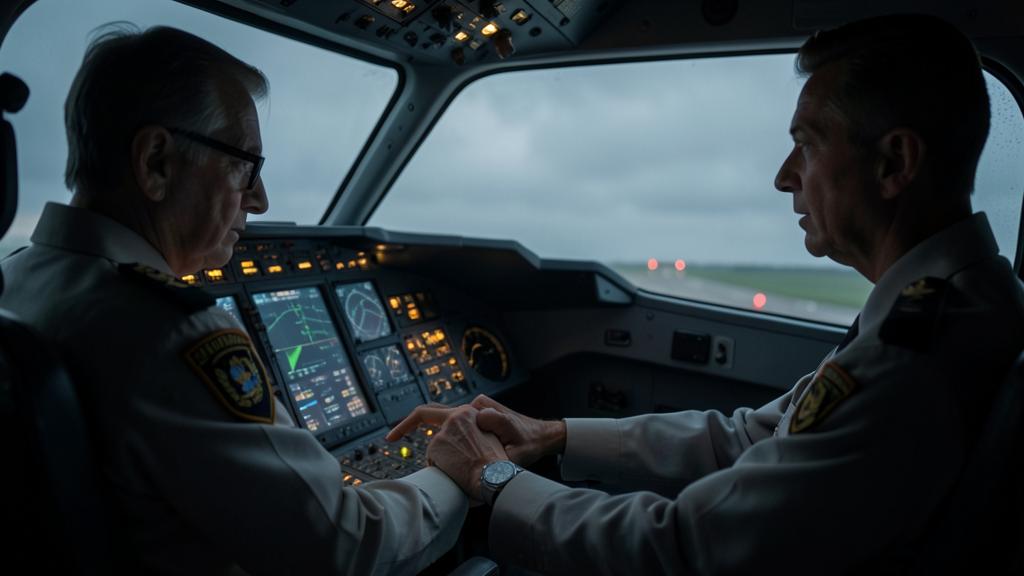
An A320 first officer on their first sector might take 30 seconds to complete a standard approach briefing, while an experienced captain does it in 10 seconds. That 20-second difference is margin that could be needed for an unexpected ATC reroute or a sudden weather change.
The consequence is read directly. On a perfectly nominal sector, he is already working close to his ceiling — not because the flight is difficult, but because it is not yet cheap. Now margin, that is to say the gap between capacity and consumption, is exactly what absorbs the unforeseen. The runway change at eight miles is not expensive in absolute terms; it costs more than what was left.
Hence the real nature of line training: it does not add knowledge, it brings down the price of routine. Repeating the same ordinary in variable settings transfers, piece by piece, what was deliberate towards what is automatic, and frees up margin. It is slow work, whose speed depends above all on the number of sectors and their diversity — far more than on the trainee’s goodwill.
For whoever occupies the right-hand seat as an instructor, this changes the question asked. “Can he do it” proves nothing: at this stage, everything is known. The useful question is “how much did it cost him”, and it is read without instrumentation — the delay in answering the frequency, the visual scan that freezes, the sequence interrupted then resumed from the beginning, the briefing that recites everything because he does not yet know how to sort.
The observation trap. A correct execution says nothing about the availability that was left to produce it. A trainee can succeed over a long series of sectors at saturated capacity and be overwhelmed by the first event too many — whoever looked only at the result will have seen nothing coming.
| What structures the flight | Simulator session | Line sector |
|---|---|---|
| Beginning and end | set by the instructor, known in advance | set by the roster and by the day, never by oneself |
| Passage of time | can be frozen, can be repositioned | irreversible, and it is paid for in fuel |
| Origin of threats | introduced by the scenario | to be detected, and most often non-technical |
| Density of the abnormal | high: it is the very object of the session | almost nil on the scale of a career |
| Feedback | immediate, explicit, recorded | absent most of the time |
| Criterion of success | the expected demonstration | the safety obtained and the margin left available |
| Cost of an error | pedagogical | real, immediate and shared |
What line training really builds
The operator’s arrangement is not a prolonged school, and it gains from being read as three distinct instruments, often confused under a single name. Familiarisation first: the pilot observes, from the flight deck or from the cabin, without responsibility — its object is rhythm and sequencing, not the manoeuvre. Line flying under supervision next: the pilot holds his position, a qualified instructor occupies the other seat and assumes the responsibility of pilot-in-command. The line check last, conducted by an examiner, which is not an examination of manoeuvres but the finding that a pilot holds his place in a normal operation.
What the operator adjusts during this period is not the difficulty of the flights — it does not choose that — but the height of the net. Several levers contribute, all written in the operations manual: crew composition, which forbids pairing two inexperienced pilots; aerodrome categorisation, which reserves demanding airfields for those who have received particular preparation or made a prior visit; the maintenance of recent experience; and the ability to extend supervision when the learning trajectory is not there.
An uncomfortable consequence must be drawn from this for the impatient trainee: the end of supervision is not a grade, it is a decision on exposure. It says that from now on the other seat will no longer be held by someone whose job is to catch you. The number of sectors that conditions it is a floor, not a target, and extending it is not a sanction: it is the only means available to the operator to adjust a variable the programme does not know, namely you.
Variation between captains is not a contradiction
Then comes the most commonplace and the most poorly handled destabilisation. Ten sectors, ten captains, ten slightly different ways of doing the same thing. The trainee, who comes from a world where every action had one right answer and only one, reads a contradiction into it and starts composing: a little of one, a little of the other, a personal synthesis. That is the worst possible outcome, for this assembly belongs to nobody, appears in no manual and holds up under no check.
The way out lies in a sorting into three categories, which must be done on the spot, in flight, with no documentation to hand.
| Nature | Distinguishing sign | Course of action |
|---|---|---|
| Prescribed | appears in the approved operating procedures: the wording of a callout, the triggering of an action, the sharing of tasks | no legitimate variation; a practice that departs from it is a deviation, not a school |
| Discretionary | remains within the authorised envelope: two ways of doing lead to the same state of the aircraft at the same moment | observe, try, keep what holds up under check; it is the very substance of the job |
| Deviation | removes a defence: an item not read, a callout skipped, a check moved outside its useful moment | do not reproduce it; name the fact without judging the person, and report it if it recurs |
The sorting is in no way academic: it determines what must be copied and what must only be observed. What is prescribed is learned once and for all; what is discretionary is collected and chosen with experience; what is a deviation is identified and not carried along.
The deviation that looks like a skill. A shortcut taken by a very experienced captain always looks elegant, and it sometimes is — for him. It holds because whoever takes it has a margin the trainee does not yet have. Copied by someone whose routine is still expensive, the same shortcut consumes exactly the resource that is missing, and produces the opposite of the effect attributed to it.
Saying what you see is a matter of procedure, not of character
Silence costs more, on the line, than ignorance. The mechanism has nothing psychological about it in the vague sense: the trainee weighs his doubt against the other’s experience, and his doubt loses — rationally, on average. The problem is that safety is not played out on average. It is played out in the tail of the distribution, precisely where it is the least experienced who saw correctly.
The remedy is not self-confidence, which cannot be decreed. It is a form of statement that costs little to produce and that calls for an answer. Escalation is conducted in steps: state the observed fact, then the gap with what was expected, then the consequence together with an explicit request, and as a last resort the announcement of taking over control. Each step is short, factual, and having a progression available saves one from having to decide whether “it is worth it”: you enter at the bottom, and you climb as long as the answer does not come.
Enter at the lowest step, right away. A fact stated without comment — “two dots above the glide path” — puts nobody in question and costs nothing to say, including when the observation turns out to be wrong. Waiting to be sure before speaking guarantees speaking late. The obligation is moreover symmetrical: a callout left without an answer teaches silence to the one who made it, whatever the intention may have been.
The feedback loop no longer closes by itself
The school closes the loop for you. Every session has its debriefing, its findings, sometimes its grade; the gap is named the same day, and the correction is played out at the following session. An ordinary day on the line, on the other hand, ends on nothing. No verdict, no comment — and the absence of comment is read as approval when most of the time it means nothing at all. The loop that the institution used to close must from now on be closed by the pilot himself.
The gesture that closes it is simple and rarely made: ask for a debriefing while the flight is still fresh, including — above all — when it went well; record the two moments one would have wanted to handle differently; reread that list after a few weeks to see what has disappeared and what keeps coming back. It is the only instrumentation a pilot has on his own trajectory during the first months, and it costs only a few minutes per trip.
The rhythm also changes in nature, and that is the second surprise. The fatigue of the school is occasional and chosen: one knows when the session falls and one prepares for it. That of the line is chronic and imposed by the roster — back-to-back duties, nights, time-zone shifts, wake-ups at hours the body has never practised. Flight and duty time limitations are a boundary, not a target: a perfectly legal roster can be a badly slept roster. Nothing in the curriculum has taught sleep as a professional discipline, nor the fact that a fatigue report is an instrument of the safety management system and not an admission of weakness.
Sleep is prepared like a phase of the flight. The useful question is not the state of fatigue felt at the moment, but the time of the last sleep and that of the next. Asked out loud during flight preparation, this double question leaves the register of personal endurance to enter that of crew resource — that is to say the register in which it is dealt with.
What you should go and read, and what will remain grey
Three documents concretely decide this period, and deserve to be read before it rather than after. The operations manual, for the description of the conversion course and the objectives the operator declares it builds: they do not always coincide with what the trainee imagines he has to prove. The part of the same manual dealing with crew composition and with the status of inexperienced pilot, because it sets pairing and aerodrome constraints that explain many apparently arbitrary rosters. The line check form last, with the competency framework on which it rests: it says in so many words what will be observed, and rarely what one believes.
Two grey areas remain, which it is better to know than to discover. The first has to do with the status itself: “inexperienced” is a state defined by a threshold — hours, sectors — that nothing attaches to the real trajectory of an individual. Two pilots can come out of it on the same day with very different margins, and the arrangement has no instrument for seeing it. The second has to do with the decision to extend: whoever observes is not always the one who bears the rostering cost of it, and this dissociation weighs on decisions more than the procedures admit.
For whoever is preparing a type rating, the consequence is counter-intuitive. Useful preparation is not additional system knowledge, already largely sufficient on leaving the course. It is the deliberate reduction of the cost of the ordinary — sequences, callouts, briefing structure, rehearsed on the ground until they cost almost nothing — so that margin exists from the first sector and not after several dozen sectors. It is also the only work that can be conducted without a machine and without an instructor, and it is the principle that structures the paths listed in the FL330 training area.
This text describes mechanisms, not obligations. The applicable regulation, the operator’s approved documentation and the instructions of its management prevail in all circumstances over what has just been written here.
Questions fréquentes
How long does line training last, and what decides when it ends?
The operations manual sets a minimum number of sectors or hours under supervision, approved together with the conversion course. That floor is not a term: the effective end depends on the judgement of the line instructors, then on the finding made at the line check. An extension remains possible and belongs to the normal conduct of the arrangement, not to sanction, since it serves to adjust an individual variable the programme does not know in advance.
Why can a pilot who has just passed his type rating be saturated on a perfectly normal sector?
Because his knowledge is complete but his actions are not yet automatic. Every normal action passes through explicit reasoning and consumes a real share of his attentional capacity, which leaves very little available margin. A commonplace event, such as a late runway change, is not expensive in absolute terms but costs more than what was left, hence the saturation. Line training does not correct a deficit of knowledge, it brings down the price of routine.
What should you do when two captains carry out the same thing differently?
Sort instead of composing. If the wording, the triggering or the sharing of tasks appears in the approved procedures, there is no legitimate variation and the departure must be identified as such. If the two ways of doing lead to the same state of the aircraft at the same moment while remaining within the authorised envelope, it is a discretionary technique, one to be observed and chosen later. Manufacturing a personal synthesis between the two is the only option to be ruled out from the start, because it holds up under no check.
How do you report something to a very experienced captain without getting the tone wrong?
By treating the matter as a procedure and not as a question of character. You enter at the lowest step — the statement of an observed fact, without interpretation or reproach — then you go up one notch as long as the answer does not come: the gap with what was expected, the consequence together with an explicit request, and as a last resort the announcement of taking over control. Entering at the bottom immediately costs far less than waiting to be certain, and saves you from having to judge whether the remark is worth it.
Does an unsatisfactory line check end a career?
No. The operator’s approved procedures provide for additional training and for the renewal of the check, and this handling belongs to the training system, not to a disciplinary decision. The point to watch is rather what the finding designates: a targeted deficit is made up in a few sessions, a general saturation by additional exposure under supervision. Refer to the operations manual, which describes the follow-up to be given and the applicable deadlines.
What can usefully be prepared during the type rating to approach the first line flight?
The reduction of the cost of the ordinary, and not additional system knowledge, already largely sufficient at this stage. Rehearsing on the ground the sequences, the callouts and the structure of briefings until they demand almost no attention frees up margin from the very first sector. Also getting into the habit of recording after each session the two moments one would have wanted to handle differently installs, even before the line, the feedback loop that operations will no longer close for you.


Leave a Reply
You must be logged in to post a comment.